
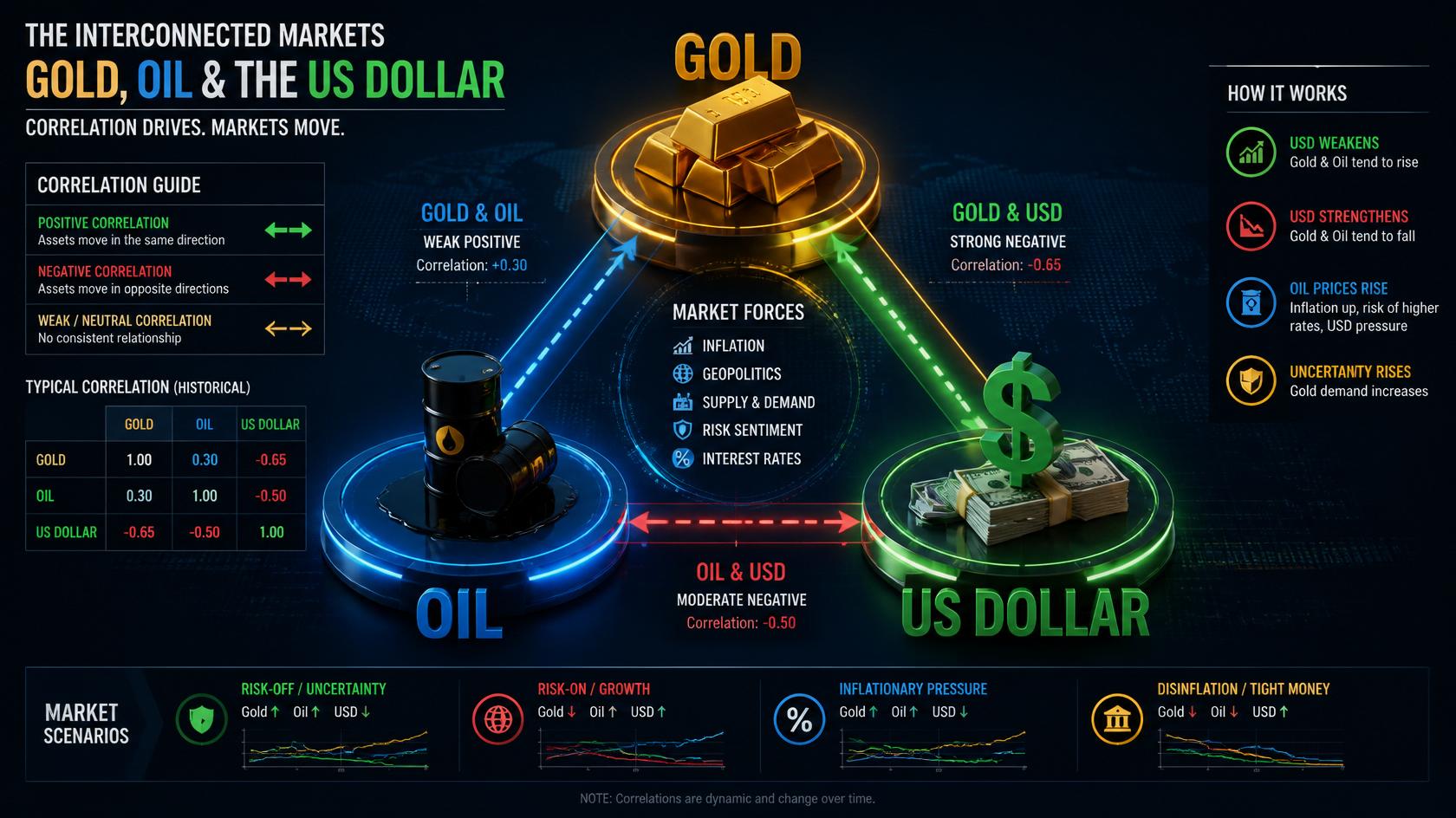
Financial markets are closely connected, and understanding how different assets interact can give traders a better view of what may be happening beneath the surface. Instead of looking at one market in isolation, experienced traders often compare several assets to see whether their movements support the same market idea.
This approach is known as correlation trading. It can help traders spot potential opportunities, confirm trade setups, and manage risk more effectively.
One of the most closely watched relationships is the connection between gold, crude oil, and the US dollar. These markets are influenced by many of the same forces, including inflation, interest rates, economic growth, geopolitical events, and central bank policies.
For traders involved in commodities, forex, stocks, or ETFs, understanding these relationships can provide useful context when analyzing the markets in 2026.
What Is Correlation Trading?
Correlation trading involves studying how two or more financial assets move relative to each other.
When two assets generally move in the same direction, they are said to have a positive correlation. When one tends to rise while the other falls, they have a negative correlation.
However, correlations are not fixed. They can become stronger, weaker, or even change direction as economic conditions evolve.
The goal of correlation trading is therefore not to assume that two markets will always behave in a particular way. Instead, traders use these relationships as additional information when evaluating potential trades.
Why the US Dollar Matters
The US dollar plays a central role in global financial markets. It is the world’s primary reserve currency and is used to price many major commodities, including gold and crude oil.
Because commodities are generally priced in dollars, changes in the value of the currency can influence their affordability for international buyers.
When the dollar strengthens, commodities can become more expensive for buyers using other currencies. This can sometimes put pressure on commodity demand and prices.
When the dollar weakens, commodities may become relatively cheaper for international buyers, potentially supporting demand.
This relationship is important, but it is not guaranteed to work in exactly the same way every day. Other market forces can easily become more influential.
Gold and the US Dollar
Gold has traditionally shown an inverse relationship with the US dollar.
When the dollar becomes stronger, gold can come under pressure as investors may find dollar-based assets more attractive, particularly when interest rates are high.
When the dollar weakens, gold may receive additional attention as investors look for protection against currency depreciation or inflation.
Gold also has another important characteristic: it is widely viewed as a safe-haven asset.
During periods of geopolitical tension, financial instability, or market stress, investors may increase their exposure to gold.
However, there are situations where both gold and the dollar rise at the same time. For example, investors may seek safety in both assets during a severe global crisis.
This is why traders need to consider the broader market environment rather than relying on the dollar-gold relationship alone.
Oil and the US Dollar
Crude oil also has an important relationship with the US dollar.
Because oil is traded internationally in dollars, a stronger dollar can make crude more expensive for buyers using other currencies. In some situations, this can weigh on demand and prices.
A weaker dollar can have the opposite effect by making oil relatively cheaper for international buyers.
However, currency movements are only one piece of the oil market.
Oil prices are also heavily influenced by production levels, inventories, global economic growth, transportation demand, supply disruptions, and geopolitical developments.
For that reason, traders should examine both dollar strength and the underlying fundamentals of the energy market.
The Relationship Between Gold and Oil
Gold and oil are both major global commodities, but they respond differently to economic conditions.
There are periods when both markets move higher, particularly when inflation expectations increase.
Higher oil prices can raise transportation and manufacturing costs throughout the economy. This can contribute to inflation and encourage investors to consider gold as a potential hedge against declining purchasing power.
However, the relationship can change when economic growth slows.
Weak economic activity can reduce demand for oil because businesses and consumers use less energy. At the same time, investors may turn toward gold because of increased uncertainty.
As a result, gold and oil can move together at certain times and in opposite directions at others.
Inflation and Interest Rates
Inflation is one of the major forces connecting gold, oil, and the US dollar.
When inflation increases, central banks may respond by raising interest rates.
Higher interest rates can support the US dollar because investors may seek higher returns from dollar-denominated assets. At the same time, higher rates can make gold less attractive because gold does not generate interest income.
Oil behaves somewhat differently.
If inflation is being driven by strong economic activity, oil demand may remain healthy. But if higher interest rates eventually slow economic growth, energy consumption can weaken and place pressure on oil prices.
Understanding these different reactions can help traders make more sense of changing relationships between the three markets.
Geopolitical Events Can Change Everything
Geopolitical developments can quickly disrupt traditional market relationships.
A conflict in a major oil-producing region, for example, can create concerns about energy supplies and send crude oil prices higher.
At the same time, investors may buy gold as a safe-haven asset.
The US dollar can also strengthen as investors seek the relative safety and liquidity of US financial markets.
This means gold, oil, and the dollar can sometimes move in unexpected ways during major geopolitical events.
For traders, current events and economic conditions should always be considered alongside historical correlations.
Correlation Trading Strategies
Correlation trading works best when traders use relationships as confirmation rather than treating them as automatic buy or sell signals.
For example, suppose gold begins moving higher while the US dollar weakens. That combination may support the traditional inverse relationship and provide additional confirmation for a bullish gold setup.
On the other hand, if gold continues rising despite a stronger dollar, traders may investigate whether other factors, such as geopolitical uncertainty or strong investment demand, are driving the market.
The same principle applies to oil.
If crude oil rises despite a stronger dollar, traders may look for other explanations, such as supply disruptions, production cuts, or stronger-than-expected energy demand.
The key is understanding why markets are moving rather than simply observing that they are moving.
Combining Correlation With Technical Analysis
Correlation analysis becomes even more useful when combined with technical analysis.
A bullish breakout in gold accompanied by a weakening dollar may provide stronger confirmation than the gold chart alone.
Similarly, falling oil prices combined with a stronger dollar and signs of slowing economic activity may strengthen a bearish market view.
Traders can combine these relationships with tools such as support and resistance, moving averages, trendlines, volume, and momentum indicators.
Using several forms of analysis can provide a more complete picture of market conditions.
Risk Management Is Still Essential
Correlation analysis can improve market understanding, but it does not eliminate risk.
Relationships between assets can change unexpectedly because of political developments, central bank decisions, natural disasters, financial crises, or major economic surprises.
Traders should therefore continue using sensible position sizes and clearly defined risk limits.
Stop-loss orders may also be appropriate depending on the trading strategy, while diversification can help prevent excessive exposure to one market theme.
Protecting capital should always be more important than trying to predict every market movement.
Common Correlation Trading Mistakes
One of the biggest mistakes traders make is assuming that correlations remain constant.
Market relationships can change as economic conditions change. A relationship that appears strong for several months may weaken significantly when a new market driver becomes dominant.
Another mistake is ignoring the broader economic environment.
For example, gold may continue rising even while the dollar strengthens if investors are aggressively seeking safe-haven assets.
Some traders also focus too heavily on historical price relationships and overlook current economic data, central bank policy, and geopolitical developments.
Successful correlation trading requires flexibility and continuous observation.
Why Correlation Trading Matters in 2026
Financial markets are becoming increasingly interconnected through technology, international trade, algorithmic trading, and institutional investment.
Traders now have access to real-time economic information and can respond almost instantly to changes across different markets.
This makes intermarket analysis increasingly valuable.
Instead of studying gold, oil, or the US dollar separately, traders can compare their movements to develop a broader understanding of market conditions.
This approach can help identify potential opportunities and provide additional confirmation before entering a position.
Future Outlook
The relationship between gold, oil, and the US dollar is likely to remain important for global traders.
Inflation, interest rates, energy demand, geopolitical developments, central bank policies, and the transition toward renewable energy will continue influencing these markets.
At the same time, unexpected events can quickly change established relationships.
For traders, the most useful approach is to treat correlation as one part of a broader strategy rather than a guaranteed trading signal. Combining intermarket analysis with fundamental research, technical analysis, and disciplined risk management can provide a stronger foundation for navigating financial markets in 2026 and beyond.