
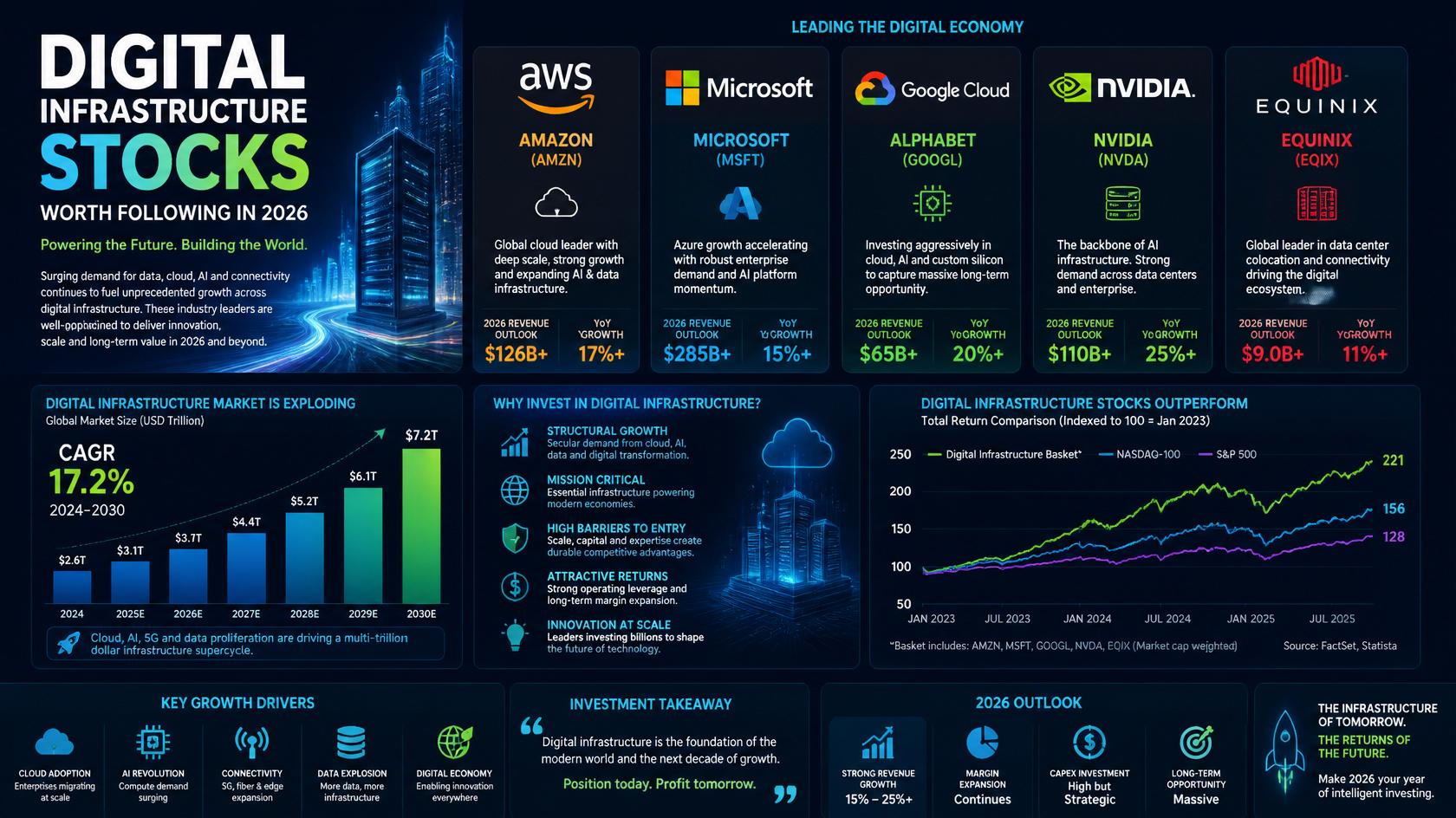
Digital infrastructure has quietly become one of the most important foundations of the modern economy. Every time someone watches a video online, makes a digital payment, uses cloud software, searches the web, or interacts with an AI system, they are relying on a huge network of technology working behind the scenes.
That network includes data centers, fiber-optic cables, communication towers, semiconductor technology, cloud platforms, and other essential systems that keep the digital world running.
As we move through 2026, businesses and governments are continuing to invest heavily in this infrastructure. For investors, that makes digital infrastructure an interesting long-term area to watch. Unlike short-lived technology trends, infrastructure tends to benefit from the broader and continuing growth of digital services.
This article looks at why digital infrastructure matters in 2026, what is driving its growth, which companies investors may want to follow, the risks involved, and what the sector could look like over the longer term.
Why Digital Infrastructure Matters More Than Ever
The global digital economy continues to expand, and that growth requires a strong physical and technological foundation.
Businesses increasingly depend on cloud computing to run applications and store information. Consumers spend more time streaming content, using online services, shopping digitally, and playing games over the internet. Financial institutions process huge numbers of digital transactions, while artificial intelligence systems require enormous amounts of computing power.
Behind all of these activities are data centers, communication networks, servers, networking equipment, cloud platforms, and semiconductor technologies.
As digital services become a normal part of everyday life, demand for the infrastructure supporting them is also increasing. This creates opportunities for companies that build, operate, or supply these essential systems.
The Digital Infrastructure Boom in 2026
Several major technology trends are helping push digital infrastructure investment higher in 2026.
Artificial intelligence is creating demand for powerful data centers and advanced processors. Cloud computing continues to replace many traditional on-premises technology systems. The expansion of 5G networks is increasing demand for communication towers and fiber infrastructure.
At the same time, streaming platforms, online gaming, and other data-heavy services continue to increase internet traffic. Businesses are also putting more money into cybersecurity as digital threats become a bigger concern.
Government investment in broadband and digital connectivity is another important factor. Together, these trends are creating a favorable environment for companies responsible for building and maintaining the infrastructure behind the digital economy.
Artificial Intelligence Is Driving Infrastructure Investment
Artificial intelligence has quickly become one of the biggest drivers of technology infrastructure spending.
Modern AI models require enormous computing resources. Supporting them often means building specialized data centers equipped with powerful processors, high-speed networking equipment, advanced cooling systems, and reliable power infrastructure.
Large technology companies are investing heavily in AI-related infrastructure, and the impact extends well beyond the companies developing AI software.
Suppliers of networking hardware, servers, electrical equipment, power systems, cooling technology, and connectivity solutions can also benefit from this growing investment.
If AI adoption continues expanding throughout 2026, the infrastructure required to support it should remain an important area of investment.
Data Centers Continue Expanding
Data centers are at the heart of many of the digital services people use every day.
Online searches, financial transactions, social media activity, streaming platforms, cloud applications, and many other services depend on data centers processing and storing information around the clock.
The rapid growth of artificial intelligence is adding another layer of demand. AI applications require substantial computing capacity, while businesses are also increasing their use of cloud storage and enterprise software.
For this reason, companies that design, operate, or supply data centers are positioned to benefit from the continued need for additional computing capacity.
Fiber Optic Networks Support the Digital Economy
Fast and reliable internet connections depend heavily on fiber-optic infrastructure.
Fiber networks can provide high-speed data transmission, low latency, and reliable connectivity, making them an important part of modern telecommunications.
Governments and private companies continue working to expand broadband access and upgrade existing networks. As internet usage grows and newer communication technologies are deployed, the need for fiber infrastructure is likely to remain important.
For investors, this makes companies connected to fiber networks and telecommunications infrastructure worth watching.
Digital Infrastructure Stocks Worth Following in 2026
Equinix
Equinix is one of the world’s major data center operators and provides digital infrastructure services to a wide range of customers.
Its facilities connect cloud providers, financial institutions, technology companies, and enterprises across different markets.
The company’s interconnected data centers support cloud computing, artificial intelligence, digital commerce, and enterprise connectivity. Continued demand from customers and recurring revenue make Equinix a company many investors continue to follow closely.
Digital Realty Trust
Digital Realty Trust operates a large portfolio of data centers serving customers around the world.
Its facilities support cloud computing, enterprise software, artificial intelligence, digital communications, and data storage.
As businesses require more computing and storage capacity, demand for data center space can continue to grow. Its international presence also gives the company exposure to the broader expansion of digital infrastructure.
American Tower Corporation
American Tower operates thousands of communication towers used by wireless carriers and mobile networks.
As people consume more mobile data and telecommunications companies continue expanding their networks, reliable tower infrastructure remains important.
The company’s long-term leasing arrangements can provide relatively predictable cash flow while allowing it to benefit from continued investment in wireless connectivity.
Crown Castle
Crown Castle focuses on wireless infrastructure in the United States.
Its assets include communication towers, fiber-optic networks, and small-cell infrastructure that help support mobile connectivity.
Increasing smartphone usage and wireless data consumption continue to create demand for network capacity. Further network expansion could therefore support the long-term importance of the company’s infrastructure assets.
NVIDIA
NVIDIA is best known for its graphics processors, but its role in digital infrastructure has become much broader.
Its advanced processors are widely used in artificial intelligence data centers, cloud computing, scientific research, and enterprise computing.
As businesses continue investing in AI, demand for the computing hardware needed to run these systems remains an important factor for NVIDIA.
Arista Networks
Arista Networks develops high-performance networking equipment used in cloud data centers and enterprise environments.
Its technology helps move large amounts of information between servers, storage systems, and applications.
As cloud services expand and AI workloads become more demanding, fast and efficient networking becomes increasingly important. This puts networking technology companies such as Arista in an important position within the digital infrastructure ecosystem.
Cisco Systems
Cisco remains a major name in networking infrastructure.
The company provides routers, switches, cybersecurity products, collaboration platforms, and other enterprise networking solutions.
These technologies play an important role in connecting businesses and managing modern digital environments. Cisco’s continued focus on cloud networking and cybersecurity also gives it exposure to several areas of long-term digital infrastructure spending.
Vertiv Holdings
Vertiv provides critical infrastructure used inside data centers.
Its products and services include power management, cooling systems, monitoring technology, and backup power solutions.
This area is becoming particularly important as AI workloads increase the amount of electricity and cooling required by modern data centers.
As companies build more AI-ready facilities, efficient power and cooling systems could become increasingly valuable, making Vertiv an important company to watch within the sector.
The Growing Importance of Cybersecurity
Digital infrastructure cannot operate effectively without strong security.
As businesses move more applications, data, and critical operations into cloud environments, protecting networks and sensitive information becomes increasingly important.
Cybersecurity spending is growing across industries including finance, healthcare, technology, and government.
Companies involved in secure networking, cloud security, threat detection, and related technologies may therefore benefit from continued investment in protecting digital systems.
For investors, cybersecurity is worth considering as another important part of the broader digital infrastructure story.
Government Investment Supports Infrastructure Growth
Governments around the world increasingly view digital infrastructure as strategically important.
Broadband expansion, telecommunications upgrades, smart-city projects, cybersecurity initiatives, and artificial intelligence research all require modern technology infrastructure.
Public investment can also encourage private companies to spend more on related projects, creating additional opportunities for infrastructure operators, technology suppliers, and equipment manufacturers.
This combination of public and private investment could provide continued support for the sector over the long term.
Risks Investors Should Consider
Digital infrastructure has attractive long-term potential, but that does not mean every company in the sector will perform well.
Technology changes quickly, so companies often need to keep investing in new products and systems to remain competitive. Large infrastructure projects can also require substantial amounts of capital.
Interest rates are another factor worth watching because higher borrowing costs can make financing expensive for infrastructure companies.
Competition is also strong across cloud computing, telecommunications, networking, and semiconductor markets. In addition, an economic slowdown could temporarily reduce business technology spending.
Investors should therefore look beyond industry growth alone and examine a company’s financial position, profitability, competitive advantages, debt levels, and long-term strategy before making an investment decision.
Building a Diversified Digital Infrastructure Portfolio
Investors looking for exposure to digital infrastructure do not necessarily have to focus on a single part of the industry.
Data center operators can provide exposure to the growing demand for computing and storage capacity. Telecommunications infrastructure companies can benefit from expanding mobile connectivity.
Networking equipment manufacturers support cloud computing and enterprise communications, while semiconductor companies provide the processing power behind AI and advanced computing.
There are also companies focused on power management and cooling, which are becoming increasingly important as data center capacity expands.
Spreading exposure across several segments can help reduce company-specific risk while allowing investors to participate in the broader growth of digital infrastructure.
Long-Term Outlook for Digital Infrastructure
The long-term outlook for digital infrastructure remains closely connected to the continued expansion of the digital economy.
Artificial intelligence is being adopted across a growing number of industries, while cloud computing remains an important part of modern business technology.
Digital payments, online education, healthcare technology, streaming services, connected devices, and other digital applications are also contributing to rising demand for internet connectivity and computing capacity.
The development of 5G, edge computing, autonomous technologies, and smart manufacturing could add further demand for reliable infrastructure.
As more parts of the economy become digitally connected, the companies providing the physical systems and technology that make this possible are likely to remain important players in the market.
For investors, digital infrastructure may therefore be worth watching as a long-term theme in 2026 and beyond. However, individual companies can face very different financial and competitive conditions, so careful research and diversification remain essential.