
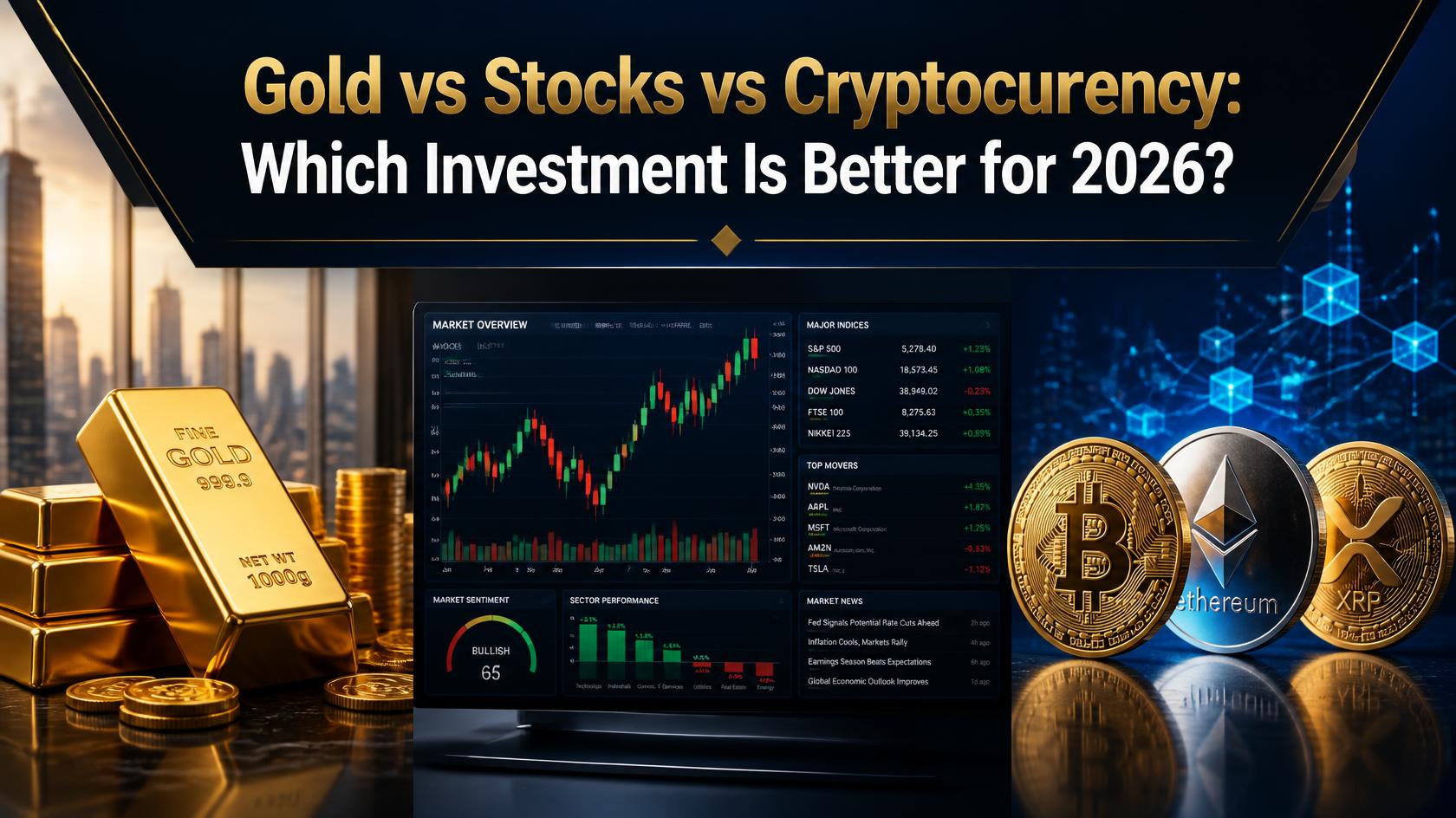
Choosing where to invest money in 2026 has become more complicated than simply looking for the asset with the highest recent return. Investors are facing a combination of changing interest-rate expectations, inflation concerns, geopolitical uncertainty, technological growth, and rapidly evolving financial markets. Gold, stocks, and cryptocurrency each offer a different way to participate in the economy, protect wealth, or pursue long-term growth.
For U.S. investors, the question is not necessarily whether gold, stocks, or cryptocurrency is universally the best investment. The more useful question is which asset best matches an investor’s goals, time horizon, risk tolerance, and need for diversification.
Gold has traditionally been viewed as a store of value and a defensive asset during periods of uncertainty. Stocks represent ownership in businesses and have historically been one of the strongest long-term wealth-building tools. Cryptocurrency, particularly Bitcoin, offers exposure to a relatively new digital asset class with significant growth potential but substantially higher volatility.
Market conditions in 2026 illustrate why comparing these assets matters. Gold experienced an extraordinary rise into early 2026 before undergoing a significant correction, while U.S. stocks have continued to benefit from strong corporate earnings and enthusiasm surrounding technology and artificial intelligence. Cryptocurrency remains highly sensitive to investor sentiment, regulation, liquidity, and institutional demand.
This guide compares gold, stocks, and cryptocurrency for 2026 and explains the potential advantages, disadvantages, risks, and appropriate role each asset can play in a diversified investment strategy.
Gold Investment Outlook for 2026
Gold has maintained its position as one of the world’s most recognized defensive investments. Unlike stocks, gold does not represent ownership in a company, and unlike cryptocurrency, it does not depend on blockchain networks or digital infrastructure. Its value is primarily influenced by supply and demand, interest rates, currency movements, inflation expectations, central-bank activity, and investor confidence.
The beginning of 2026 demonstrated how quickly gold can move when investors are concerned about economic and geopolitical conditions. The World Gold Council reported that gold moved above $5,500 per ounce during January before falling below $4,000 later in June, highlighting both its strength and its volatility even within a traditionally defensive asset.
Gold’s appeal in 2026 is also supported by continued central-bank demand and investor interest in diversification. The World Gold Council expects central banks to remain significant buyers, although annual purchases may be lower than in 2025. Investment demand is also expected to remain constructive, particularly as investors consider inflation, geopolitical risks, currency movements, and monetary policy.
For American investors, gold can serve as a portfolio diversifier rather than a replacement for productive assets. Investors can gain exposure through physical gold, gold-backed exchange-traded funds, or shares of gold-mining companies. Each approach carries different costs and risks.
Physical gold provides direct ownership but can involve storage, insurance, and transaction costs. Gold ETFs can provide easier market access and liquidity, while mining stocks can potentially produce greater gains when gold prices rise but also carry company-specific risks.
The main weakness of gold is that it does not generate earnings, dividends, or interest. Investors depend primarily on price appreciation. If inflation falls, real interest rates rise, or the U.S. dollar strengthens substantially, gold can come under pressure.
Therefore, gold may be most useful in 2026 as a diversification and risk-management asset rather than as the sole foundation of a long-term portfolio.
Stock Market Outlook for 2026
Stocks remain one of the most important investment categories for Americans seeking long-term wealth creation. When investors purchase shares of publicly traded companies, they gain an economic interest in businesses that can generate revenue, profits, dividends, and cash flow.
The biggest advantage of stocks over gold and cryptocurrency is their connection to productive economic activity. A successful company can increase sales, improve profit margins, develop new products, enter new markets, and return capital to shareholders. Over long periods, these factors can support the growth of stock prices.
The U.S. stock market has remained strong in 2026 despite periods of volatility. Recent market activity has been heavily influenced by technology companies, artificial intelligence investment, corporate earnings, inflation expectations, and Federal Reserve policy. The S&P 500 reached record territory during August, although analysts have also warned that elevated valuations leave markets vulnerable to disappointing economic or corporate news.
This does not mean stocks are guaranteed to rise. Equity markets can experience sharp declines during recessions, financial crises, geopolitical shocks, or periods of excessive valuation. Individual companies can also fail, making diversification particularly important.
For most long-term investors, broad stock-market exposure can be more practical than attempting to select a handful of individual companies. A diversified portfolio of U.S. and international companies can spread risk across different industries and economic regions.
Another advantage of stocks is the potential for compounding. Reinvested dividends and long-term earnings growth can allow investors to build wealth over decades. This makes equities particularly attractive for retirement accounts and other long-term financial goals.
The major disadvantage is short-term volatility. Stocks can lose substantial value during market corrections, even when the underlying businesses remain financially healthy. Investors who may need their money soon should therefore be cautious about relying heavily on equities.
Cryptocurrency Investment Outlook for 2026
Cryptocurrency occupies a very different position from gold and stocks. Digital assets such as Bitcoin operate through blockchain technology rather than traditional corporate ownership or physical commodities.
The strongest argument for cryptocurrency is its potential for substantial long-term growth. Bitcoin has attracted increasing institutional attention, while the development of cryptocurrency-related financial products has made digital assets more accessible to American investors.
Regulatory developments are also becoming increasingly important. In August 2026, U.S. policymakers continued working toward clearer cryptocurrency regulations, with proposed legislation and regulatory initiatives focused on creating a more defined framework for digital assets. These developments could influence institutional participation and the broader adoption of cryptocurrency.
However, cryptocurrency remains significantly more volatile than traditional investments. Prices can rise or fall dramatically in relatively short periods because of changes in market sentiment, regulation, liquidity, technological developments, and investor speculation.
Cryptocurrency also lacks some of the traditional valuation tools available for stocks. A company can be evaluated through earnings, revenue, cash flow, assets, and other financial measures. Valuing a cryptocurrency can be considerably more difficult because its price is heavily influenced by supply, demand, network activity, adoption, liquidity, and market expectations.
This makes cryptocurrency potentially attractive for investors who can tolerate substantial losses, but it also makes it unsuitable as the only investment for most people.
For many investors, cryptocurrency may make more sense as a smaller portion of a diversified portfolio rather than its central component.
Gold vs Stocks: Which Is Better?
The answer depends largely on the investor’s objective.
Gold is generally more attractive when the primary goal is diversification, wealth preservation, or protection against certain economic and geopolitical risks. Stocks are generally more attractive when the objective is long-term capital growth through exposure to productive businesses.
Gold can perform well when investors become concerned about inflation, currency weakness, geopolitical instability, or financial-market stress. Stocks can perform better when economic growth is healthy, corporate earnings are increasing, and investor confidence remains strong.
There is also an important difference in income generation. Many stocks pay dividends, while companies can increase earnings over time. Gold does not produce cash flow.
For a young investor with a long investment horizon, a portfolio centered on diversified equities may offer greater growth potential. For an investor seeking additional diversification, a measured allocation to gold may provide balance.
The two assets do not have to compete with each other. They can serve different purposes within the same portfolio.
Stocks vs Cryptocurrency: Which Is Better?
Stocks have a much longer history as mainstream investment assets and are supported by established financial markets, corporate reporting requirements, and well-developed valuation methods.
Cryptocurrency offers a different opportunity. It provides exposure to digital networks and potentially transformative financial technology, but the risk is considerably higher.
An investor choosing between stocks and cryptocurrency should consider whether they prioritize consistency or higher-risk growth potential. Stocks generally provide broader diversification when purchased through an index fund or diversified ETF. Cryptocurrency can provide significant upside but can also experience extreme drawdowns.
For most investors, stocks are better suited as a core long-term investment, while cryptocurrency may be more appropriate as a smaller alternative allocation for those who understand and accept its risks.
Gold vs Cryptocurrency: Which Is Safer?
Gold has thousands of years of history as a form of wealth preservation, while cryptocurrency is a relatively new asset class.
Gold’s physical nature, global recognition, limited supply, and established financial-market infrastructure contribute to its defensive characteristics. Cryptocurrency is digital, highly liquid, globally accessible, and capable of operating around the clock, but its market behavior is much more volatile.
The difference became especially important during periods of market uncertainty. Gold can benefit from safe-haven demand, while cryptocurrency can behave more like a risk asset when investors reduce exposure to speculative investments.
This does not mean cryptocurrency cannot eventually develop stronger defensive characteristics. As institutional participation and financial infrastructure evolve, its relationship with traditional assets may continue to change. However, investors should not assume that Bitcoin or other cryptocurrencies provide the same protection as gold during every market crisis.
Which Investment Has the Best Potential in 2026?
There is no reliable way to identify one asset as the guaranteed winner for the entire year.
Gold has strong structural support from central-bank purchases, investor demand, geopolitical concerns, and its role as a portfolio diversifier. At the same time, its strong recent performance means investors should be prepared for substantial price swings.
Stocks continue to benefit from corporate earnings and investment in areas such as artificial intelligence and technology. However, elevated valuations and economic uncertainty can create meaningful downside risk.
Cryptocurrency offers the highest potential for dramatic gains among the three categories, but it also carries the highest level of uncertainty and volatility.
The best investment therefore depends on what an investor is trying to accomplish.
For long-term growth, diversified stocks generally have the strongest role.
For diversification and potential protection during economic uncertainty, gold can be valuable.
For higher-risk growth exposure and participation in digital-asset innovation, cryptocurrency may have a place for investors who can tolerate significant volatility.
A Balanced Approach to Gold, Stocks and Crypto
Instead of trying to predict which single asset will outperform in 2026, investors may benefit from thinking in terms of portfolio construction.
A diversified portfolio can combine growth-oriented assets with defensive and alternative investments. Stocks can provide exposure to business growth, gold can add diversification, and cryptocurrency can provide limited exposure to a developing digital asset class.
The appropriate allocation depends on age, income, financial obligations, investment horizon, risk tolerance, and personal objectives.
An investor saving for retirement decades from now may be able to tolerate considerably more stock-market volatility than someone who expects to use the money within the next few years. Similarly, an investor who cannot tolerate a major temporary loss may find a large cryptocurrency allocation unsuitable.
The key principle is not simply diversification by owning several investments. True diversification means owning assets that respond differently to economic conditions and avoiding excessive concentration in one market or theme.
What Should U.S. Investors Consider Before Investing in 2026?
U.S. investors should pay close attention to interest rates, inflation, economic growth, corporate earnings, the strength of the dollar, geopolitical developments, and changes in financial regulation.
Interest rates are particularly important because they can influence all three asset classes. Higher real yields can make non-income-producing assets such as gold less attractive, while lower rates can support risk assets and alternative investments.
Inflation also matters. Gold has historically attracted investors seeking protection against declining purchasing power, while stocks can potentially benefit over the long term because successful companies may increase prices and earnings. Cryptocurrency’s relationship with inflation is less predictable.
Taxes should also be considered. Different investments can receive different tax treatment depending on how they are held and how long they are owned. Investors should understand the tax consequences before making major portfolio changes.
Most importantly, investors should avoid making decisions based solely on recent performance. An asset that has risen dramatically can still decline sharply, and an asset that has underperformed can remain weak for longer than expected.
Gold, Stocks or Cryptocurrency: The Final Verdict
For most U.S. investors in 2026, stocks are likely to remain the strongest foundation for long-term wealth building because they provide ownership in productive businesses and offer the potential for earnings growth, dividends, and compounding.
Gold can complement stocks by providing diversification and potential resilience during periods of inflation, geopolitical stress, currency weakness, or market uncertainty. Its role is often more about portfolio balance than aggressive growth.
Cryptocurrency is the most speculative of the three. Its potential upside is considerable, but so is the possibility of severe losses. Investors who choose to own digital assets should approach them with a clear understanding of volatility and avoid allowing a speculative position to dominate their overall financial plan.
The most sensible answer to the question “Gold vs Stocks vs Cryptocurrency: Which Investment Is Better for 2026?” is therefore not to choose one blindly.
Stocks can serve as the growth engine. Gold can serve as a diversification tool. Cryptocurrency can provide limited exposure to a high-risk, emerging asset class.
Rather than attempting to predict the single winning investment of 2026, investors may be better served by building a portfolio that reflects their personal financial goals and ability to withstand market volatility.ersified strategy that can survive both strong markets and difficult ones.
Investors should consider their own financial circumstances, investment horizon, risk tolerance, and tax situation before making investment decisions. Past performance does not guarantee future results, and no investment is completely risk-free.