
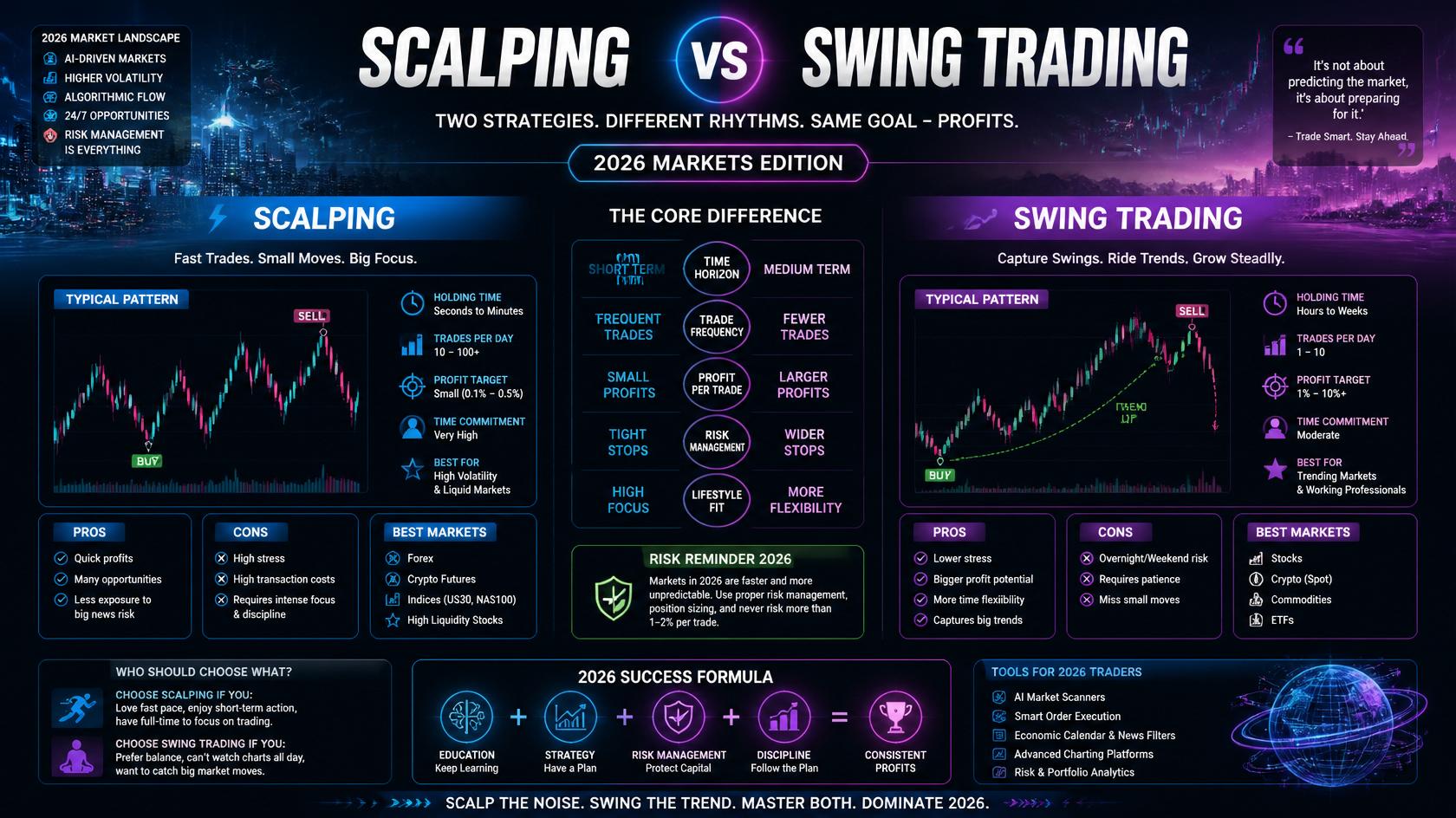
Financial markets in 2026 are changing at a remarkable pace. Artificial intelligence, automated trading, real-time data, global economic developments, and higher volatility are influencing the way traders make decisions. While these changes have created new opportunities, they have also made it more important to choose a trading style that matches your goals and personality.
Two of the most popular approaches are scalping and swing trading. Both strategies attempt to profit from price movements, but the way traders use them is very different. They vary in terms of holding time, risk, technology, emotional pressure, and the amount of time required each day.
So, which one is better in 2026? The answer depends largely on your experience, lifestyle, available capital, and ability to manage risk.
What Is Scalping?
Scalping is a fast-paced trading strategy where positions are opened and closed within seconds or minutes. Instead of waiting for a major market move, scalpers try to take advantage of many small price changes throughout a trading session.
The idea is simple: take a small profit from multiple trades rather than relying on one large move. Over time, those smaller gains can add up if the trader maintains a high win rate and keeps losses under control.
Scalping is commonly used in highly liquid markets such as forex, stocks, index futures, commodities, and major cryptocurrencies.
Because positions are normally closed quickly, scalpers can reduce overnight exposure. However, the strategy requires constant attention and fast decision-making.
How Does Swing Trading Work?
Swing trading takes a much slower approach. Instead of opening and closing positions within minutes, swing traders typically hold trades for several days or sometimes a few weeks.
The main goal is to capture a meaningful portion of a market trend. A trader may identify a potential breakout, pullback, or momentum move, enter a position, and wait for the market to develop.
Swing traders often use technical analysis alongside broader market information. Economic reports, interest-rate decisions, company earnings, market sentiment, and industry trends can all influence their decisions.
One of the biggest advantages of swing trading is that it does not require traders to watch their screens continuously. This makes it easier to combine trading with a full-time job or other responsibilities.
Why the 2026 Market Environment Matters
The market environment in 2026 presents both opportunities and challenges for traders.
Artificial intelligence and algorithmic systems can analyze market information and execute orders extremely quickly. High-frequency trading firms also compete heavily in short-term markets, making it harder for individual traders to consistently profit from very small price movements.
At the same time, economic uncertainty, changing interest-rate expectations, geopolitical developments, technological growth, and shifts between market sectors can create longer-lasting trends.
These conditions can provide opportunities for traders who are willing to hold positions for several days or weeks rather than trying to capture every small movement.
For this reason, understanding the differences between scalping and swing trading has become increasingly important.
Time Commitment
One of the biggest differences between the two strategies is the amount of time they require.
Scalping demands intense concentration. Traders may monitor several charts at once and execute numerous positions during a single session. A small delay or missed opportunity can affect the outcome of a trade.
Because of this, scalping is generally more suitable for people who can dedicate several uninterrupted hours to trading.
Swing trading offers considerably more flexibility. Traders can perform their analysis after the market closes, identify potential setups, and place trades that remain open for several days.
This makes swing trading a practical option for people who have careers, businesses, or other daily responsibilities.
Profit Potential
Scalping generally targets small gains from individual trades. Since the profit target is relatively small, traders may need to complete many successful trades to generate meaningful returns.
Transaction costs are also important. Spreads, commissions, and execution quality can have a noticeable impact when a trader enters and exits positions frequently.
Swing traders typically aim for larger price movements. A single successful trade may generate a much larger percentage gain than a typical scalp.
However, larger potential returns also come with greater exposure to market fluctuations. A swing trader must be prepared for prices to move against the position before the expected trend develops.
Risk Management
No trading strategy eliminates risk.
Scalpers often use tight stop-loss levels because their trades are designed to develop quickly. If the market moves in the wrong direction, the position may be closed within a short period.
The challenge is that frequent trading can create more opportunities for mistakes. Overtrading, emotional decisions, and poor execution can quickly turn a profitable strategy into an expensive habit.
Swing traders generally use wider stop-loss levels because their trades need room to handle normal market fluctuations. Proper position sizing is therefore especially important.
Since swing positions can remain open overnight, traders also need to consider unexpected news, economic announcements, earnings reports, and geopolitical events.
Technology Requirements
Technology plays a major role in modern scalping.
Fast and reliable internet, real-time market data, a responsive trading platform, competitive spreads, and efficient order execution can all make a difference. When a strategy depends on very small price movements, even minor execution delays can affect the result.
Swing trading is less dependent on speed.
While a reliable trading platform is still important, swing traders usually have more time to analyze charts, review market conditions, and make decisions. This makes the strategy more accessible to individual traders who do not have advanced professional trading infrastructure.
Emotional Pressure
Scalping can be mentally exhausting.
A trader may need to make dozens of decisions during a single session while dealing with rapidly changing prices. One impulsive decision can lead to another, especially after a losing trade.
Successful scalpers need strong discipline and the ability to follow their trading plan without allowing fear or greed to take control.
Swing trading tends to provide a calmer environment. Since trades develop more slowly, traders have more time to analyze their decisions instead of reacting to every small price movement.
Patience is therefore one of the most important qualities for a swing trader.
Capital Requirements
Scalping can benefit from larger trading capital because individual trades often produce relatively small price gains. Traders may rely on larger position sizes to make those small movements financially meaningful.
However, larger positions also increase risk, so proper position sizing remains essential.
Swing trading can be more practical for smaller accounts because the strategy targets larger price movements. A trader does not necessarily need to make numerous trades every day to participate in meaningful market trends.
Regardless of strategy, traders should only risk an amount they can afford to lose.
Best Markets for Scalping
Scalping generally works best in markets with strong liquidity and relatively tight spreads.
Major forex pairs, actively traded stocks, index futures, gold, crude oil, and major cryptocurrencies can provide the activity required for short-term trading.
High liquidity allows traders to enter and exit positions more efficiently, although it does not guarantee profitability.
Best Markets for Swing Trading
Swing trading can work particularly well when markets develop clear trends.
Technology stocks, semiconductor companies, artificial intelligence-related businesses, exchange-traded funds, precious metals, mining companies, commodities, and cryptocurrencies can all produce price movements that last several days or longer.
The key is not simply choosing a specific market. Traders need to identify assets with sufficient liquidity, momentum, and a setup that matches their strategy.
Which Strategy Is Better for 2026?
There is no universal winner.
Scalping can still be attractive to experienced traders who enjoy fast decision-making, have excellent discipline, and can dedicate significant time to the markets. However, increased automation and algorithmic competition can make short-term trading especially challenging for retail traders.
Swing trading may be a better fit for many traders in the current environment because it provides a balance between market participation and flexibility.
Economic uncertainty, changing monetary policy, technological innovation, inflation concerns, and sector rotation can create trends that develop over multiple trading sessions.
For traders who prefer patience over constant activity, swing trading may offer a more manageable approach.
How to Choose the Right Strategy
Your personality and lifestyle should play an important role in your decision.
If you enjoy fast-paced environments, can remain focused for hours, and are comfortable making rapid decisions, scalping may suit you.
If you prefer more time for research, want less screen time, and are comfortable holding positions for several days, swing trading may be a better choice.
Some experienced traders also use a combination of both approaches. They may use swing trading for larger market moves while taking occasional short-term trades when market conditions provide particularly strong opportunities.
Common Mistakes Traders Should Avoid
One of the biggest mistakes beginners make is constantly switching strategies without giving themselves enough time to understand and test one approach.
Others trade too frequently, ignore their stop-loss rules, increase position sizes after losses, or allow emotions to influence their decisions.
The strategy itself is only one part of successful trading. Discipline, consistency, risk management, and proper position sizing are equally important.
Whether you choose scalping or swing trading, protecting your trading capital should always come before chasing profits.
The Future of Trading Beyond 2026
Financial markets will continue to evolve as technology becomes more advanced.
Artificial intelligence, machine learning, automated trading systems, and data-driven analysis are likely to play an increasingly important role in how markets operate.
This does not necessarily mean that traditional trading strategies will disappear. Instead, traders may need to adapt the way they use them.
The most successful traders are likely to be those who continue learning, understand changing market conditions, manage risk carefully, and remain flexible when their strategies stop working as expected.
In the end, the best trading strategy is not necessarily the fastest or the one with the biggest potential return. It is the strategy that fits your skills, schedule, risk tolerance, and ability to remain disciplined over time.