
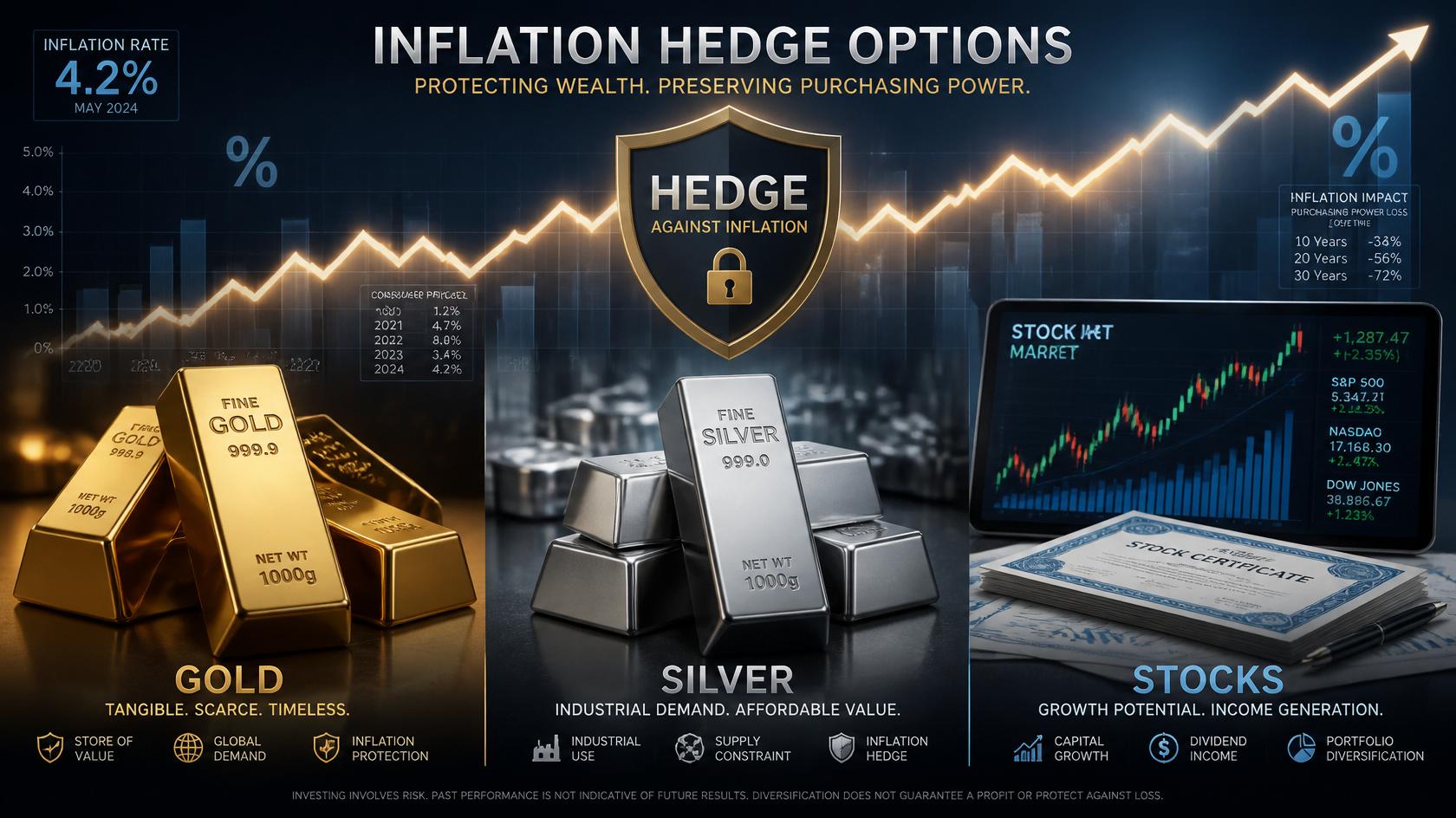
When prices of everyday goods and services rise, the purchasing power of money falls. The same amount of money simply does not buy as much as it used to. Inflation can be driven by many factors, including higher energy costs, supply chain problems, strong consumer demand, wage growth, or changes in monetary policy.
For investors, inflation creates a difficult challenge: how can wealth continue to grow when the value of money is declining?
Gold has traditionally been considered one of the most reliable safe-haven assets. Silver offers a combination of precious-metal characteristics and industrial demand, while stocks provide investors with ownership in businesses that can potentially grow their earnings and prices over time.
Each asset behaves differently when inflation rises. Understanding those differences can help investors make more informed decisions in 2026 and beyond.
What Is Inflation and Why Does It Matter?
Inflation occurs when the overall prices of goods and services increase over time. A moderate level of inflation is generally considered normal for a growing economy, but persistent or unusually high inflation can create serious challenges.
Consumers may find that groceries, housing, transportation, and other necessities become more expensive. Businesses can also face higher costs for labor, materials, energy, and financing.
Central banks often respond to high inflation by raising interest rates. Higher rates can slow economic activity, increase borrowing costs, and put pressure on financial markets.
For investors, the biggest concern is not simply seeing an account balance remain stable. What matters is whether that money is maintaining its purchasing power after inflation.
Gold as an Inflation Hedge
Gold has been used as a store of value for thousands of years. During periods of financial uncertainty, currency weakness, inflation concerns, and geopolitical instability, investors often turn toward gold.
One reason is its limited supply. Unlike fiat currencies, gold cannot simply be created by governments or central banks whenever additional money is needed.
Gold can therefore act as a form of diversification when confidence in traditional financial assets declines.
Central banks have also remained important participants in the gold market, and institutional demand can influence prices significantly.
However, gold has an important limitation: it does not generate regular income. Unlike a dividend-paying stock or an interest-bearing asset, physical gold does not produce cash flow. Investors generally rely on an increase in its market price to generate a return.
Gold can also underperform during periods when economic growth is strong and investors prefer assets with higher growth potential.
Silver as an Inflation Hedge
Silver has many of the same characteristics as gold, but its investment story is more closely connected to industrial activity.
Silver is used in electronics, solar technology, electrical components, medical equipment, automotive applications, and various advanced manufacturing processes.
This gives silver two major sources of demand: investment demand and industrial demand.
When economic growth is strong and inflation is elevated, both sources can support silver prices. This can sometimes allow silver to outperform gold during powerful commodity or industrial cycles.
The trade-off is greater volatility.
Silver has a smaller market than gold and is more sensitive to changes in industrial activity. Prices can rise quickly when demand is strong, but they can also fall sharply when economic growth slows.
For investors who are comfortable with larger price swings, silver may offer greater upside potential than gold during certain market cycles.
Stocks as an Inflation Hedge
Stocks represent ownership in businesses, and that makes them fundamentally different from precious metals.
When companies have strong brands, loyal customers, efficient operations, and pricing power, they may be able to raise their prices when their own costs increase. This can help protect revenues and profits from inflation.
Over long periods, diversified stock markets have historically generated returns that have exceeded inflation. However, stock performance can vary significantly from one period to another.
Some industries may perform particularly well during inflationary periods. Energy companies can benefit from higher commodity prices, while mining companies may benefit when metal prices increase.
Consumer staples businesses may also have an advantage because people continue purchasing essential products even when household budgets become tighter.
Other sectors, including technology, financial services, healthcare, and industrial companies, can perform differently depending on interest rates, economic growth, and individual business conditions.
Stocks therefore have strong long-term wealth-building potential, but they can experience significant short-term declines.
Gold, Silver, or Stocks: Which Is More Volatile?
The risk profile of each asset is different.
Gold is generally viewed as the more defensive option. It can provide diversification during periods of market stress, although its price can still experience substantial fluctuations.
Silver is usually more volatile than gold. Its price is influenced not only by investor sentiment but also by industrial demand, making it more sensitive to changes in economic growth.
Stocks can also be highly volatile, especially during recessions, financial crises, or periods of rapidly rising interest rates. However, a diversified stock portfolio gives investors exposure to many businesses and the potential for long-term earnings growth.
The right choice ultimately depends on how much short-term volatility an investor can comfortably handle.
How These Assets Perform in Different Economic Environments
There is no single asset that performs best in every economic situation.
Gold may become more attractive when inflation is high, financial markets are under pressure, currencies are weakening, or geopolitical uncertainty increases.
Silver can benefit when inflation is combined with strong industrial activity. Demand from manufacturing, renewable energy, electronics, and other industries can provide an additional source of support.
Stocks tend to perform well when inflation remains manageable and the economy continues expanding. Companies with strong balance sheets, growing earnings, and pricing power can potentially increase profits even as costs rise.
This is why investors should avoid thinking about inflation hedges as a simple winner-takes-all competition.
Why Diversification Matters
Instead of putting all their money into one asset, many investors choose to combine different investments.
A portfolio containing stocks, gold, and silver can provide exposure to several different economic drivers. Stocks offer business growth, gold can provide defensive diversification, and silver combines precious-metal demand with industrial exposure.
If one asset performs poorly, another may perform better and help reduce the overall impact on the portfolio.
Diversification does not eliminate losses, but it can reduce the risk of becoming overly dependent on a single investment or economic scenario.
What Should Investors Consider Before Investing?
The right allocation depends on several personal factors.
Investors primarily concerned with preserving wealth during uncertain periods may find gold attractive because of its long-standing safe-haven reputation.
Those who are comfortable accepting greater volatility and want exposure to industrial growth may consider silver.
Investors focused on building wealth over decades may place greater emphasis on stocks because of their potential for capital appreciation and dividend income.
Before investing, it is important to consider your investment horizon, risk tolerance, financial objectives, and existing portfolio. Interest rates, inflation expectations, corporate earnings, economic growth, and global events can also influence how each asset performs.
Inflation and the 2026 Investment Environment
Inflation remains an important consideration for investors in 2026. Even when headline inflation begins to moderate, individual categories such as housing, energy, labor, and essential goods can continue experiencing price pressure.
Global supply chains, geopolitical developments, energy markets, government spending, and changes in monetary policy can all affect future inflation.
At the same time, major investment themes such as artificial intelligence, renewable energy, semiconductor manufacturing, electrification, and digital infrastructure are reshaping the global economy.
These trends are creating opportunities for businesses and increasing demand for certain industrial commodities.
For investors, this changing environment makes diversification particularly important.
Which Inflation Hedge Is Best?
There is no universal answer.
Gold may be better suited to investors who prioritize wealth preservation and want a traditional safe-haven asset.
Silver can appeal to investors looking for precious-metal exposure combined with the potential benefits of industrial demand, although the higher volatility comes with additional risk.
Stocks may be the strongest choice for investors focused on long-term wealth creation, particularly when they invest in financially healthy businesses with sustainable competitive advantages.
Rather than choosing only one, investors may benefit from combining different asset classes according to their individual goals and risk tolerance.
The most important point is that inflation does not affect every investment in the same way. A well-diversified portfolio can give investors multiple sources of potential returns while reducing reliance on a single asset.
In 2026 and beyond, understanding how gold, silver, and stocks respond to changing economic conditions may be more valuable than simply trying to predict which one will deliver the highest return.