
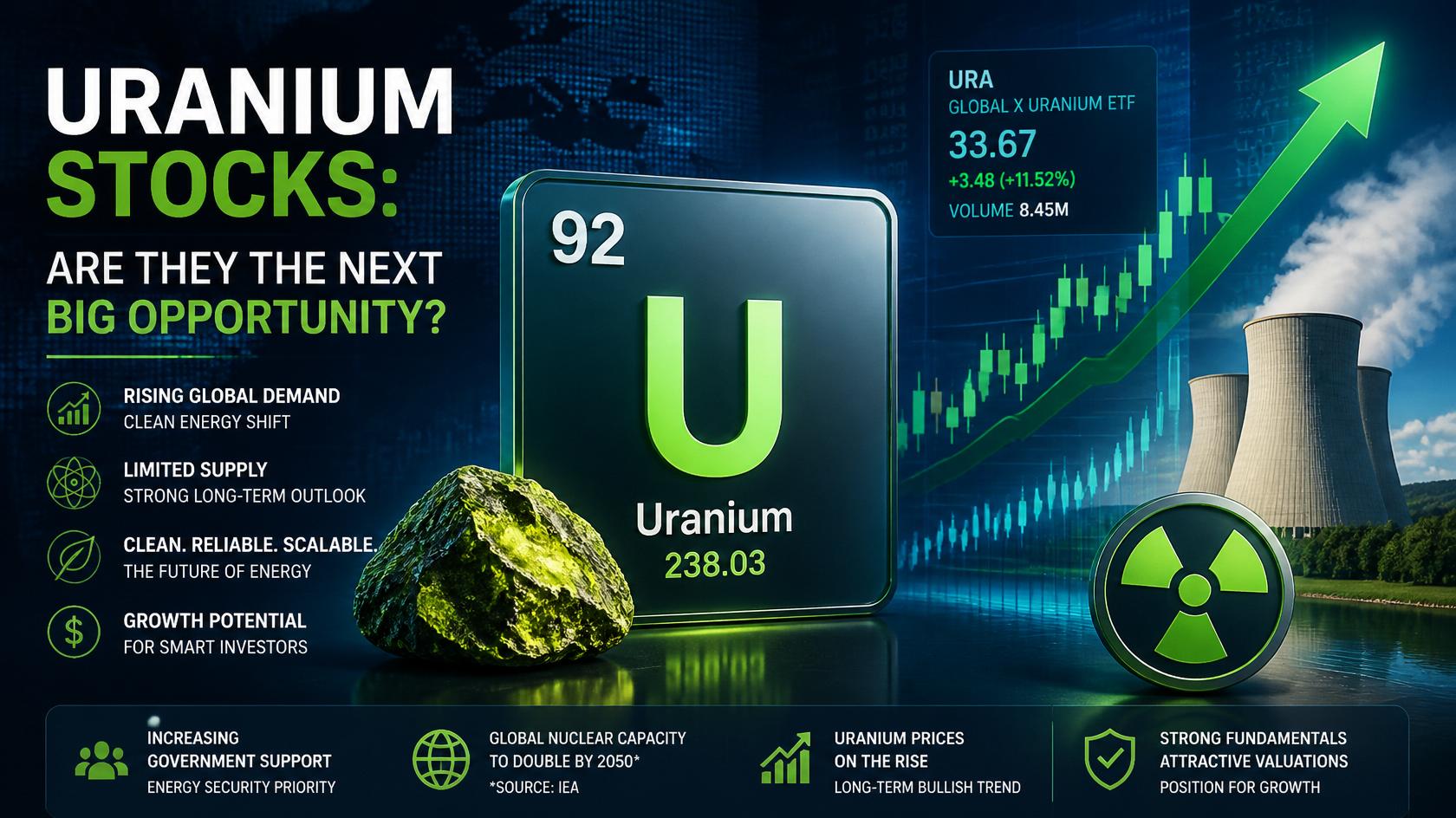
The global energy industry is going through a major transformation, and uranium has once again become a commodity that investors are watching closely. After years of relatively limited attention, uranium is back in the spotlight as governments, energy companies, institutional investors, and individual traders look for ways to benefit from the renewed interest in nuclear power.
The push for cleaner electricity, rising energy consumption, expanding nuclear projects, and growing concerns about energy security are all contributing to this renewed interest.
For investors looking beyond traditional areas such as technology and banking, uranium stocks offer an interesting opportunity. However, the sector also comes with substantial risks, so understanding the industry is important before investing.
This article looks at why uranium is gaining attention, what is driving the industry, the major risks investors should consider, and why uranium could remain an important investment theme in the years ahead.
Why Uranium Is Becoming Important Again
For many years, nuclear power faced strong opposition in several countries because of concerns surrounding major nuclear accidents and environmental issues.
The energy landscape today, however, looks different.
Electricity demand is increasing as artificial intelligence, electric vehicles, industrial automation, and large data centers expand. At the same time, governments are trying to reduce carbon emissions while maintaining reliable electricity supplies.
Nuclear power has an important advantage because reactors can generate electricity continuously without depending on sunlight or wind conditions.
Since nuclear reactors require uranium as fuel, expanding nuclear capacity can create additional long-term demand for uranium.
As a result, many governments are once again considering nuclear power as part of their strategy for reliable, lower-carbon electricity and greater energy security.
The Global Supply Challenge
One of the main reasons uranium has attracted investor attention is the potential gap between future supply and demand.
Developing a uranium mine is not a quick process. Projects can take many years to move from exploration to commercial production because companies must secure permits, complete environmental assessments, obtain financing, and develop the necessary infrastructure.
At the same time, existing nuclear reactors require a continuous supply of uranium.
During periods of low uranium prices, some mining companies reduced production or postponed new projects. If nuclear demand continues increasing, the limited pipeline of new production could create tighter market conditions.
A sustained imbalance between supply and demand could provide support for uranium prices and potentially improve the financial performance of efficient uranium producers.
Why Governments Are Supporting Nuclear Energy
Government attitudes toward nuclear power have changed in several major economies.
Some countries are extending the operating lives of existing reactors, while others are planning new nuclear facilities. Small Modular Reactors, commonly known as SMRs, are also receiving attention as a potential way to develop more flexible nuclear power systems.
Several factors are behind the renewed government interest in nuclear energy:
Reducing dependence on imported fossil fuels.
Meeting long-term climate objectives.
Supporting rising electricity demand.
Providing reliable power for large-scale technology and data-center infrastructure.
Improving national energy security.
These developments could create a more supportive environment for the uranium industry than the sector experienced during previous periods of weak nuclear investment.
How Uranium Stocks Generate Value
Uranium companies can have very different business models, and investors should understand those differences before buying a stock.
Exploration companies search for uranium deposits that could eventually become commercial mines. These businesses can offer significant upside if they discover valuable resources, but they also carry considerable risk because exploration does not guarantee successful production.
Uranium producers operate mines and sell uranium to customers such as nuclear utilities. Their profitability is influenced by uranium prices, production costs, operating efficiency, and the quality of their mining assets.
Royalty companies can generate revenue from mining projects without directly operating the mines themselves. This structure can reduce some operational risks, although it comes with its own investment considerations.
Investors can also gain diversified exposure through uranium-focused ETFs, which hold multiple companies rather than relying on the performance of a single stock.
Understanding how a company makes money is one of the most important steps before investing in the uranium sector.
Factors Driving Uranium Stock Performance
Uranium stocks can respond to several different market and industry developments.
Higher uranium prices can improve revenue potential for producers.
New nuclear reactor construction can increase long-term demand for uranium.
Government policies supporting nuclear energy can improve industry sentiment.
Changes in interest rates can influence investor appetite for growth-oriented mining companies.
Production disruptions can tighten uranium supply and potentially support prices.
Geopolitical developments can also increase interest in nuclear power as countries look for reliable domestic energy sources.
Because the uranium market is relatively small compared with major commodities such as oil, price movements can sometimes be particularly sharp.
Advantages of Investing in Uranium Stocks
The uranium sector has several characteristics that may appeal to long-term investors.
One is the potential for sustained demand growth as nuclear power expands.
Another is the difficulty of quickly increasing uranium production because new mines require significant time and capital.
The industry is also benefiting from stronger government support for nuclear energy in several markets.
Uranium investments can also provide diversification away from traditional technology, financial, and consumer sectors.
For investors interested in infrastructure and the long-term energy transition, uranium provides exposure to a specialized part of the global energy market.
Risks Investors Should Understand
The potential upside does not come without significant risks.
Uranium prices can be highly volatile and may experience substantial increases or declines over relatively short periods.
Mining companies can also face environmental regulations, permitting challenges, political uncertainty, labor issues, and operational problems.
Delays in new nuclear reactor projects could reduce expected demand growth.
Government policies can change, potentially slowing nuclear development in certain countries.
Exploration companies face an additional risk because a promising project may never become a commercially viable mine.
Broader economic weakness can also reduce investor interest in commodity markets.
Because of these risks, concentrating a large portion of a portfolio in one uranium company can create unnecessary exposure to company-specific problems.
The Role of Artificial Intelligence
Artificial intelligence could become an important indirect driver of uranium demand.
Modern AI systems require enormous computing power, and large data centers can consume significant amounts of electricity around the clock.
Technology companies are investing heavily in new AI infrastructure, putting additional pressure on electricity grids.
Nuclear power could play a larger role in meeting this demand because reactors can provide consistent electricity with relatively low operational carbon emissions.
If AI-driven electricity demand continues increasing over the coming decades, the resulting need for reliable power could indirectly support long-term uranium demand.
Long-Term Investment Outlook
Uranium is generally better viewed as a long-term investment theme than as a simple short-term trading opportunity.
Building a nuclear reactor can take years, while developing a new uranium mine can require an even longer process.
Nuclear utilities also commonly use long-term contracts to secure uranium supplies, meaning changes in the market may take time to fully affect producers and consumers.
For investors with a long time horizon, the sector could offer attractive opportunities if nuclear power continues expanding and uranium supply remains constrained.
However, patience is important because uranium companies can experience substantial volatility along the way.
How Beginners Can Approach Uranium Investing
New investors should be careful about buying uranium stocks simply because prices are rising.
A better approach is to research individual companies and understand their production plans, costs, financial position, uranium resources, project quality, and management teams.
Diversification can also help reduce company-specific risk. Instead of relying entirely on one uranium producer or exploration company, investors may consider exposure across several businesses or use a uranium-focused ETF.
Regular portfolio reviews and disciplined position sizing can also help investors manage the volatility associated with the sector.
Could Uranium Become a Major Investment Theme?
Many major investment trends begin before they attract widespread attention.
Uranium has several characteristics that could support continued investor interest: increasing nuclear power investment, rising electricity demand, limited near-term supply growth, and growing recognition of nuclear energy’s role in reliable electricity generation.
The expansion of AI infrastructure could provide another long-term source of electricity demand.
Of course, no investment theme is guaranteed to deliver strong returns. Uranium stocks can experience major price swings, and individual companies face risks that are unique to the mining and nuclear industries.
Still, if nuclear power continues expanding over the next decade, uranium producers and other companies connected to the nuclear fuel cycle could remain an important part of the global energy investment landscape.