
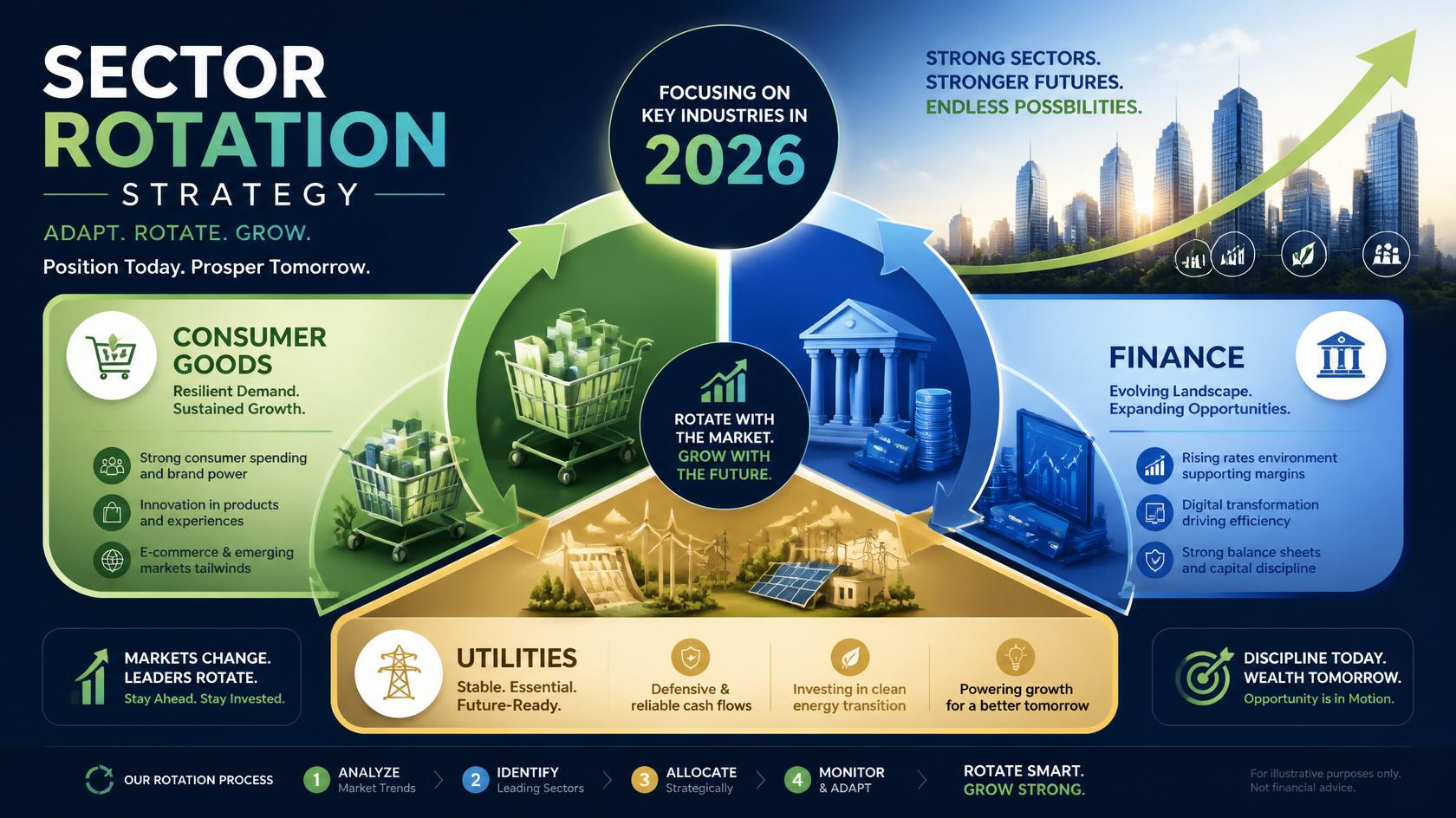
Financial markets are always moving. Interest rates change, inflation rises and falls, new technologies emerge, and global events can quickly shift investor sentiment. Because of this, the industries leading the market today may not be the same ones leading it six months from now.
One strategy investors use to adapt to these changes is sector rotation. Instead of keeping the same industries in a portfolio through every stage of the economic cycle, investors adjust their exposure based on where they believe the economy and markets are heading.
In 2026, this approach has become particularly relevant. Investors are dealing with ongoing inflation concerns, rapid artificial intelligence adoption, changing energy markets, evolving consumer habits, and geopolitical uncertainty.
Understanding how different sectors respond to these conditions can help investors identify potential opportunities while keeping portfolio risk under control.
This guide explains how sector rotation works, why it matters in 2026, and how investors can identify industries that may have stronger growth potential.
What Is Sector Rotation?
Sector rotation is an investment strategy that involves moving money between different sectors based on changing economic and market conditions.
Different industries tend to perform differently depending on the stage of the economic cycle. When growth is accelerating, cyclical industries may perform strongly. When the economy begins slowing, defensive sectors can become more attractive.
Rather than trying to predict which individual stock will become the next big winner, sector rotation looks at broader industry trends.
Investors typically consider factors such as economic growth, inflation, interest rates, monetary policy, consumer spending, and corporate earnings when deciding where to increase or reduce exposure.
Why Sector Rotation Matters in 2026
The investment landscape in 2026 is being shaped by several major structural changes.
Artificial intelligence is changing the way businesses operate, renewable energy investment remains significant, healthcare technology continues advancing, and manufacturers are adapting to changing supply chains.
At the same time, central banks are trying to balance inflation with economic growth. These shifting conditions can make it difficult for one sector to remain the market leader indefinitely.
Instead of relying heavily on a single industry, investors can use sector rotation to increase exposure to sectors showing improving fundamentals and momentum while reducing exposure to areas that appear to be weakening.
This flexible approach can help investors participate in new opportunities without completely ignoring risk.
Understanding the Economic Cycle
The economy generally moves through different stages, and each stage can favor different industries.
During an early recovery, financial companies, industrial manufacturers, transportation businesses, and consumer discretionary companies can benefit as economic activity begins to pick up.
As the economy moves into a stronger expansion phase, technology, communication services, and industrial companies may perform well as businesses increase spending and consumers become more active.
When economic growth starts slowing, defensive industries such as healthcare, utilities, and consumer staples can become more attractive because demand for their products and services tends to remain relatively stable.
During a recession, investors often place greater emphasis on stability and may favor defensive businesses over highly cyclical industries.
Understanding the broader economic environment can therefore help investors decide which sectors deserve more attention at a particular time.
The Strongest Growth Sectors in 2026
Artificial Intelligence
Artificial intelligence remains one of the biggest investment themes of 2026.
The growth of AI is benefiting more than just the largest technology companies. Businesses involved in AI infrastructure, cloud computing, semiconductors, cybersecurity, robotics, networking, and enterprise software are also attracting investor interest.
As AI becomes part of more business operations, the investment opportunity is spreading across a much wider ecosystem.
For investors, this means looking beyond headline AI companies and considering the businesses providing the hardware, software, infrastructure, and services needed to support the technology.
Semiconductor Industry
Semiconductors are essential to almost every major area of modern technology.
Demand is being supported by artificial intelligence servers, autonomous vehicles, smartphones, industrial automation, medical equipment, cloud computing, and other digital technologies.
Semiconductor stocks can be volatile, especially because the industry is highly cyclical. However, the continued expansion of digital technology is creating long-term demand for increasingly advanced chips.
For investors with a technology-focused portfolio, semiconductor companies can provide exposure to one of the core building blocks of the digital economy.
Healthcare Innovation
Healthcare remains another sector with attractive long-term opportunities.
An aging global population, biotechnology advances, personalized medicine, robotic surgery, and digital healthcare platforms are all contributing to continued industry development.
The sector includes pharmaceutical companies, biotechnology businesses, medical device manufacturers, and healthcare technology providers.
Healthcare can also provide some defensive characteristics because demand for medical products and services does not necessarily disappear when economic conditions become weaker.
Energy Transition
The global energy system continues to evolve.
Traditional oil and natural gas companies remain important because the world still relies heavily on conventional energy sources. At the same time, renewable energy is expanding through investment in solar, wind power, battery storage, hydrogen, and electrical infrastructure.
This creates opportunities across both traditional and emerging areas of the energy market.
For investors, diversification within the energy sector can provide exposure to the changing energy landscape without relying entirely on one technology or fuel source.
Financial Services
Financial companies are closely connected to interest rates and overall economic activity.
Banks, insurers, investment firms, payment companies, and asset managers can benefit when economic conditions are stable and demand for financial services remains healthy.
Technology is also changing the financial industry. Digital banking, electronic payments, financial technology platforms, and automated financial services are creating new opportunities beyond traditional banking.
As a result, the financial sector offers exposure to both traditional economic growth and ongoing digital transformation.
Industrial Manufacturing
Manufacturing is becoming increasingly sophisticated as companies adopt automation, robotics, artificial intelligence, and advanced logistics.
Government infrastructure spending, efforts to bring more production closer to domestic markets, and supply-chain diversification are supporting interest in industrial companies.
Businesses involved in engineering, construction equipment, aerospace, transportation infrastructure, and factory automation can all benefit from continued investment in modern manufacturing.
Cybersecurity
Cybersecurity has developed into one of the fastest-growing areas of the technology industry.
Companies and governments are spending more on security as cyber threats, ransomware, cloud migration, and data privacy concerns continue to grow.
Many cybersecurity companies also use subscription-based business models, which can provide recurring revenue.
As more organizations move their operations online, protecting digital infrastructure becomes increasingly important, making cybersecurity a sector worth watching in 2026.
Consumer Discretionary
Consumer discretionary companies tend to perform better when consumers feel confident about their financial situation.
Retailers, travel companies, restaurants, entertainment businesses, automobile manufacturers, and luxury brands can benefit when employment is strong and disposable income is rising.
However, these companies are also more exposed to economic slowdowns. Consumers may reduce spending on non-essential products and services when economic conditions become difficult.
This makes timing particularly important when considering consumer discretionary stocks as part of a sector rotation strategy.
Defensive Sectors Still Matter
Growth sectors often receive the most attention, but defensive industries can play an equally important role in a balanced portfolio.
Utilities provide essential services such as electricity, water, and natural gas, which means demand can remain relatively stable across different economic environments.
Consumer staples companies sell everyday products such as food, beverages, household goods, and personal-care items. These products tend to remain in demand even when consumers become more cautious.
Healthcare can also provide a combination of defensive characteristics and long-term growth opportunities.
Keeping some exposure to defensive sectors can help reduce portfolio volatility when markets become uncertain.
Indicators That Signal Sector Rotation
Successful sector rotation requires more than simply following headlines. Investors often monitor several economic and market indicators to understand where money may be moving.
Interest-rate changes can have a major impact on financial companies, real estate, and growth stocks.
Inflation trends can influence commodities, energy producers, and consumer businesses.
Corporate earnings provide insight into whether companies within a sector are improving or losing momentum.
Manufacturing activity can provide clues about economic expansion or contraction, while employment data can offer a broader view of economic strength.
Consumer confidence is another useful indicator because it can influence retail and discretionary spending.
Commodity prices can also affect industries such as mining, metals, agriculture, and energy.
Watching these indicators together can give investors a better understanding of potential changes in market leadership.
How Institutional Investors Rotate Capital
Large investment firms generally do not move their entire portfolios from one sector to another overnight.
Instead, they often increase exposure gradually as the outlook for a particular industry improves and reduce positions in areas where earnings or growth prospects are weakening.
Over time, these decisions can create noticeable trends in sector performance.
Individual investors can look for signs such as improving earnings, stronger relative stock performance, rising trading activity, and positive changes in analyst expectations.
Understanding how institutional money moves can provide useful clues about where market leadership may be developing.
Risk Management in Sector Rotation
Sector rotation can provide opportunities, but no strategy works in every market environment.
Economic conditions can change unexpectedly, and geopolitical events can quickly disrupt market expectations.
Diversification remains one of the simplest ways to manage this risk. Investors should be careful about concentrating their entire portfolio in a single industry simply because that sector is currently popular.
Regular portfolio reviews can also help investors determine whether their allocations still match their goals.
Position sizing is important as well. Even when an investor has strong confidence in a particular sector, limiting the size of individual positions can help prevent one wrong decision from causing excessive damage to the overall portfolio.
Common Mistakes Investors Make
One of the biggest mistakes with sector rotation is chasing a sector after it has already experienced a major rally.
When investors buy after a long period of strong performance, they may be entering just as momentum begins to weaken.
Another common mistake is reacting emotionally to short-term market movements. A temporary decline does not necessarily mean the long-term outlook for a sector has changed.
Valuation is also important. A promising industry can still produce disappointing investment returns if stocks become excessively expensive.
Successful sector rotation therefore requires more than identifying popular industries. Investors need to combine economic research, fundamental analysis, market trends, valuation, and disciplined risk management.
Building a Balanced Sector Rotation Portfolio
A balanced sector rotation strategy does not necessarily require finding one perfect sector.
Instead, investors can maintain exposure to several industries with different characteristics.
Growth-oriented areas such as artificial intelligence, semiconductors, cybersecurity, healthcare innovation, and industrial automation may provide long-term growth opportunities.
At the same time, defensive sectors such as healthcare, consumer staples, and utilities can provide greater stability when markets become more uncertain.
Regular rebalancing can help investors lock in gains from sectors that have performed strongly while maintaining diversification across the portfolio.
Outlook for Sector Rotation in 2026
Sector rotation is likely to remain an important strategy throughout 2026 as economic conditions continue to change.
Artificial intelligence, semiconductor manufacturing, cybersecurity, healthcare innovation, industrial modernization, and energy infrastructure all have factors supporting long-term demand.
At the same time, defensive sectors should not be overlooked because inflation concerns, economic uncertainty, and market volatility can quickly change investor preferences.
The key lesson is that market leadership does not remain fixed. A sector that performs strongly today may eventually lose momentum as economic conditions change.
For investors, understanding the business cycle, tracking important economic indicators, watching sector fundamentals, and maintaining diversified exposure can provide a more disciplined way to navigate changing markets.
Sector rotation is not about perfectly predicting the future. It is about recognizing changing conditions and adjusting a portfolio thoughtfully as opportunities and risks evolve.