
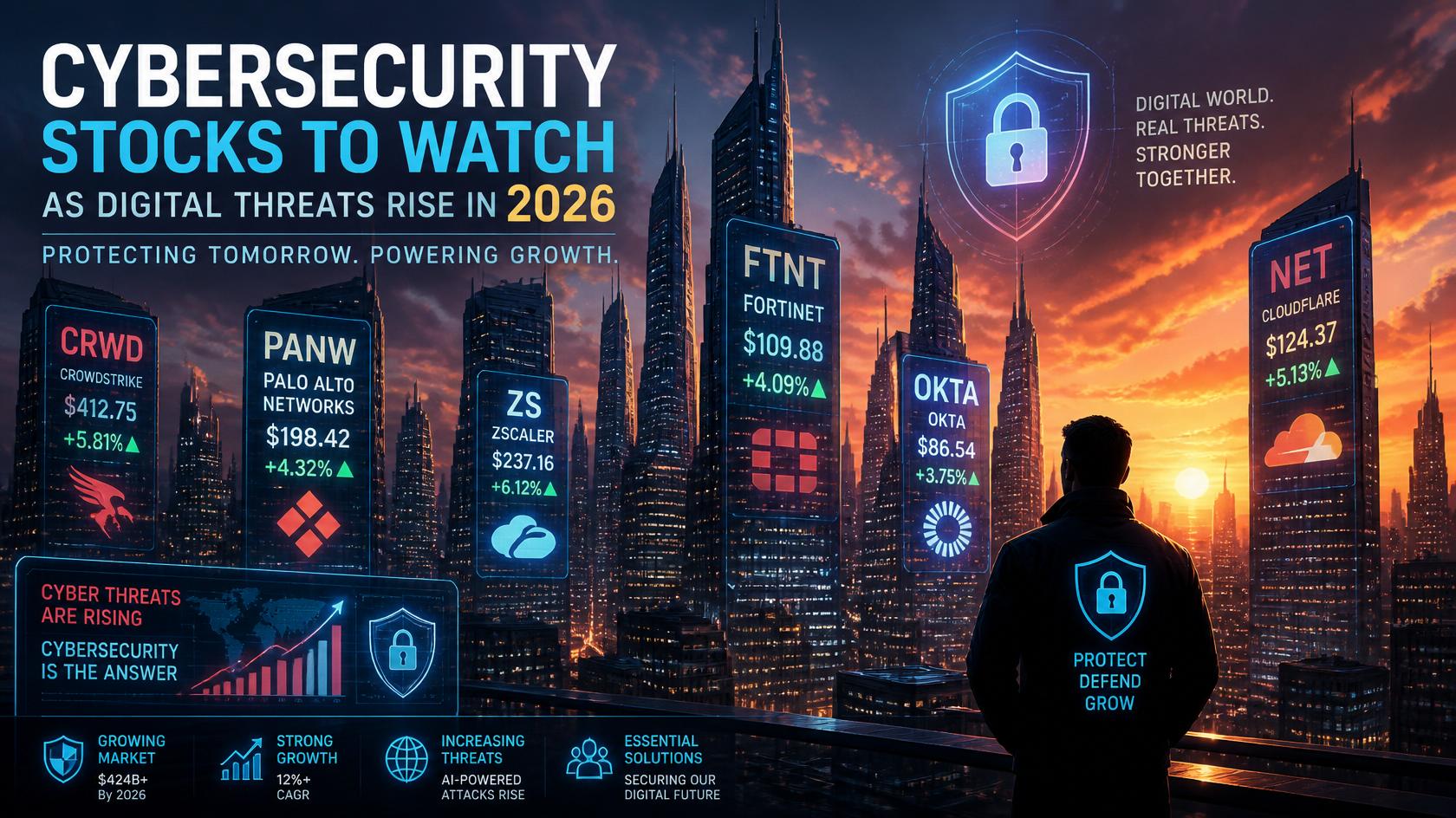
Cybersecurity has become one of the most important investment themes in the global stock market. As businesses, governments, hospitals, banks, and individuals move more of their activities online, the need to protect digital systems has never been greater.
At the same time, cyberattacks are becoming more sophisticated. Artificial intelligence, cloud computing, remote work, connected devices, and digital financial services are creating new opportunities for businesses, but they are also opening new doors for cybercriminals.
That is why cybersecurity spending continues to attract attention in 2026. Companies are investing in security software, cloud protection, identity management, threat detection, and other technologies designed to keep their digital operations safe.
For investors, cybersecurity is more than just another technology trend. It has become an essential part of the digital economy, creating potential long-term opportunities for companies that can keep up with an increasingly complex threat environment.
This article looks at why cybersecurity remains important in 2026, the trends driving industry growth, what to look for in cybersecurity companies, and several cybersecurity stocks worth watching.
Why Cybersecurity Is More Important Than Ever
Almost every modern organization relies on digital infrastructure.
Banks process transactions online, hospitals store patient information digitally, businesses use cloud applications, and AI systems depend on large amounts of connected data and computing resources.
As more valuable information moves through digital networks, the potential consequences of a security breach become greater.
Cybercriminals are also becoming more sophisticated. Ransomware, phishing, identity theft, supply-chain attacks, data breaches, and AI-assisted attacks are creating serious challenges for organizations of all sizes.
Because of this, cybersecurity is no longer something businesses can treat as an optional expense. Protecting sensitive information, maintaining customer confidence, and meeting regulatory requirements have all made security a core business priority.
For cybersecurity companies, that creates a market where demand can remain strong even as technology continues to change.
The Cybersecurity Market Outlook in 2026
Cybersecurity spending is expected to remain an important area of technology investment throughout 2026.
Several major trends are helping drive this demand.
Artificial intelligence is creating new types of cyber threats while also giving security companies better tools for detecting suspicious activity.
Cloud computing is replacing many traditional data-center environments, increasing the need for security solutions designed specifically for cloud platforms.
Remote and hybrid work have also made endpoint protection more important because employees may access company systems from many different locations and devices.
Governments are increasing their focus on protecting critical infrastructure, while financial institutions continue investing in fraud prevention and digital security.
Healthcare organizations face the challenge of protecting growing amounts of sensitive patient information, and manufacturers are investing more in industrial cybersecurity as factories become increasingly connected.
These trends give cybersecurity providers several potential sources of long-term demand.
What Makes a Strong Cybersecurity Stock?
Not every cybersecurity company has the same business model or growth potential. Investors often look for several characteristics when evaluating companies in this sector.
Recurring Revenue
Subscription-based security services can provide predictable revenue and help create more stable cash flow.
Cloud-Based Security
Cloud security platforms are becoming increasingly important as businesses move applications and data away from traditional on-premise systems.
Artificial Intelligence Capabilities
AI can help security companies identify unusual behavior, detect threats, and automate parts of the response process.
Customer Retention
Strong customer retention can be an important sign that a company’s security products are valuable and deeply integrated into its customers’ operations.
Continuous Innovation
Cyber threats change constantly. Companies need to keep improving their products and developing new solutions if they want to remain competitive.
Global Reach
Companies with customers across multiple regions can benefit from broader growth opportunities and may be less dependent on a single market.
Investors may also want to look at revenue growth, profitability, free cash flow, and the company’s ability to maintain its competitive position.
Cloud Security Remains a Major Growth Driver
The shift to cloud computing has changed the cybersecurity landscape.
Businesses increasingly use cloud platforms to store sensitive information, operate applications, and manage important parts of their operations.
This creates demand for security solutions covering identity management, cloud workloads, access controls, encryption, and compliance.
Cloud-native cybersecurity companies are particularly well positioned to benefit from this shift because their products are designed around modern cloud environments rather than older network architectures.
As cloud adoption continues, security is becoming an increasingly important part of the overall cloud investment story.
Artificial Intelligence Is Reshaping Cybersecurity
Artificial intelligence is having a major impact on both sides of cybersecurity.
Cybercriminals can use AI to automate phishing campaigns, develop more sophisticated attacks, and search for vulnerabilities more efficiently.
Security companies, however, can also use AI to fight back.
Machine learning systems can analyze huge amounts of information, identify unusual network behavior, detect potential threats, and help security teams respond more quickly.
This ability to automate parts of the security process can be especially valuable for organizations dealing with large numbers of alerts every day.
For investors, cybersecurity companies with useful and well-integrated AI capabilities may have an advantage as the threat environment becomes more complicated.
Cybersecurity Stocks Worth Watching in 2026
Several publicly traded cybersecurity companies have established strong positions in different parts of the security market.
Palo Alto Networks
Palo Alto Networks is one of the largest names in cybersecurity.
The company provides solutions covering network security, cloud security, endpoint protection, artificial intelligence, and threat intelligence.
Its broader platform strategy allows organizations to bring multiple security functions together rather than managing a large collection of unrelated products.
Continued enterprise demand and the company’s broad product portfolio make Palo Alto Networks an important company for investors following the cybersecurity industry.
CrowdStrike
CrowdStrike has become a major player in cloud-native endpoint security.
Its Falcon platform uses AI and other technologies to help organizations detect, prevent, and respond to threats across computers, servers, and cloud environments.
The company’s subscription-based model provides recurring revenue, while its expansion into areas such as identity protection, cloud workload security, and managed detection services gives it additional opportunities to grow.
Its focus on cloud-based security has helped make CrowdStrike one of the most closely watched companies in the sector.
Fortinet
Fortinet focuses on network security, firewalls, secure networking, and integrated cybersecurity solutions.
Its customers range from smaller businesses to large multinational organizations.
The company combines hardware, software, and cloud-based services, giving it exposure to several parts of the security market.
As businesses continue strengthening their networks and expanding digital operations, Fortinet remains a company worth watching.
Zscaler
Zscaler specializes in cloud security and secure internet access through its zero-trust approach.
As companies move away from traditional office-based networks, employees increasingly need secure access to applications from different locations and devices.
Zscaler’s platform is designed to provide secure access without relying heavily on older network infrastructure.
Continued cloud adoption and the broader move toward zero-trust security could support long-term demand for its services.
SentinelOne
SentinelOne has attracted attention for its AI-powered cybersecurity platform.
The company provides endpoint protection, threat detection, cloud security, and identity protection using automated security technologies.
Its emphasis on artificial intelligence is particularly relevant as organizations look for faster ways to identify and respond to increasingly sophisticated attacks.
The company’s future growth will depend in part on how successfully it continues expanding its platform and competing in a crowded cybersecurity market.
CyberArk
CyberArk specializes in identity security and privileged access management.
Identity protection has become one of the most important areas of cybersecurity because stolen or compromised credentials can give attackers access to sensitive systems.
As businesses move toward zero-trust security models, controlling who can access critical applications and data becomes increasingly important.
This makes identity security an important area of the broader cybersecurity market and gives CyberArk a distinct position within the industry.
Emerging Cybersecurity Trends Investors Should Monitor
Several cybersecurity trends could influence the industry throughout 2026 and beyond.
Zero-Trust Security
Zero-trust security is becoming more common as organizations move away from the assumption that users inside a corporate network can automatically be trusted.
Instead, access is continuously evaluated based on factors such as identity, device, and activity.
Identity Management
As businesses strengthen authentication and access controls, identity management is becoming a central part of cybersecurity strategies.
Cloud-Native Security
More organizations are moving away from traditional on-premise systems, creating additional demand for security platforms built specifically for cloud environments.
Managed Security Services
Many businesses do not have enough cybersecurity specialists to handle every security task internally. Managed security providers can fill that gap by monitoring systems and responding to threats on behalf of customers.
AI-Powered Security
Security automation can help organizations analyze threats and respond faster, particularly when security teams are dealing with huge numbers of alerts.
Internet of Things Security
Connected devices are becoming common in homes, offices, factories, and other environments. Protecting these devices is becoming increasingly important as the number of connected endpoints grows.
Post-Quantum Security
Research into quantum computing is also encouraging cybersecurity companies to explore new encryption technologies that could help protect digital systems against future threats.
Companies positioned in these growing areas could benefit from continued investment in cybersecurity.
Risks Facing Cybersecurity Investors
The cybersecurity industry offers strong growth potential, but investors should also understand the risks.
Many technology companies trade at relatively high valuations, which can make their stocks more sensitive to interest rates and broader market volatility.
Competition is another major issue. Large technology companies, established security providers, and smaller startups are all developing new security products.
The industry also changes quickly. Cybersecurity companies need to spend heavily on research and development to keep pace with new threats and changing customer requirements.
Economic slowdowns can also affect technology budgets, potentially delaying some security purchases or reducing short-term growth.
For these reasons, investors should evaluate individual companies carefully rather than assuming that overall cybersecurity growth will automatically translate into strong stock performance.
Building a Cybersecurity Investment Strategy
Investors who want exposure to cybersecurity may want to avoid putting all their money into a single company or security segment.
The industry includes companies focused on cloud security, endpoint protection, identity management, network security, threat detection, and artificial intelligence.
Spreading exposure across several of these areas can provide broader participation in the industry’s growth while reducing dependence on the performance of one company.
Before making an investment, investors should consider factors such as revenue growth, free cash flow, profit margins, recurring subscription revenue, customer retention, valuation, and research and development spending.
A long-term strategy based on company fundamentals can often be more effective than trying to predict short-term movements in cybersecurity stocks.
Why Cybersecurity Will Remain a Long-Term Investment Theme
Digital transformation is still expanding across almost every major industry.
Artificial intelligence, cloud computing, connected vehicles, smart cities, financial technology, healthcare systems, autonomous technologies, and industrial automation all depend on secure digital infrastructure.
As organizations become more connected, cybersecurity becomes increasingly difficult to separate from normal business operations.
Companies need to protect their data, customers, employees, applications, and infrastructure regardless of the economic environment.
That makes cybersecurity different from many temporary technology trends. Security is becoming a permanent requirement of the digital economy.
For investors, this structural demand could create long-term opportunities for companies developing technologies that help businesses and governments protect their increasingly connected digital environments.