
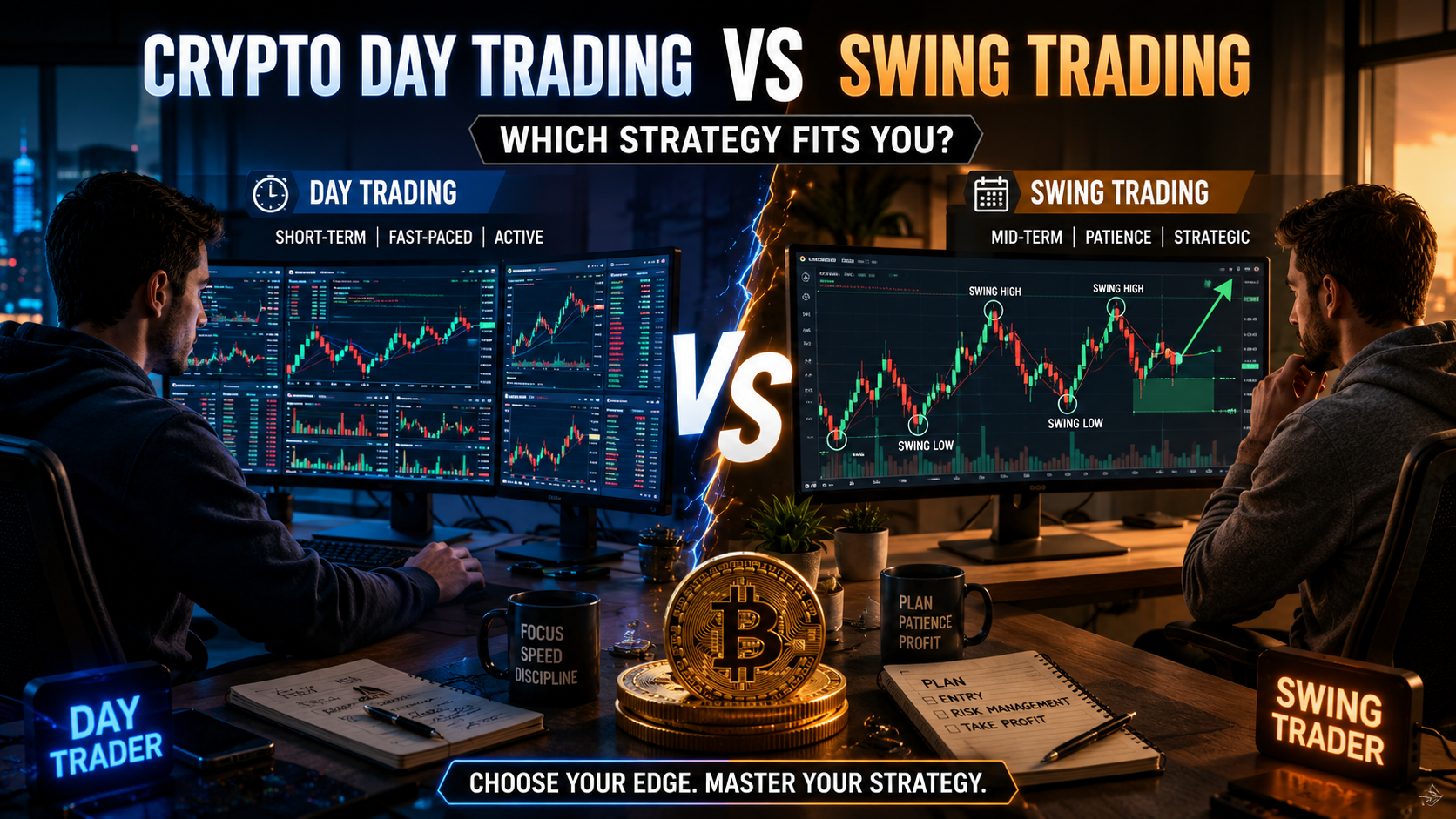
With thousands of cryptocurrencies available and the market operating 24/7, traders have plenty of opportunities to take advantage of price movements. Two of the most popular approaches are day trading and swing trading.
Both strategies aim to profit from changes in cryptocurrency prices, but they require very different levels of time, patience, risk tolerance, and commitment. Day traders look for quick opportunities and usually close their positions within the same day, while swing traders hold positions for several days or weeks, hoping to benefit from larger market moves.
Choosing between the two isn’t simply about deciding which strategy can make more money. The better option depends on your experience, schedule, financial goals, risk tolerance, and personality. Some people enjoy the fast pace of short-term trading, while others prefer a slower approach that gives trades more time to develop.
This guide breaks down the key differences between crypto day trading and swing trading, along with their advantages, disadvantages, and tips for choosing the approach that fits you best.
What Is Crypto Day Trading?
Crypto day trading is a short-term strategy where traders open and close positions within the same day. The goal is to capture relatively small price movements instead of holding a position for several days.
Day traders spend considerable time watching charts and monitoring market activity. They may use technical indicators, candlestick patterns, trading volume, support and resistance, and momentum signals to identify potential entries and exits.
Because cryptocurrency markets never close, traders can choose the periods when liquidity and volatility are most suitable for their strategy.
Day trading can be exciting, but it also demands quick decisions and strong discipline. Successful traders generally follow a specific plan instead of reacting emotionally whenever prices suddenly move.
What Is Crypto Swing Trading?
Swing trading takes a more relaxed approach. Instead of opening and closing positions within a few hours, swing traders may hold their trades for several days or even weeks.
The objective is to capture larger price movements that develop over time. Traders may look for breakouts, trend reversals, support and resistance zones, and established market trends before entering a position.
Swing traders often combine technical analysis with fundamental factors such as blockchain developments, adoption, market sentiment, and broader economic conditions.
One of the biggest advantages is flexibility. Since swing traders don’t need to watch the market every minute, this approach can be easier to manage alongside a job, business, or other daily responsibilities.
The Main Difference Between Day Trading and Swing Trading
The clearest difference is how long positions are held.
Day traders typically close their positions within the same day and may execute several trades during a single session.
Swing traders keep positions open for longer, giving their trades more time to develop and potentially capture larger price movements.
This difference affects almost everything else, including the amount of screen time required, trading frequency, transaction costs, emotional pressure, and risk management.
Time Commitment
Your daily schedule should be one of the first things you consider.
Day trading requires significant attention. Traders may spend several hours studying charts, monitoring price movements, searching for opportunities, and managing open positions. Because prices can move quickly, missing an important market move can affect the outcome of a trade.
Swing trading is less demanding in terms of screen time. After identifying a suitable setup and establishing entry and exit levels, traders can monitor the position periodically instead of watching every price movement.
For people with full-time jobs or limited availability, swing trading may be easier to fit into a normal routine.
Profit Potential
Both strategies can offer opportunities for profit, but they approach the market differently.
Day traders generally look for smaller moves and may execute multiple trades to build their overall returns. A single trade might generate a relatively small gain, but several successful trades can add up over time.
Swing traders usually target larger price movements that take days or weeks to develop. Because they hold positions longer, one successful trade can potentially produce a larger percentage gain than an individual day trade.
However, there is no guarantee that either strategy will be profitable. Results depend on market conditions, strategy quality, execution, experience, and risk management—not simply on how frequently you trade.
Risk Comparison
Both strategies involve risk, but the type of risk can be different.
Day traders face frequent decisions and rapid price changes. Taking many trades can increase the chance of mistakes, particularly when traders become frustrated or overconfident.
Swing traders face a different challenge because their positions remain open for longer periods. Unexpected news, major market events, or sharp price movements can occur while they are holding a position.
Weekend and overnight exposure can also create additional uncertainty.
Regardless of the strategy, controlling position size and defining acceptable losses before entering a trade is essential.
Technical Analysis Requirements
Technical analysis is important for both day and swing traders, although they often use it differently.
Day traders tend to focus on shorter time frames and may closely monitor momentum indicators, volume, moving averages, candlestick formations, and short-term support and resistance.
Swing traders generally look at longer time frames to identify broader trends and important price zones. They may combine these charts with fundamental research and market sentiment.
Using multiple time frames can also help traders understand whether a short-term opportunity is moving in line with the larger market trend.
Emotional Discipline
Trading psychology can have a major impact on results.
Day trading can be particularly demanding because decisions often need to be made quickly. Fear, excitement, frustration, and overconfidence can easily influence a trader who is constantly entering and exiting positions.
Swing trading involves fewer decisions, but patience becomes especially important. A trader may need to wait several days for a setup to reach its target while dealing with temporary price fluctuations along the way.
In both cases, emotional control is essential. A good strategy can quickly lose its value if traders repeatedly abandon their rules because of fear or excitement.
Capital Requirements
There is no universal amount of money required to become a day or swing trader. The appropriate capital depends on your goals, risk tolerance, and strategy.
Day traders may need enough capital to make their smaller price targets meaningful, while frequent transactions can also result in higher cumulative trading costs.
Swing traders generally make fewer trades, which can reduce transaction expenses. Their capital remains invested for longer periods, allowing them to focus on larger market movements.
Regardless of account size, risking too much money on a single trade can create unnecessary financial pressure.
Market Conditions Matter
Different market environments can create different opportunities.
Highly volatile markets may offer more short-term setups for experienced day traders because prices can move quickly throughout the day.
Swing traders may benefit from sustained trends where prices continue moving in one direction for several days or weeks.
However, neither strategy works perfectly in every market. Understanding whether the market is trending, ranging, or experiencing unusually high volatility can help traders decide which approach makes more sense.
Advantages of Crypto Day Trading
One major advantage of day trading is the opportunity to participate in frequent short-term market movements.
Traders who close their positions within the day can also avoid carrying the same overnight exposure associated with swing trading.
Day trading provides quick feedback as well. Traders can review their performance at the end of each session and identify mistakes or areas for improvement.
For people who enjoy active decision-making and have enough time to monitor the market, this style can be appealing.
However, the fast pace can also increase stress and encourage overtrading if proper discipline is lacking.
Advantages of Crypto Swing Trading
Swing trading offers a more flexible approach and generally requires less time in front of a screen.
Traders can focus on larger market trends instead of reacting to every small price movement. The lower trading frequency can also mean fewer transaction costs and fewer opportunities for impulsive decisions.
Another advantage is having more time to research a potential trade before committing capital.
For traders who prefer patience and a less intense routine, swing trading can be a more comfortable option.
Common Mistakes to Avoid
Beginners often make the mistake of choosing a strategy based solely on its potential returns.
Some new traders jump into day trading without understanding technical analysis, leading to excessive trading and emotional decisions.
Others enter swing trades without defining where they will exit if the market moves against them.
Common mistakes include risking too much capital, chasing sudden price increases, ignoring stop-loss levels, trading without a clear plan, and changing strategies after a few unsuccessful trades.
Trying to predict every market movement is unrealistic. Building a consistent process is far more useful.
Which Strategy Is Better for Beginners?
For many beginners, swing trading can provide a more manageable introduction to cryptocurrency markets.
The slower pace gives new traders more time to study charts, understand market behavior, research cryptocurrencies, and develop risk management skills.
Day trading can be more demanding because decisions often need to be made quickly. It may become more appropriate after a trader has gained experience and developed confidence with technical analysis and trade execution.
That doesn’t mean swing trading is automatically safer or more profitable. It simply requires a different pace and skill set.
How to Choose the Right Strategy
Start by looking honestly at your lifestyle and personality.
If you enjoy active trading, have several hours available each day, can handle rapid price movements, and prefer making frequent decisions, day trading may be a better fit.
If you have limited time, prefer a slower approach, and are comfortable holding positions for several days or weeks, swing trading may suit you better.
Your risk tolerance is equally important. Don’t choose a strategy simply because someone claims it can produce high returns.
Test Before Committing Real Money
You don’t have to choose a strategy immediately.
Paper trading or using a simulated account can help you experience both approaches without putting significant capital at risk. You can also start with very small positions while learning how each strategy affects your decision-making and emotions.
Keep track of your trades and review the results regularly. Pay attention not only to profits and losses but also to how comfortable you were following your trading rules.
Over time, this experience can make it easier to determine which style fits your goals and personality.