
Gold and silver have been valuable for thousands of years, and both remain important markets for modern investors and traders. During periods of inflation, economic uncertainty, or financial market stress, investors often turn to precious metals as a way to diversify their portfolios.
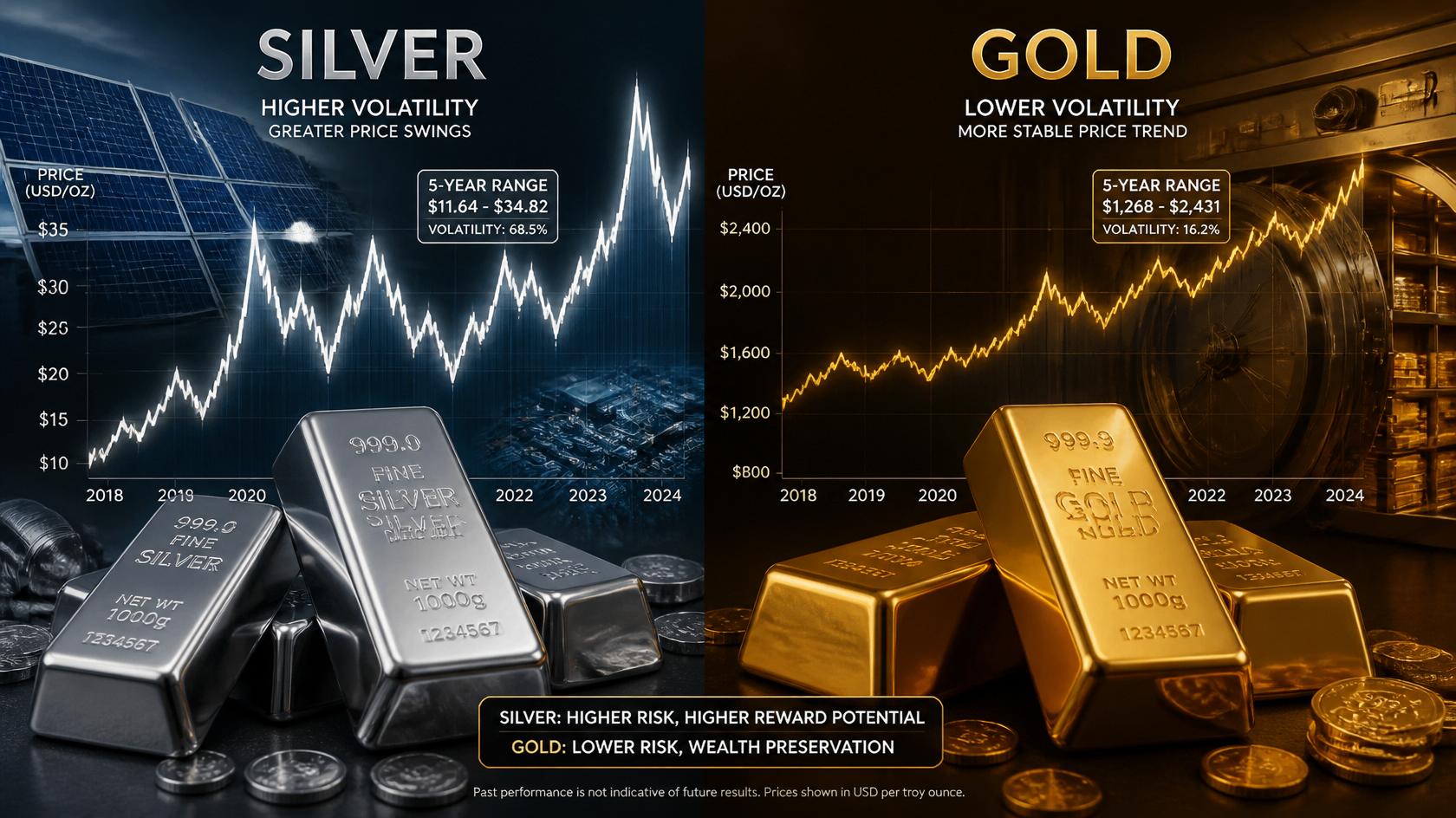
Although gold and silver frequently move in the same general direction, their price behavior can be very different. Silver tends to experience much larger and faster price swings than gold.
For traders, that volatility can create attractive opportunities. At the same time, it can increase the risk of significant losses when markets suddenly reverse.
So why does silver move so much faster than gold?
The answer comes down to several factors, including silver’s industrial demand, smaller market size, speculative activity, supply structure, and its relationship with the broader economy.
The Connection Between Gold and Silver
Gold and silver have several things in common.
Both are precious metals, both trade globally, and both are often viewed as stores of value. Investors may buy them when they are concerned about inflation, currency weakness, geopolitical uncertainty, or financial instability.
However, silver has an important characteristic that separates it from gold.
Silver is both a precious metal and an industrial commodity.
Gold is primarily used for investment, jewelry, central-bank reserves, and specialized industrial applications. Silver, meanwhile, is heavily used in manufacturing and technology.
That means silver responds not only to investor sentiment but also to changes in global industrial activity.
Industrial Demand Makes Silver More Sensitive
Industrial consumption is one of the biggest reasons silver can be more volatile than gold.
Silver is used in electronics, solar panels, electrical components, medical equipment, electric vehicles, semiconductors, telecommunications, and other industrial applications.
When the global economy is expanding, factories increase production and demand for industrial materials can rise. This can provide additional support for silver prices.
But the opposite can happen during an economic slowdown.
If manufacturers reduce production, demand for industrial silver may weaken. Investors may also become more cautious at the same time.
This combination can produce much larger price movements than those typically seen in gold.
The continued growth of renewable energy, electronics, electrification, and advanced technology could make industrial demand increasingly important for silver.
Silver Has a Smaller Market
Another major factor is market size.
The global gold market is considerably larger and generally more liquid than the silver market. Gold also has substantial participation from central banks, institutional investors, governments, and long-term investors.
Silver has a smaller overall market.
Because of this, changes in buying or selling pressure can have a greater impact on price. A relatively large institutional order or sudden increase in retail demand can move silver significantly.
The smaller market structure is one reason silver can experience dramatic rallies and equally sharp corrections.
Speculative Trading Adds More Volatility
Silver is also popular among traders looking for larger short-term price movements.
When precious metals enter a strong bullish trend, speculative traders may move into silver because it can generate larger percentage gains than gold.
This can accelerate upward momentum.
However, the same behavior works in reverse.
When sentiment turns negative, traders may exit silver positions quickly. This can create a wave of selling that pushes prices lower in a relatively short period.
Gold tends to attract more long-term institutional and reserve-related demand, which can help make its price behavior comparatively steadier.
Silver Often Makes Larger Percentage Moves
The difference becomes especially obvious when comparing percentage changes.
Gold may move several percentage points during a major market trend, while silver can sometimes move substantially more over the same period.
For example, if gold rises 3%, silver might gain significantly more during a strong bullish phase.
But there is an important downside.
If the market reverses, silver can also fall much faster.
This makes silver attractive to active traders but potentially uncomfortable for investors who have a low tolerance for volatility.
Silver’s Supply Structure Is Different
Silver production has another unusual characteristic.
A significant amount of silver is produced as a byproduct of mining other metals, including copper, lead, and zinc.
This means that silver supply does not always respond directly to changes in silver prices.
A silver price increase does not necessarily cause mining companies to dramatically increase production because much of the metal is recovered from mines whose primary focus is another commodity.
This can make supply less flexible.
If demand suddenly increases while production remains relatively stable, prices may react sharply.
Mining disruptions, labor problems, energy shortages, or geopolitical events can further tighten supply and increase volatility.
Why Gold Is Generally More Stable
Gold has a much stronger identity as a monetary and financial asset.
Central banks hold gold as part of their reserves, while institutional investors often use it as a portfolio diversifier and potential hedge during periods of uncertainty.
Gold’s enormous market size and deep liquidity also help absorb large transactions.
It still experiences significant price movements, but its broader financial role can make its behavior less sensitive to short-term changes in industrial activity.
Silver does not have the same level of central-bank demand, which contributes to its more volatile market structure.
Economic Growth Matters More for Silver
Silver is particularly sensitive to global economic conditions.
When manufacturing, construction, technology production, and industrial investment increase, demand for silver can benefit.
Gold is less dependent on this type of economic growth. Its price is more strongly influenced by factors such as interest rates, inflation expectations, currency movements, monetary policy, and investor confidence.
Silver is influenced by many of these same financial factors, but it also reacts to changes in industrial demand.
That gives silver an additional source of price momentum.
Inflation Can Affect Both Metals
Gold and silver are commonly considered potential inflation hedges, but their reactions can differ.
When inflation expectations rise, investors may increase exposure to precious metals. Silver can benefit from this investment demand while simultaneously receiving support from industrial consumption.
This combination can create powerful price rallies.
However, if inflation falls and interest rates rise, investment demand for precious metals may weaken. If economic growth also slows, silver can face additional pressure from declining industrial demand.
Gold may hold up better in such conditions because of its stronger defensive role.
The Gold-to-Silver Ratio
The gold-to-silver ratio is another important concept for precious-metals traders.
It shows how many ounces of silver are needed to purchase one ounce of gold.
Traders and investors watch the ratio because significant changes can highlight periods when one metal is performing very differently from the other.
For example, if the ratio becomes unusually high, some traders may view silver as relatively cheap compared with gold and look for opportunities if they expect the relationship to move back toward historical ranges.
However, the ratio should not be treated as a guaranteed trading signal. It can remain elevated or depressed for extended periods because market conditions change over time.
Trading Opportunities in Silver
Silver’s volatility makes it popular among different types of traders.
Day traders can potentially take advantage of larger intraday movements, while swing traders may look for multi-day or multi-week trends.
Long-term investors can also use silver as part of a diversified portfolio, particularly if they want exposure to both precious metals and industrial growth.
Technical analysis can help traders identify potential support, resistance, breakouts, pullbacks, and momentum changes.
But volatility must always be respected.
A larger potential move means a larger potential loss when the trade moves in the wrong direction.
Managing the Risks of Silver Trading
Silver can produce impressive gains, but it can also punish traders who take excessive risks.
Large positions, excessive leverage, and emotional decision-making can turn normal market fluctuations into major losses.
Risk management should therefore be part of every silver trading strategy.
Traders can consider using sensible position sizes, predefined stop-loss levels, realistic profit targets, and clear entry and exit rules.
It is also important to monitor economic data, industrial trends, interest-rate expectations, and broader market sentiment.
Silver’s Long-Term Outlook
Silver has several potential long-term demand drivers.
The expansion of solar energy, electric vehicles, electronics, artificial intelligence infrastructure, semiconductor manufacturing, and advanced industrial technology could support continued industrial consumption.
At the same time, silver retains its traditional role as a precious metal and may continue attracting investment demand during periods of inflation or economic uncertainty.
This combination gives silver a unique position in the commodities market.
However, strong long-term demand does not guarantee continuously rising prices. New technologies, changes in manufacturing processes, recycling, economic downturns, and shifts in investor sentiment can all affect the market.
Final Thoughts
Silver tends to move faster than gold because it sits at the intersection of two worlds.
It is both a precious metal and an important industrial commodity. Its smaller market, strong industrial exposure, speculative interest, and relatively inflexible supply can amplify price movements.
Gold generally provides a more defensive and liquid precious-metal exposure, while silver offers greater sensitivity to economic growth and potentially larger price swings.
For traders, that volatility can create significant opportunities, but it also demands disciplined risk management.
Understanding the relationship between gold and silver, monitoring industrial demand, and paying attention to broader economic conditions can help traders make more informed decisions in one of the most dynamic areas of the commodities market.