
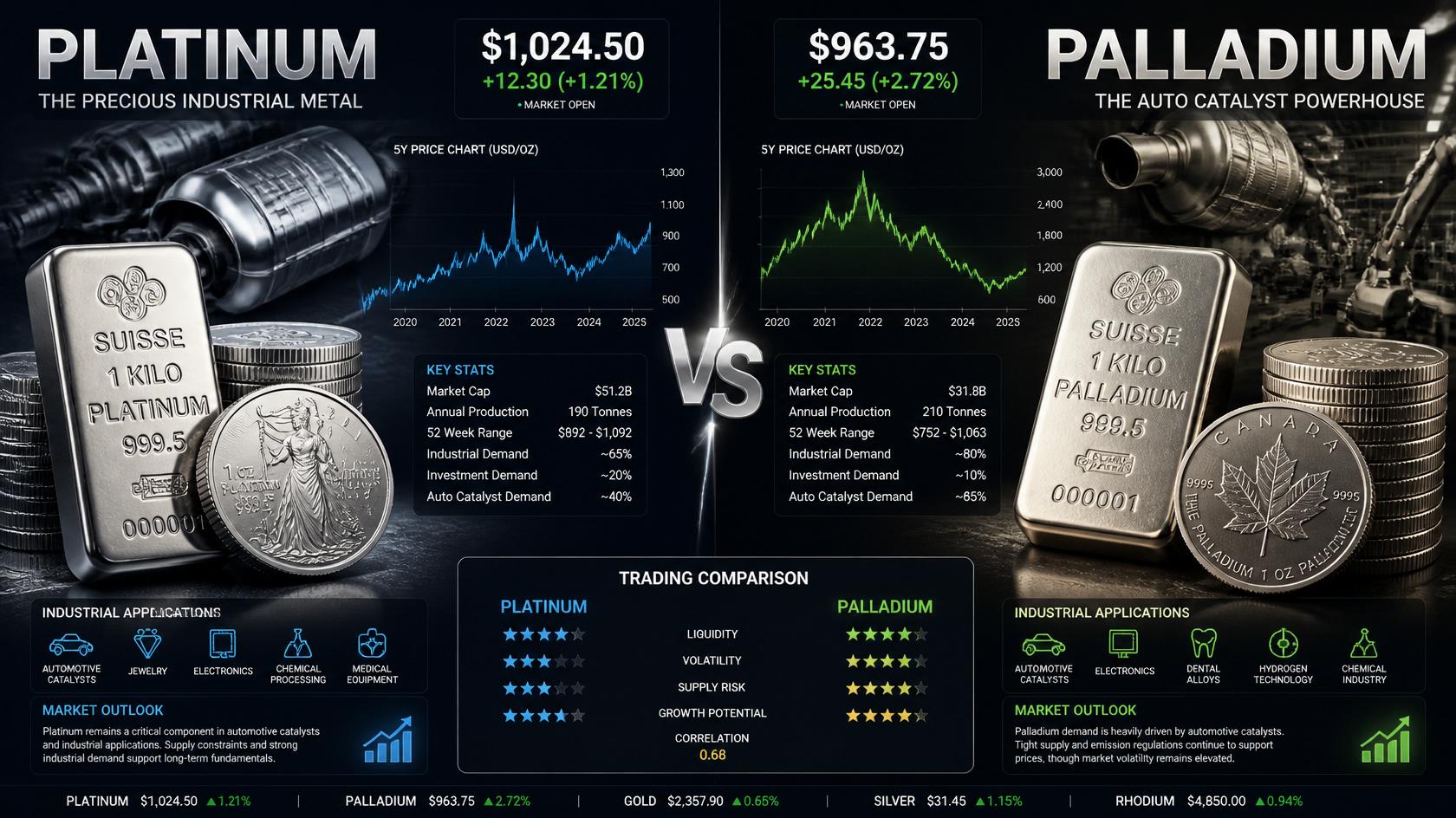
Platinum and palladium are two of the most interesting metals in the commodities market. Unlike gold, which is primarily known as a safe-haven asset, both platinum and palladium have strong industrial connections. Their prices can be influenced by automobile production, manufacturing activity, environmental regulations, technological developments, supply disruptions, and broader economic conditions.
For traders, understanding what makes these two metals different is important. Although platinum and palladium share several characteristics, their supply chains and demand profiles are quite different, which can lead to major differences in price performance.
This guide looks at the key differences between platinum and palladium, the factors that influence their prices, and what traders should consider when evaluating these markets.
What Are Platinum and Palladium?
Platinum and palladium belong to the platinum group metals and are known for their durability, corrosion resistance, and ability to withstand extremely high temperatures.
These characteristics make them useful in a wide range of applications, including automotive manufacturing, electronics, medical equipment, chemical processing, and jewelry.
Platinum has traditionally occupied both an industrial and luxury role. It is used in jewelry, automotive catalytic converters, industrial equipment, investment products, and emerging hydrogen technologies.
Palladium is more heavily tied to industrial demand, particularly the automotive sector. It has historically been widely used in catalytic converters for gasoline-powered vehicles because of its ability to help reduce harmful emissions.
While the two metals sometimes compete for similar applications, their overall demand structures are different. This can cause their prices to move in very different directions.
Market Size and Liquidity
Neither platinum nor palladium has a market as large or liquid as gold.
Their smaller markets mean that changes in buying or selling pressure can have a noticeable effect on prices. This can create attractive opportunities for traders, but it also increases risk.
Palladium has historically experienced particularly sharp price movements because production is limited and demand has been heavily concentrated in the automotive sector.
Platinum can also be volatile, although its broader range of industrial applications may sometimes provide a more balanced demand base.
For traders, lower liquidity means that sudden price moves and wider spreads can occur, particularly during major market events.
Industrial Demand Is a Major Price Driver
Industrial demand plays a central role in determining the value of both metals.
Palladium has historically relied heavily on the automobile industry. Gasoline-powered vehicles use palladium in catalytic converters to help meet emissions standards.
When global vehicle production increases, demand for palladium can rise. On the other hand, weaker automobile production or changes in vehicle technology can put pressure on prices.
Platinum is also used in automotive emissions-control systems, but its applications extend much further.
It is used in jewelry, petroleum refining, industrial catalysts, medical equipment, electronics, and hydrogen-related technologies.
This broader range of applications gives platinum a more diversified demand base than palladium.
Supply Constraints Matter
Both metals face supply challenges because global production is relatively limited.
A large portion of platinum production comes from South Africa, while palladium supply has historically been concentrated in Russia and South Africa.
This geographic concentration creates potential risks.
Mining disruptions, labor disputes, electricity shortages, political developments, environmental regulations, and infrastructure problems can all affect production.
Because opening a new mine can take many years, supply cannot quickly respond when demand suddenly increases.
Even a relatively small disruption can therefore have a significant effect on prices.
Why Palladium Can Be So Volatile
Palladium has historically shown greater price volatility than platinum.
Periods of strong automotive demand combined with limited supply have previously pushed palladium prices dramatically higher.
However, the same concentration that can create powerful rallies can also increase downside risk.
If automobile production falls, emission technologies change, or manufacturers replace palladium with other materials, demand can weaken quickly.
This can lead to sharp price corrections.
Platinum can also experience major price movements, but its broader industrial applications may provide somewhat more diversified support over longer periods.
Economic Growth and Metal Prices
Global economic conditions have a major influence on both metals.
During periods of strong economic growth, automobile production, manufacturing, construction, and industrial activity generally increase. This can support demand for platinum and palladium.
During recessions or major economic slowdowns, industrial production can decline, reducing demand and putting pressure on prices.
This is an important difference from gold.
Gold often attracts investors when economic conditions deteriorate because it is viewed as a defensive asset. Platinum and palladium, by contrast, are more closely connected to industrial activity.
Their performance can therefore depend heavily on whether businesses and consumers are increasing or reducing economic activity.
Environmental Regulations Are Important
Government emissions regulations have played a major role in the demand for platinum and palladium.
As governments introduce stricter limits on vehicle emissions, automakers have needed increasingly sophisticated catalytic converter systems.
That can increase the amount and importance of precious metals used in emission-control technologies.
Any major change in environmental regulations can therefore influence demand.
Traders should pay attention to policy developments in major automobile markets because regulatory changes can affect future metal consumption.
How Electric Vehicles Could Change the Market
The growth of electric vehicles is one of the biggest long-term questions facing platinum and palladium.
Battery-electric vehicles do not use traditional catalytic converters, which means they do not require platinum or palladium for the same emissions-control purpose.
If EV adoption continues to increase, demand for these metals from conventional vehicles could gradually decline.
However, the impact may not be identical for both metals.
Platinum has potential exposure to hydrogen fuel-cell technology, where platinum plays an important role in fuel-cell systems.
Palladium has fewer major alternative applications capable of replacing its historical automotive demand at the same scale.
This makes technological change particularly important for palladium investors.
Trading Platinum
Platinum can appeal to traders who want exposure to both precious metals and industrial commodities.
Its price can respond to changes in manufacturing activity, automotive demand, jewelry consumption, mine supply, investor sentiment, and developments in hydrogen technology.
Some investors also monitor the price relationship between platinum and gold. When platinum becomes unusually cheap relative to gold, traders may view the difference as a potential opportunity, although price relationships can remain stretched for long periods.
The expanding interest in hydrogen technology also gives platinum an additional long-term investment narrative.
Trading Palladium
Palladium can be attractive to traders who prefer markets with strong momentum and significant price movements.
Automotive demand, supply disruptions, emissions regulations, and changes in production can all create rapid price swings.
However, the same volatility that creates opportunities can also produce substantial losses.
Palladium’s heavy dependence on the automobile industry means traders need to monitor global vehicle production, gasoline vehicle demand, emissions regulations, and technological changes closely.
Strong risk controls are especially important when trading such a volatile market.
Platinum vs. Palladium: Which Is Better?
The better choice depends on the trader’s objectives.
Platinum may appeal to investors who want broader industrial exposure and are interested in long-term themes such as hydrogen technology, clean energy, and diversified industrial demand.
Palladium may be more attractive to active traders who are comfortable with higher volatility and want exposure to automotive-related price movements.
There is also another approach: trading the relationship between the two metals.
Because platinum and palladium can sometimes move in opposite directions or experience significant changes in their relative prices, some traders monitor the platinum-to-palladium ratio for potential opportunities.
Managing Risk
Both markets require disciplined risk management.
Platinum and palladium can experience sudden price movements following unexpected geopolitical events, mining disruptions, changes in automobile production, economic data releases, or government policy decisions.
Traders should avoid taking oversized positions simply because a metal appears undervalued or has recently experienced a strong rally.
Position sizing, stop-loss planning, diversification, and an understanding of market liquidity can help reduce unnecessary risk.
It is also important to recognize that no market setup is guaranteed to work.
What Does the Future Hold?
The future of platinum and palladium will depend heavily on technological development, automobile demand, clean-energy investment, global economic growth, and the evolution of supply chains.
Platinum has several potential long-term growth drivers. Its industrial applications, jewelry demand, and potential role in hydrogen technologies could provide multiple sources of future demand.
Palladium is likely to remain important for conventional gasoline-powered vehicles, but its long-term outlook faces greater uncertainty as electric vehicle adoption continues to expand and automakers explore alternative technologies.
Neither metal is automatically a better investment.
For traders, the key is understanding what drives each market and recognizing that their opportunities can change as economic and technological conditions evolve.
Final Thoughts
Platinum and palladium offer traders exposure to two relatively rare metals with strong industrial foundations.
Platinum provides a more diversified demand story and potential exposure to emerging hydrogen technologies, while palladium has historically been more closely tied to the automobile industry and can experience much larger price swings.
Both markets can offer attractive opportunities, but they also carry significant risks.
The most effective approach is to combine fundamental research with technical analysis, monitor global economic and industry developments, and maintain disciplined risk management.
As the global automotive and energy industries continue to change, platinum and palladium will remain important markets to watch in the evolving commodities landscape.