
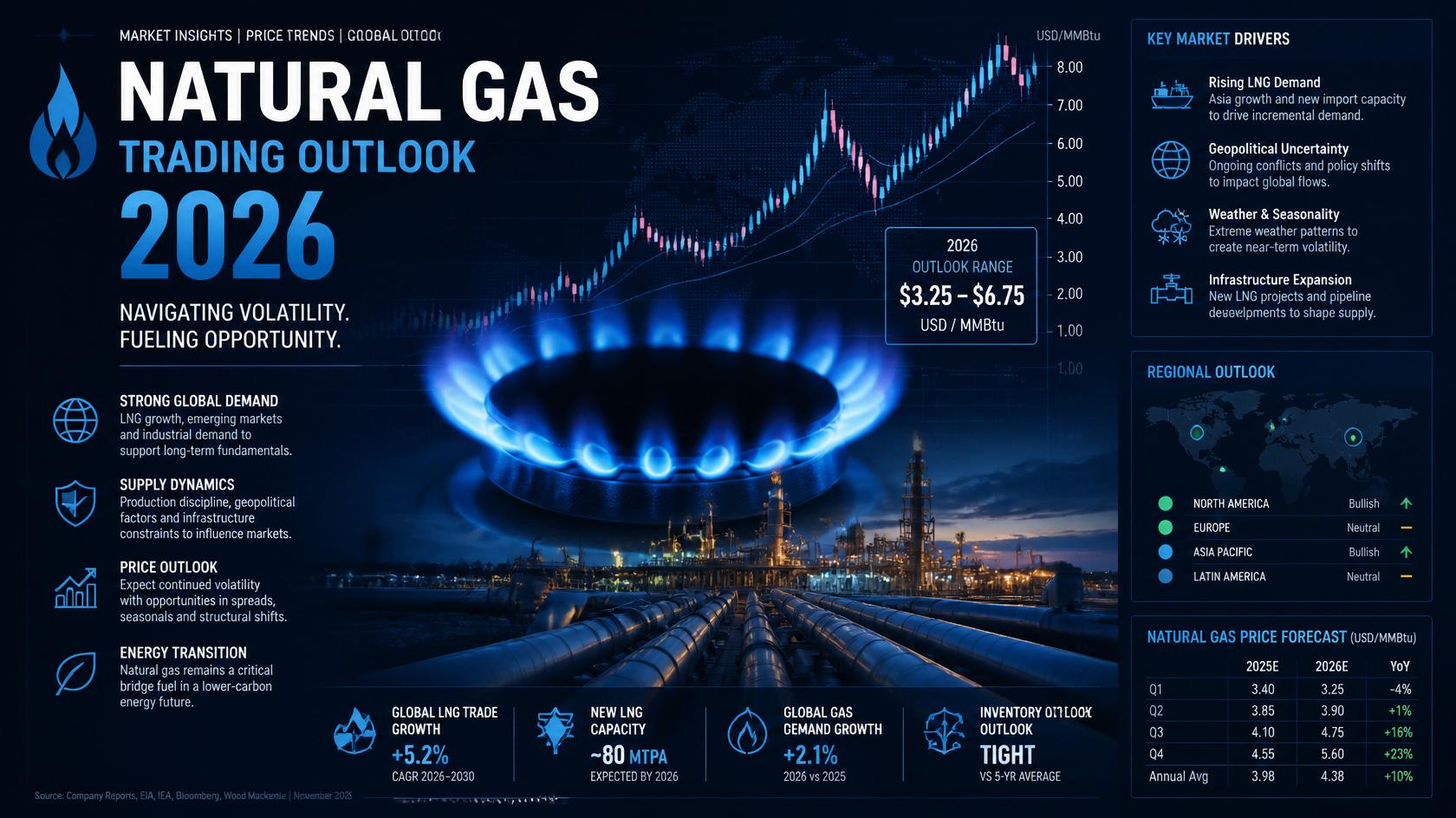
Natural gas remains one of the most important energy commodities in the world. It plays a major role in electricity generation, industrial production, home heating, and the broader shift toward cleaner energy systems.
As markets move through 2026, natural gas traders are watching several factors closely, including supply levels, weather conditions, geopolitical developments, economic growth, and rising global demand for liquefied natural gas (LNG).
Natural gas is well known for its sharp price movements. While that volatility can create significant risks, it also creates opportunities for active traders and investors who understand what drives the market.
This guide looks at the natural gas outlook for 2026, the major forces affecting prices, potential opportunities, and the risks traders should keep in mind.
Understanding the Natural Gas Market
Natural gas is a fossil fuel made primarily of methane and is used across a wide range of industries.
One of the biggest differences between natural gas and crude oil is the strong influence of seasonal weather. Demand can change dramatically depending on temperatures.
Cold winters typically increase demand for heating, while extremely hot summers can increase electricity consumption as households and businesses use more air conditioning.
These seasonal changes can cause significant price swings, creating opportunities for traders who closely follow weather forecasts and market expectations.
The United States remains one of the world’s major natural gas producers and exporters, which means developments in the U.S. energy market can have an important influence on global supply and pricing.
Natural Gas Market Outlook for 2026
The natural gas market entered 2026 with several competing forces affecting supply and demand.
Growing LNG exports, increasing industrial consumption, and rising electricity demand are providing support to the market. At the same time, periods of strong production can create temporary oversupply and put downward pressure on prices.
This balance between rising demand and expanding production is one of the key reasons natural gas prices can remain volatile.
Traders are closely watching storage inventories, drilling activity, pipeline capacity, production levels, and LNG export facilities for clues about where prices could move next.
Major Factors Influencing Natural Gas Prices
Natural gas prices can react quickly to changes in several important market factors.
Weather
Weather is one of the biggest influences on natural gas demand.
A particularly cold winter can increase heating consumption, while a prolonged summer heatwave can raise electricity demand as power plants use more natural gas to meet air-conditioning needs.
Unexpected changes in weather forecasts can therefore cause significant price movements.
Production
Production levels are another major factor.
Higher shale gas production can increase available supply and potentially put pressure on prices. On the other hand, production disruptions can tighten the market and support higher prices.
Pipeline problems, equipment failures, maintenance, and severe weather can all temporarily affect production.
Storage
Natural gas storage data provides an important look at the balance between supply and demand.
If inventories are lower than expected, traders may interpret this as a sign of stronger demand or tighter supply, which can support prices.
Higher-than-expected inventories can have the opposite effect and may put temporary pressure on prices.
LNG Demand
Growing LNG exports are changing the way natural gas markets operate.
U.S. producers are increasingly able to supply international markets, allowing domestic natural gas to reach buyers in Europe, Asia, and other regions.
As global LNG demand grows, international market conditions can have a greater influence on U.S. natural gas prices.
Economic Growth
Economic activity also affects natural gas consumption.
Manufacturing facilities use natural gas for a variety of industrial processes, so stronger economic growth can increase industrial demand.
A slowdown in manufacturing or broader economic activity can reduce consumption and potentially weigh on prices.
Geopolitical Developments
Geopolitical events can quickly change expectations about global energy supplies.
Developments involving major producing or consuming regions can create uncertainty and increase volatility.
For natural gas traders, geopolitical developments are therefore another factor worth monitoring closely.
The Growing Importance of LNG
Liquefied natural gas has significantly changed the global energy market.
LNG allows natural gas to be transported by ship rather than relying entirely on pipelines. This gives countries greater flexibility when sourcing energy from international suppliers.
The continued expansion of LNG export infrastructure is particularly important for the United States.
As additional export capacity becomes available, American natural gas producers can gain greater access to international markets. Strong overseas demand could provide additional support for U.S. natural gas prices.
Europe and Asia remain important markets for LNG, making global demand an increasingly important part of the natural gas story.
Renewable Energy and Natural Gas
The growth of renewable energy does not necessarily mean natural gas demand will disappear.
Solar and wind generation depend heavily on weather conditions. When renewable output falls, natural gas power plants can provide flexible electricity generation to help maintain grid reliability.
This makes natural gas a potential complement to renewable energy rather than simply a competitor.
As countries add more solar and wind capacity, flexible natural gas generation may continue playing an important role in supporting electricity grids.
Artificial Intelligence and Energy Consumption
Artificial intelligence is creating another potential source of electricity demand.
Large AI data centers require significant amounts of power to operate advanced computing systems. Technology companies are investing heavily in new data centers and supporting infrastructure, increasing electricity requirements.
Natural gas power plants can provide reliable electricity for these facilities.
As AI adoption continues expanding, higher electricity consumption could indirectly support natural gas demand, particularly in regions where gas-fired power generation plays an important role.
Supply Outlook for 2026
U.S. natural gas production continues to benefit from improvements in drilling technology and operational efficiency.
However, increased production does not automatically mean prices will fall.
Pipeline maintenance, transportation limitations, extreme weather, and unexpected equipment failures can temporarily reduce available supply.
At the same time, strong LNG exports can draw more natural gas away from domestic inventories and toward international markets.
The interaction between production, exports, storage, and demand means the supply picture could remain highly dynamic throughout 2026.
Demand Outlook for 2026
Several long-term trends are supporting natural gas demand.
Population growth can increase residential energy consumption, while manufacturing expansion can raise industrial demand.
Electricity generation remains one of the largest uses of natural gas, and growing LNG exports are opening additional international markets.
The expansion of AI infrastructure is also increasing electricity requirements.
Together, these factors provide a supportive long-term demand outlook, although short-term market conditions can still change quickly.
Trading Strategies for Natural Gas
Natural gas can suit different trading approaches depending on an investor’s time horizon.
Day traders may focus on short-term price movements caused by weather updates, storage reports, economic data, and breaking market news.
Swing traders generally look for price trends lasting several days or weeks as supply and demand expectations change.
Position traders take a longer-term view and may focus on seasonal demand, LNG expansion, production trends, and broader economic developments.
Regardless of the strategy, natural gas requires careful risk management because prices can move sharply in a short period.
Risk Management in Natural Gas Trading
Natural gas is considered a highly volatile commodity.
A sudden weather change, unexpected inventory report, production disruption, geopolitical event, or policy announcement can quickly change market direction.
Traders can manage some of this risk through sensible position sizing, stop-loss orders, diversification, and clearly defined trading plans.
Perhaps most importantly, traders should avoid making emotional decisions after sudden price movements. A disciplined approach can be especially valuable in a market that frequently experiences rapid changes.
Technical Analysis for Natural Gas Traders
Many traders combine fundamental research with technical analysis when evaluating natural gas.
Trend lines can help identify the broader direction of the market.
Support and resistance levels can highlight areas where prices have historically reacted.
Moving averages can provide information about momentum and potential trend changes.
Volume can help traders assess whether a price movement has meaningful participation behind it.
Momentum indicators may also help identify periods when a trend is becoming weaker or a reversal could be developing.
Technical analysis cannot predict future prices with certainty, but it can provide a structured framework for making trading decisions when combined with fundamental market information.
Opportunities and Challenges Ahead
Natural gas offers considerable opportunities because of its liquidity and frequent price movements.
Growing LNG exports, rising electricity consumption, AI-related infrastructure investment, and continued industrial demand could provide long-term support for the market.
However, traders also need to consider the bearish side of the equation.
Higher production, weaker-than-expected demand, mild weather, regulatory changes, or slower economic growth could put temporary pressure on prices.
Considering both bullish and bearish scenarios can help traders prepare for different market outcomes rather than relying on a single forecast.
Long-Term Investment Perspective
Natural gas is likely to remain an important part of the global energy system for years to come.
Many countries continue to view natural gas as a flexible energy source that can support electricity reliability while renewable energy capacity expands.
Investment in LNG terminals, pipelines, storage facilities, and other energy infrastructure could help maintain the strategic importance of natural gas.
For long-term investors, opportunities may exist not only through natural gas futures but also through companies involved in production, transportation, storage, and LNG exports.
The natural gas market will continue to be shaped by the balance between supply, demand, weather, global energy policy, and technological change. For traders in 2026, staying informed about these factors and maintaining disciplined risk management may be just as important as identifying the next major price move.