
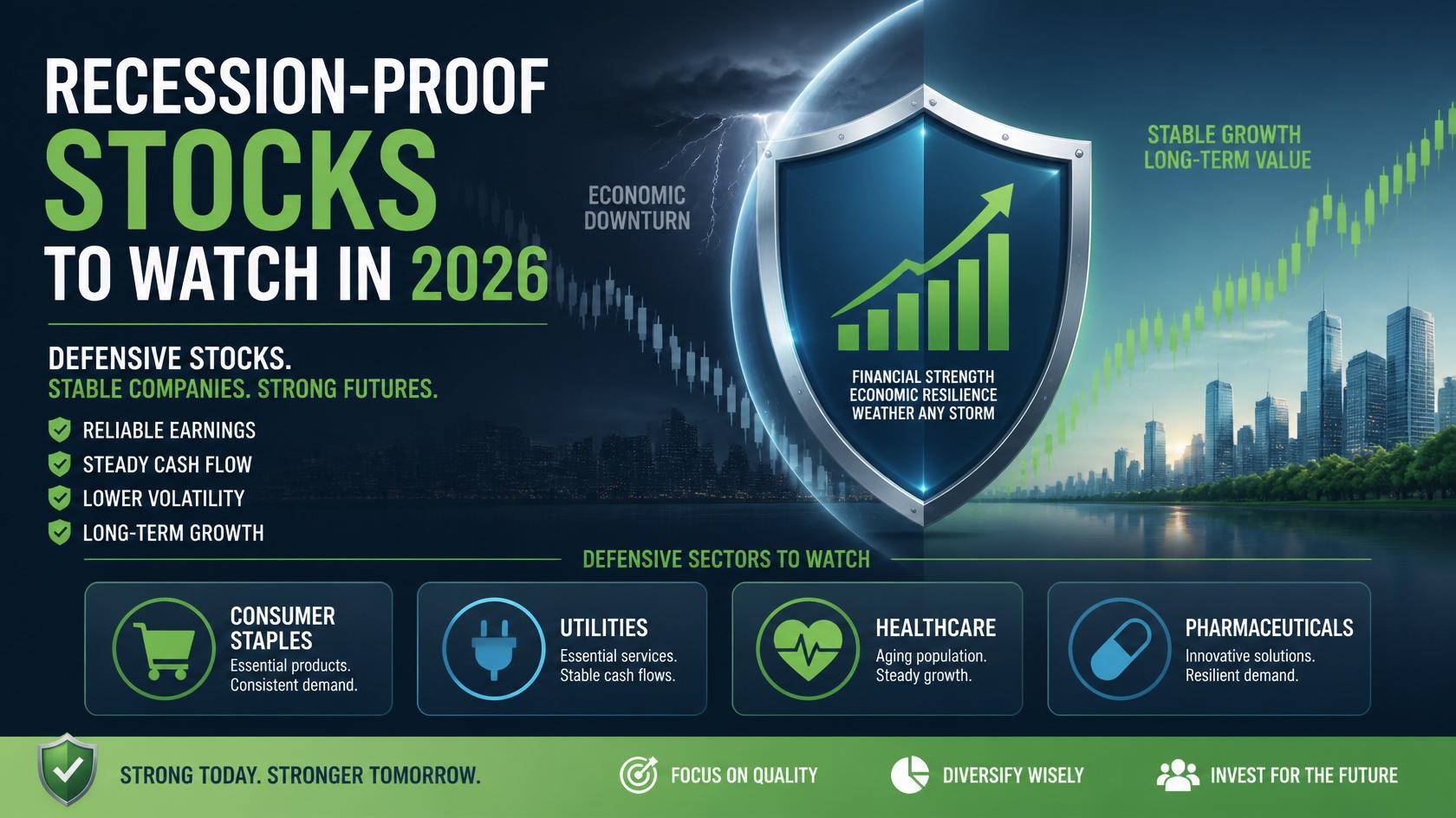
Economic uncertainty is a normal part of investing. Sooner or later, every investor has to deal with periods of slower growth, market volatility, or even a recession. While no stock can be completely protected from a market downturn, some businesses have historically been better equipped to handle difficult economic conditions.
As 2026 continues, many investors are paying closer attention to companies that can maintain relatively stable earnings, generate dependable cash flow, and continue growing even when the broader economy slows.
These businesses are often found in industries that provide essential products and services. People still need healthcare, electricity, groceries, household products, and communication services regardless of whether the economy is booming or struggling.
This article explains what makes a stock more resistant to recessions, which sectors could offer defensive opportunities in 2026, and how investors can build a portfolio designed to handle periods of economic uncertainty.
Understanding Recession-Proof Stocks
The phrase “recession-proof” can be misleading because it does not mean a company’s stock price will never fall.
Even financially strong companies can see their share prices decline during a broad market sell-off. Instead, recession-resistant businesses are companies that tend to keep generating revenue and profits when economic activity slows and consumers or businesses cut back on spending.
These companies are often found in defensive industries where demand remains relatively stable throughout different stages of the economic cycle.
People still need medical care, food, electricity, household necessities, and other essential services even during difficult economic periods.
Because demand for these products and services tends to be more consistent, companies operating in these industries may experience less earnings volatility than highly cyclical businesses.
Why Investors Are Focusing on Defensive Stocks in 2026
Several factors are encouraging investors to pay more attention to defensive companies in 2026.
Higher interest rates in recent years have increased borrowing costs for businesses and consumers. Although inflation has eased from some of its earlier highs, many households are still dealing with elevated everyday expenses.
Geopolitical uncertainty, changing supply chains, and fluctuations in energy prices are also contributing to market uncertainty.
As a result, some investors are looking beyond high-growth opportunities and focusing more closely on businesses with stable earnings, reliable cash flow, manageable debt, and strong financial foundations.
Healthcare Companies Continue Showing Strength
Healthcare is one of the sectors that tends to remain relatively resilient during economic downturns.
People still need medical treatment, prescription drugs, hospital care, and health insurance regardless of the state of the economy.
Long-term demographic trends are also supporting the sector. Aging populations in the United States and other developed markets are increasing demand for healthcare services.
Pharmaceutical companies, medical-device manufacturers, healthcare technology businesses, and health insurers can all benefit from this ongoing demand.
At the same time, developments in biotechnology, personalized medicine, and artificial intelligence are creating additional growth opportunities within the healthcare industry.
Consumer Staples Offer Consistent Demand
Consumer staples include products people purchase regularly, even when they are trying to reduce spending.
Food, beverages, cleaning products, personal-care items, and other household necessities remain part of everyday life regardless of economic conditions.
Companies with established brands can benefit from this relatively dependable demand. Consumers may cut back on expensive purchases, but they generally continue buying essential household products.
Many consumer-staples companies also have long histories of paying dividends, which can make them attractive to investors looking for a combination of stability and income.
Utility Companies Provide Defensive Stability
Utility companies provide essential services such as electricity, natural gas, and water.
Demand for these services tends to remain relatively steady because households and businesses cannot simply stop using basic utilities when the economy slows.
Many utilities also operate under regulated business models, which can provide more predictable revenue and cash flow than highly cyclical businesses.
Utilities are also known for paying dividends, making them popular among investors who prioritize income and stability.
However, investors should still consider factors such as debt levels and interest-rate sensitivity when evaluating utility stocks.
The Growing Importance of Cybersecurity
Cybersecurity has increasingly become a business necessity rather than an optional expense.
Companies and government organizations need to protect their networks, data, applications, and customers even when economic conditions are weak.
Cyberattacks can result in significant financial losses, operational disruptions, and reputational damage. Because of these risks, many organizations continue investing in cybersecurity even when they reduce spending in other areas.
The growth of cloud computing, remote work, artificial intelligence, and connected digital infrastructure is creating additional demand for security solutions.
This could allow financially strong cybersecurity companies to continue growing even if broader economic activity slows.
Artificial Intelligence Infrastructure Remains a Long-Term Opportunity
Technology stocks are often considered growth investments, but some areas of the technology sector may prove more resilient than others during periods of economic uncertainty.
Artificial intelligence is driving investment in cloud computing, semiconductor manufacturing, networking equipment, and data-center infrastructure.
Large technology companies often have substantial cash reserves, diversified revenue streams, and strong balance sheets. These advantages can give them more flexibility during economic downturns compared with smaller or less-established businesses.
However, investors should focus on companies with sustainable business models and competitive advantages rather than simply buying speculative technology stocks because of the popularity of AI.
Dividend Stocks Become More Attractive
Dividend-paying companies can become particularly appealing when markets are volatile.
Regular dividend payments provide investors with a potential source of income even when share prices are moving up and down.
Companies that have consistently maintained or increased their dividends over many years may demonstrate strong cash-flow generation and disciplined financial management.
A strong dividend history can also indicate that a company has confidence in its ability to continue generating cash.
However, investors should not choose a stock based solely on its dividend yield. The company’s earnings, debt, free cash flow, and ability to maintain the dividend are equally important.
Companies With Strong Balance Sheets
Financial strength becomes especially valuable when economic conditions deteriorate.
Companies with manageable debt, healthy cash reserves, consistent profitability, and strong free cash flow generally have more flexibility during difficult periods.
A strong balance sheet can allow a business to continue investing in research, acquisitions, new products, and expansion while weaker competitors are forced to reduce spending.
When evaluating potentially recession-resistant companies, investors should pay attention to debt levels, free cash flow, operating margins, cash reserves, and the consistency of earnings.
Industries That May Face Greater Challenges
Not every sector is equally prepared for an economic downturn.
Businesses that depend heavily on discretionary consumer spending can experience significant pressure when households become more cautious.
Luxury retailers, travel companies, restaurants, entertainment businesses, and hospitality companies may see demand decline when consumers begin prioritizing essential expenses.
Highly cyclical industries such as automobiles, construction, and certain manufacturing businesses can also experience weaker demand during recessions.
These industries may eventually recover strongly when economic growth returns, but their earnings and stock prices can be more volatile during downturns.
Diversification Remains Essential
Even companies considered recession-resistant can experience falling share prices.
For that reason, defensive stocks should be part of a diversified portfolio rather than treated as a complete solution to market risk.
A balanced portfolio might include healthcare, consumer staples, utilities, selected technology companies, energy infrastructure, and financially strong dividend-paying businesses.
Diversification cannot eliminate losses, but spreading investments across different industries can reduce the impact of problems affecting any one sector.
Characteristics of High-Quality Recession Stocks
Strong defensive companies often share several characteristics.
They tend to generate relatively consistent earnings across different economic environments.
They generally maintain manageable debt and healthy cash flow.
Many have recognizable brands, loyal customers, or other competitive advantages that make it difficult for competitors to take market share.
Reliable free cash flow is another important characteristic because it gives companies greater flexibility during challenging periods.
Experienced management teams can also make a difference when businesses need to adjust quickly to changing economic conditions.
Some companies additionally return capital to shareholders through dividends or share buybacks.
Taken together, these characteristics can help a business remain financially healthy even when economic growth slows.
Long-Term Investment Strategy
Trying to predict exactly when a recession will begin or end is extremely difficult.
Rather than constantly reacting to economic headlines, investors may be better served by focusing on high-quality businesses that can potentially perform across different market environments.
Strategies such as dollar-cost averaging, regular portfolio reviews, and maintaining diversified investments can help investors manage uncertainty without abandoning their long-term plans.
Market downturns can be uncomfortable, but making emotional decisions based on short-term price movements can create additional problems.
Patience and discipline remain important regardless of whether markets are rising or falling.
Risks to Consider
Even stocks considered recession-resistant are not guaranteed to perform well during a downturn.
Changes in interest rates, government regulations, inflation, geopolitical events, or company-specific problems can all affect stock prices and business performance.
A company may also face unexpected competition, declining margins, management challenges, or changes in consumer behavior.
Investors should therefore avoid assuming that any stock is completely protected from market declines.
Thorough research, sensible diversification, appropriate position sizing, and a long-term investment perspective remain essential when building a portfolio designed to withstand economic uncertainty.
Ultimately, the goal is not to find a stock that can never fall. It is to identify financially strong businesses with products or services that people continue to need, while building a diversified portfolio that can remain resilient through different stages of the economic cycle.