
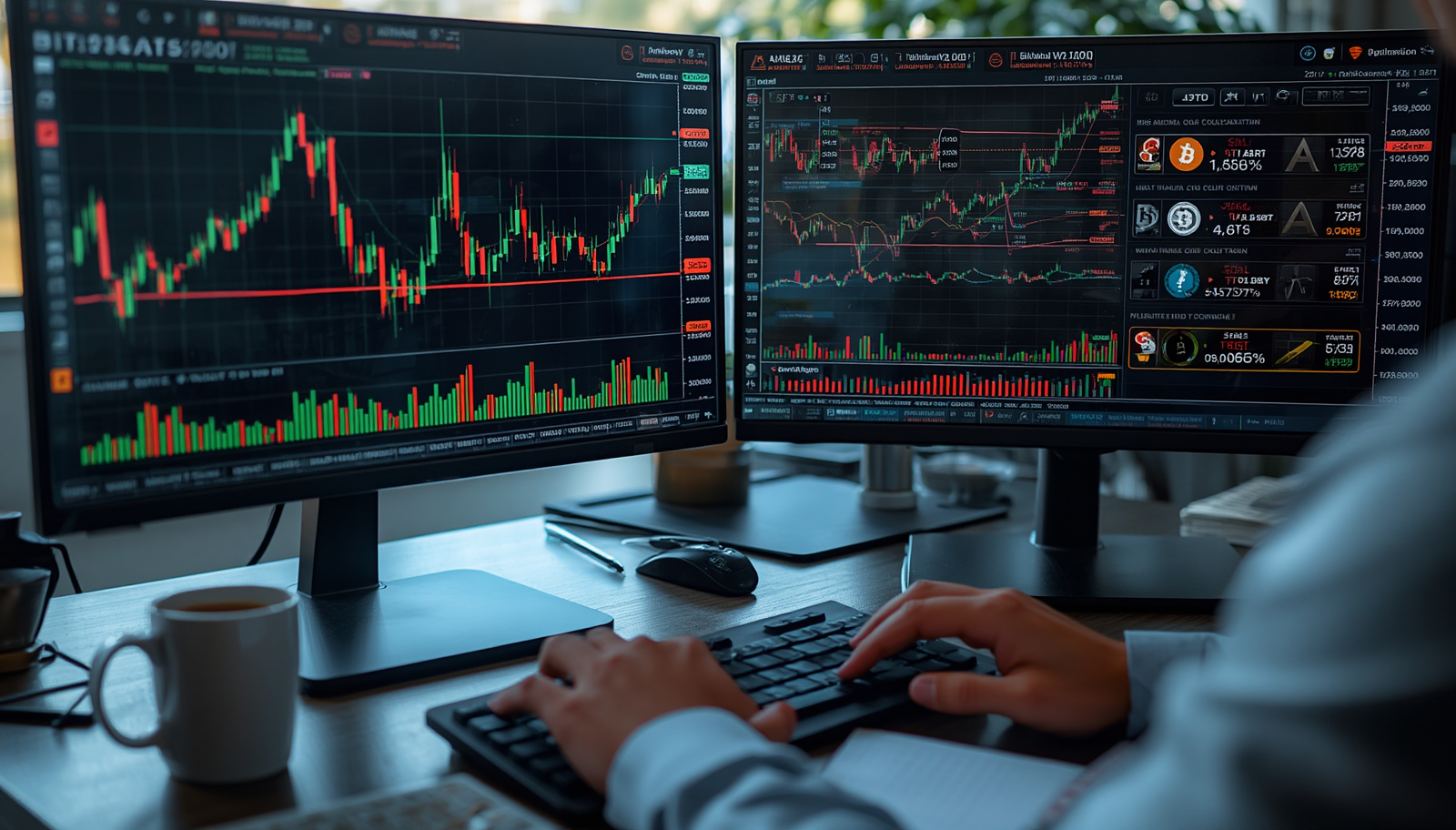
When it comes to cryptocurrency trading, one of the most common questions is whether Bitcoin or altcoins offer better profit opportunities. The truth is that there is no simple winner.
Profitability depends on several factors, including market conditions, trading strategy, risk tolerance, experience, and personal investment goals. Bitcoin generally offers stronger liquidity and a more established market, while altcoins can deliver much larger percentage gains but usually come with significantly greater risk.
This guide compares Bitcoin and altcoin trading, looking at volatility, liquidity, profit potential, risks, trading strategies, and which option may be more suitable for different types of traders.
Understanding Bitcoin Trading
Bitcoin trading involves buying and selling Bitcoin with the goal of benefiting from changes in its price. As the first and largest cryptocurrency, Bitcoin remains the most established digital asset in the market.
Its popularity attracts retail traders as well as institutional investors, investment firms, and other large market participants. Bitcoin’s large market capitalization and high trading volume generally make it easier to buy and sell without causing major price movements.
Bitcoin also plays an important role in the broader cryptocurrency market. When Bitcoin experiences a major move, many altcoins tend to react as well.
Understanding Altcoin Trading
Altcoins are cryptocurrencies other than Bitcoin. There are thousands of them, and they can differ considerably in terms of technology, purpose, development, and market size.
Some projects are built around smart contracts and decentralized finance, while others focus on gaming, artificial intelligence, payments, privacy, scalability, or tokenized assets.
The wide range of projects creates plenty of opportunities, but it also makes research particularly important. Smaller altcoins can experience extreme price movements, meaning traders can potentially make substantial gains but can also suffer large losses in a short period.
Bitcoin vs Altcoins: Volatility
Volatility is one of the biggest differences between Bitcoin and altcoins.
Bitcoin can still experience significant price swings, especially during major market events. However, its large market size generally makes it less volatile than many smaller cryptocurrencies.
Altcoins can move much more aggressively. A relatively small project may gain a large percentage in a short period when demand suddenly increases. The opposite is also true: prices can fall sharply when enthusiasm disappears or market conditions deteriorate.
For traders who understand how to manage volatility, these rapid movements can create opportunities. For inexperienced investors, however, they can quickly turn into substantial losses.
Liquidity Differences
Liquidity describes how easily an asset can be bought or sold without causing a significant change in its price.
Bitcoin generally has the deepest liquidity in the cryptocurrency market. Its high trading volume allows large orders to be executed more efficiently and usually results in lower slippage.
Large altcoins can also have strong liquidity, but smaller or lesser-known tokens may have much thinner markets. This can lead to wider spreads, greater slippage, and difficulty exiting a position when market conditions become unfavorable.
For active traders, liquidity is an important factor to consider before entering any position.
Profit Potential
Altcoins attract many traders because of their potential for large percentage gains.
A smaller cryptocurrency can sometimes rise dramatically when it gains attention, launches a major product, attracts new users, or benefits from a broader market trend. In some cases, successful early investors can achieve returns that are much larger than Bitcoin’s gains over the same period.
But these opportunities come with substantial risk. Many projects fail to achieve their goals, lose investor interest, or experience severe price declines after periods of speculation.
Bitcoin usually offers more moderate price movements compared with smaller altcoins. Its long history and established position in the market can make it more appealing to investors who prioritize durability over extreme short-term returns.
Risk Comparison
Bitcoin and altcoins both carry risk, but the risks associated with altcoins are generally higher.
Bitcoin has a long trading history, broad recognition, substantial liquidity, and significant institutional participation. None of this makes Bitcoin risk-free, but these characteristics can provide greater stability compared with many smaller digital assets.
Altcoin investors face additional risks such as weak liquidity, limited adoption, technical problems, regulatory uncertainty, project failures, and market manipulation.
Before investing in an altcoin, traders should understand what the project actually does, how its token works, who is developing it, and whether there is genuine demand for its technology.
Trading Bitcoin
Bitcoin can support several different trading approaches.
Swing traders may hold positions for several days or weeks while attempting to capture medium-term price movements.
Day traders focus on shorter-term fluctuations and commonly use technical analysis, volume, momentum, and chart patterns.
Long-term investors may gradually accumulate Bitcoin and hold it through multiple market cycles.
Bitcoin traders also tend to pay attention to broader economic factors such as interest rates, inflation, institutional activity, liquidity conditions, and regulatory developments because these factors can influence demand for digital assets.
Trading Altcoins
Altcoin trading often requires more research and closer market monitoring.
Some traders look for promising projects before they become widely known. Others focus on momentum and attempt to benefit from rapid price movements during periods of strong market interest.
Capital can also rotate between different cryptocurrency sectors. For example, traders may move their attention toward areas such as decentralized finance, artificial intelligence, gaming, or tokenized real-world assets when those sectors become popular.
Successful altcoin trading requires more than looking at a price chart. Traders should also examine the project’s technology, development activity, tokenomics, community, competition, and potential use cases.
How Market Cycles Affect Bitcoin and Altcoins
Cryptocurrency markets tend to move through different phases, and Bitcoin and altcoins do not always perform equally during each stage.
Bitcoin often attracts significant attention during the early stages of a bullish market. As confidence increases and Bitcoin gains momentum, investors may eventually start moving capital toward altcoins in search of larger percentage returns.
This can create periods when altcoins outperform Bitcoin.
During bearish conditions, however, smaller cryptocurrencies often experience much deeper declines. Bitcoin may also fall significantly, but its larger market and stronger liquidity can sometimes provide greater resilience.
Understanding these changing market conditions can help traders decide where to focus their attention.
Which Is Better for Beginners?
For many beginners, Bitcoin can be a more practical starting point.
It has a longer market history, extensive educational resources, strong liquidity, and generally less extreme volatility than smaller cryptocurrencies.
Altcoins require additional research because every project has its own technology, token economics, development team, competitors, and risks.
Starting with Bitcoin can allow new traders to learn the fundamentals of technical analysis, position sizing, and risk management before taking on the additional uncertainty associated with smaller cryptocurrencies.
Diversification Can Be a Balanced Approach
Traders do not necessarily have to choose between Bitcoin and altcoins.
Some investors combine the two, using Bitcoin as a larger part of their portfolio while allocating a smaller portion to carefully researched altcoin opportunities.
This approach can provide exposure to Bitcoin’s established market position while still allowing investors to participate in the potential growth of emerging cryptocurrency projects.
Of course, diversification does not eliminate risk, but spreading exposure across different assets can help prevent one position from having an outsized impact on the entire portfolio.
Common Mistakes to Avoid
One common mistake is assuming that a cheap-looking altcoin has more room to grow simply because its price per coin is low. A token’s price alone tells you very little about its actual valuation.
Another mistake is investing in an altcoin without researching its technology, development progress, tokenomics, or market demand.
Some traders also put too much of their capital into a single cryptocurrency or use excessive leverage because they want to increase their potential returns.
Chasing a coin after it has already experienced a sharp rally can also be dangerous. Emotional decisions based on hype, fear of missing out, or social media excitement can quickly turn a promising trade into a loss.
Good research, realistic expectations, and disciplined risk management remain important regardless of which cryptocurrency you trade.
So, Which Is More Profitable?
There is no guaranteed answer.
Bitcoin generally offers greater liquidity, a longer track record, and comparatively lower volatility, making it attractive to traders and investors who prefer a more established cryptocurrency.
Altcoins can provide much higher percentage returns during strong market rallies, but they also carry considerably greater volatility and project-specific risks.
During powerful bull markets, some altcoins can outperform Bitcoin by a wide margin. During market downturns, however, those same assets can lose value much faster.
Ultimately, the better choice depends on your trading experience, risk tolerance, research ability, strategy, and the market environment.