
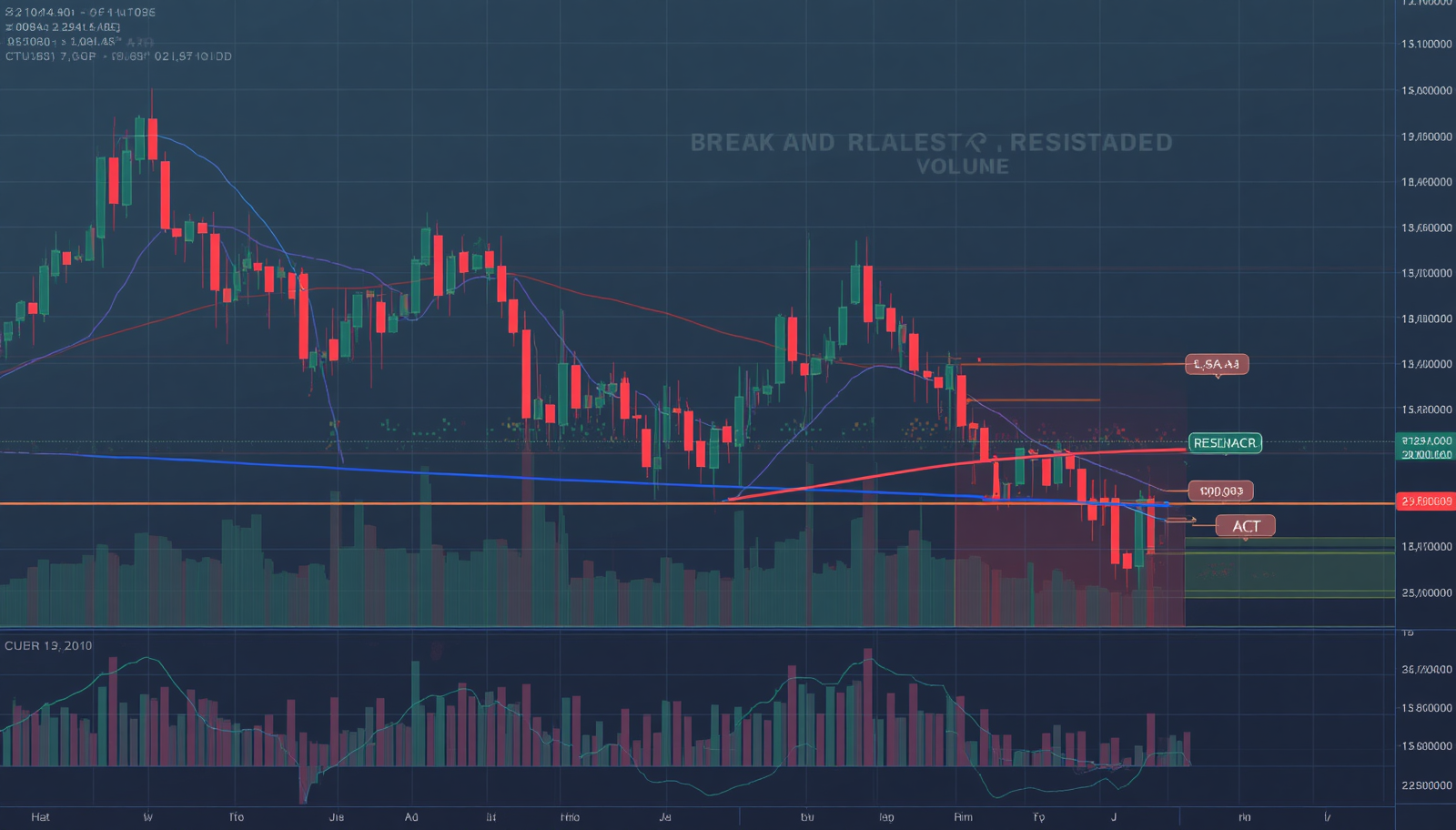
The Break-and-Retest strategy has become a popular approach among traders because it combines patience, technical analysis, and disciplined execution. Rather than jumping into a trade as soon as price suddenly breaks through a key level, traders wait to see whether the breakout holds. This extra confirmation can help reduce emotional decisions and improve trade selection.
This guide explains how the Break-and-Retest strategy works, why traders use it, how to recognize stronger setups, common mistakes to avoid, and practical ways to improve your trading process.
What Is the Break-and-Retest Trading Strategy?
The Break-and-Retest strategy is a price action technique built around confirmed breakouts.
The process starts when price moves through an important support or resistance level. Instead of entering the trade immediately, the trader waits for price to return to the broken level and test it again. If the level holds and price starts moving in the original breakout direction, the setup receives additional confirmation.
The basic idea is straightforward. When price breaks above resistance, that former resistance can become support. Likewise, when price falls below support, the old support level can turn into resistance.
This change in market structure can provide traders with a clearer entry opportunity and help separate genuine breakouts from temporary price movements.
Why the Break-and-Retest Strategy Works
Markets rarely move in a perfectly straight line. Even after a strong breakout, price may pull back before continuing in the same direction.
A retest gives traders an opportunity to see how buyers and sellers respond to the broken level. Traders who missed the initial breakout may enter during the pullback, while traders caught on the wrong side of the move may close their positions. These actions can contribute to renewed momentum.
Instead of chasing price after a sharp move, traders wait for the market to come back to a potentially important level. This can result in a more controlled entry and a potentially more favorable risk-to-reward setup.
Of course, no breakout strategy works every time. Market conditions can change quickly, and false breakouts are always possible.
Understanding Support and Resistance
Support and resistance are at the heart of the Break-and-Retest strategy.
Support is an area where buying pressure has previously helped prevent price from falling further. Resistance is an area where selling pressure has repeatedly limited upward movement.
When price convincingly moves above resistance, traders often watch that level for a possible retest. If price returns and buyers defend it, the old resistance may now act as support.
The same concept applies in reverse. When price breaks below support and later returns to that area, traders watch to see whether sellers defend the level as new resistance.
The stronger and more meaningful the original level, the more attention traders generally give to the retest.
Bullish Break-and-Retest Setup
A bullish Break-and-Retest setup develops when price breaks above an important resistance area.
First, the market approaches resistance. Buyers then push price decisively above the level. Instead of entering immediately, the trader waits for a pullback.
Price returns to the former resistance and tests it. If buyers step in and price begins moving upward again, the retest may provide a potential long entry.
Confirmation can come from a strong bullish candle, increased buying activity, or a clear rejection of the former resistance.
This approach can help traders avoid buying at the peak of an initial breakout.
Bearish Break-and-Retest Setup
A bearish setup follows the same concept in the opposite direction.
Price approaches a significant support area and sellers eventually push it below that level. Rather than immediately entering a short position, the trader waits for price to move back toward the broken support.
If sellers defend the level and price turns lower again, the previous support may now be acting as resistance.
A bearish rejection candle, strong selling momentum, or renewed downward movement can provide additional confirmation.
Identifying High-Quality Breakouts
Not every breakout is worth trading.
Stronger breakouts often involve decisive price movement and meaningful market participation. A candle that closes clearly beyond support or resistance can be more convincing than a brief price spike that immediately returns inside the previous range.
Trading volume can also provide useful information. Increased volume during a breakout may indicate stronger participation, although volume should not be treated as a guarantee that the move will continue.
The location of the breakout matters as well. A breakout occurring at a major market level and supported by the broader trend may offer a stronger setup than a random break through a minor level.
Waiting for a confirmed candle close can also help reduce the number of false signals.
The Importance of the Retest
The retest is what separates this strategy from simply trading breakouts.
Many beginners see price move above resistance or below support and enter immediately. The problem is that some breakouts fail within minutes or hours.
A retest gives traders additional information. It shows whether the market is willing to accept prices beyond the old support or resistance level.
When a broken resistance level successfully holds as support, it can indicate that buyers remain interested at that price. Similarly, when broken support turns into resistance, it can show that sellers are still defending the area.
Not every breakout will provide a clean retest. Sometimes price continues moving without looking back, and traders who insist on waiting may miss the opportunity. That is one of the trade-offs of this strategy.
Using Candlestick Confirmation
Candlestick patterns can add another layer of confirmation to a Break-and-Retest setup.
During a bullish retest, traders may watch for patterns such as bullish engulfing candles, hammer formations, or strong bullish closes. During bearish retests, bearish engulfing candles, shooting stars, and strong bearish closes may provide useful confirmation.
The goal is not to trade a candlestick pattern by itself. Instead, the candle should support the broader market structure.
For example, a bullish rejection candle at a previously broken resistance level can be more meaningful than the same candle appearing in the middle of a random trading range.
Trading Volume Confirmation
Volume can provide valuable context when analyzing breakouts.
A breakout accompanied by rising volume may suggest that more market participants are supporting the move. During a retest, volume may temporarily decline as the market pulls back.
If price then begins moving in the breakout direction while participation increases again, the move may receive additional confirmation.
Volume should always be interpreted according to the market being traded. Stock and futures markets generally provide centralized volume data, while forex traders often work with broker-specific or tick-volume information.
Combining the Strategy With Trend Analysis
The Break-and-Retest strategy can become more effective when it is aligned with the broader market trend.
For example, a bullish breakout that occurs during an established uptrend may have a better chance of continuing than a bullish breakout that goes directly against a strong downtrend.
The same applies to bearish setups. A breakdown followed by a retest may be more attractive when the broader market is already showing bearish structure.
Trend analysis helps traders avoid taking every breakout they see and instead focus on setups that fit the larger market picture.
Choosing the Right Time Frame
The strategy can be used across different time frames.
Scalpers may look for setups on one-minute or five-minute charts, while day traders often work with fifteen-minute, thirty-minute, or one-hour charts. Swing traders may prefer four-hour and daily charts.
Higher time frames generally contain less short-term noise, although they also produce fewer setups.
Using multiple time frames can provide additional context. A trader might identify the overall trend on a daily or four-hour chart and then use a lower time frame to find a more precise entry.
Markets Suitable for the Strategy
One advantage of the Break-and-Retest approach is its flexibility.
Forex traders can apply it to major and minor currency pairs. Stock traders can use it on individual companies, ETFs, and major indices. Cryptocurrency traders may look for setups on assets such as Bitcoin and Ethereum.
The same concept can also be applied to commodities, including gold, silver, and crude oil.
Because the strategy is based primarily on market structure and price behavior, it is not restricted to a single asset class.
Risk Management
Even a high-quality setup can fail, which makes risk management essential.
A stop-loss is commonly placed beyond the retested support or resistance area, giving the trade enough room to develop while defining the maximum acceptable loss.
Position size should be based on the amount of capital the trader is willing to risk rather than on how attractive the setup appears.
Many traders choose to risk only a small portion of their account on an individual trade. The exact percentage depends on the trader’s strategy, experience, and risk tolerance.
The goal is simple: one losing trade should never have the power to seriously damage the trading account.
Setting Profit Targets
There is no single method for choosing a profit target.
Some traders use previous swing highs or lows as potential targets. Others base their exits on a fixed risk-to-reward ratio, such as 2:1 or 3:1.
For example, if a trader is risking $100 on a setup, a 2:1 target would aim for approximately $200 in potential profit.
Trailing stops are another option. They allow traders to stay in a strong move while gradually protecting some of the profit already gained.
The best exit method depends on the market, trading style, and overall strategy.
Common Mistakes Beginners Make
One of the biggest mistakes is entering immediately after a breakout without waiting for confirmation.
Another common problem is treating every temporary move beyond support or resistance as a genuine breakout. Markets frequently create price spikes that quickly reverse.
Trading against the broader trend can also reduce the quality of setups. Poorly positioned stop-losses are another issue, particularly when stops are placed so close to the entry that normal market fluctuations trigger them.
Overtrading is equally damaging. Not every breakout deserves a position.
A disciplined trader understands that staying out of a weak setup is also a trading decision.
Advantages of the Break-and-Retest Strategy
The strategy has several practical advantages.
Waiting for a retest can help traders avoid chasing sudden price movements. It may also provide a more favorable entry location and create clearer areas for placing stop-loss orders.
The approach can be used across different markets and time frames, making it suitable for scalpers, day traders, and swing traders.
Perhaps most importantly, it encourages patience. Instead of reacting to every price movement, traders wait for the market to provide specific conditions before taking action.
Limitations of the Strategy
The Break-and-Retest strategy is not guaranteed to work.
Some breakouts continue moving without ever returning to the broken level. Traders who wait for a retest may therefore miss certain opportunities.
False breakouts can also occur, particularly during low-liquidity periods or around major economic announcements.
Sometimes price appears to successfully retest a level before reversing again. These failed retests can result in losing trades.
For this reason, traders should never treat the strategy as a guaranteed formula for making money. Proper risk management and consistent execution remain essential.
How to Improve Break-and-Retest Trading
Improving this strategy is largely about improving the quality of decision-making.
Traders can combine market structure with trend analysis, support and resistance, candlestick behavior, and volume to filter weaker setups.
Keeping a detailed trading journal can also be extremely useful. Recording the reason for each trade, the market conditions, entry, stop-loss, target, and final outcome can reveal patterns that are difficult to notice in real time.
Regular chart analysis helps traders become more familiar with how breakouts and retests behave in different market environments.
The objective is not to find a perfect setup every time. It is to build a repeatable process and execute it consistently.
The Future of Break-and-Retest Trading
Financial markets continue to evolve as artificial intelligence, algorithmic systems, and advanced analytical tools become more common. However, the basic principles of price behavior remain relevant.
Many automated trading systems can identify breakout conditions, key levels, and potential retests, but market psychology still plays an important role in price movement.
Support, resistance, momentum, breakouts, and retests remain fundamental elements of technical analysis.
For traders who understand its strengths and limitations, the Break-and-Retest strategy can remain a useful part of a broader trading plan. Its biggest advantage may not be the ability to predict every market move, but the discipline it encourages: wait for confirmation, manage risk carefully, and let the market provide the evidence before committing capital.