
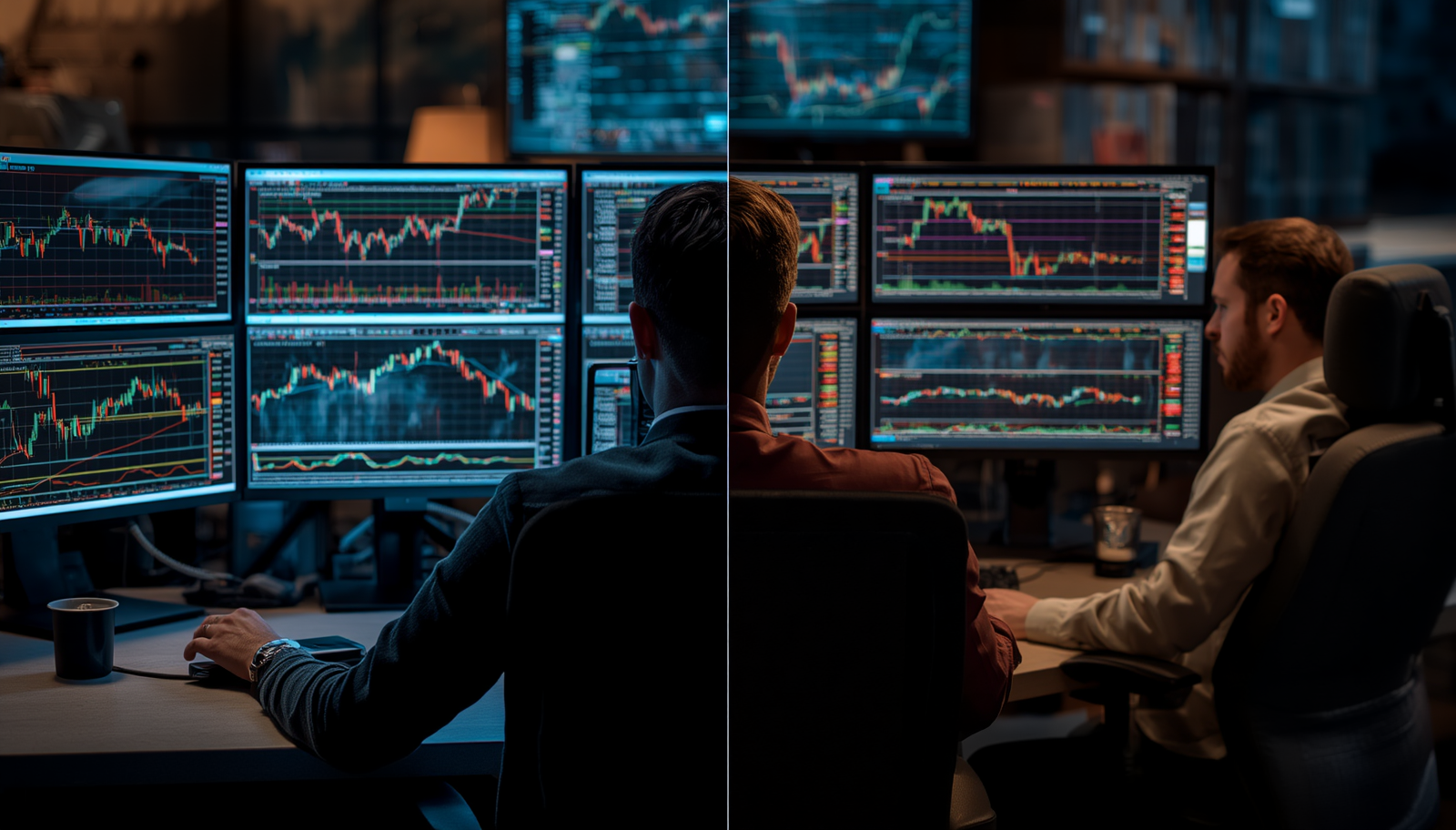
Online trading has become much easier to access in 2026. With an internet connection and a suitable trading platform, investors can participate in markets around the world, including stocks, forex, cryptocurrencies, commodities, and indices.
But getting started involves more than choosing what to trade. One of the first decisions every new trader needs to make is how they want to trade. Two of the most popular approaches are day trading and swing trading.
Both strategies aim to benefit from changes in market prices, but the way they operate is very different. Day trading is fast-paced and requires frequent attention, while swing trading gives positions more time to develop and generally requires less screen time.
Understanding these differences can help you choose an approach that fits your goals, experience, schedule, and comfort with risk.
What Is Day Trading?
Day trading involves opening and closing trades within the same trading day.
A day trader does not normally hold positions overnight. Instead, they attempt to profit from relatively small price movements that develop during a trading session.
Day traders may place several trades in a single day, using tools such as price action, technical indicators, support and resistance, volume, and short-term market momentum.
One advantage of closing trades before the market session ends is reduced exposure to overnight events. Unexpected news released after the market closes cannot directly affect a position that has already been closed.
However, day trading requires significant attention. Traders need to monitor price movements, react quickly, and make decisions under pressure.
What Is Swing Trading?
Swing trading takes a slower approach.
Instead of trying to capture small intraday movements, swing traders look for larger price moves that may develop over several days or weeks.
A swing trader might identify an emerging trend, wait for a suitable entry, and then hold the position until the market reaches a target or the trade setup is no longer valid.
Technical analysis is commonly used, including chart patterns, support and resistance, trend lines, and moving averages. Fundamental factors and major news events may also be considered when they are likely to affect the market over several days or weeks.
Because positions are held longer, swing trading usually requires less constant monitoring than day trading.
Time Commitment
Time is one of the clearest differences between the two approaches.
Day trading can require several hours of focused attention during active market sessions. Traders may need to watch charts continuously, monitor news, manage open positions, and respond quickly to changing conditions.
Swing trading is more flexible. Traders can perform their main analysis outside market hours and check their positions periodically rather than watching every price movement.
This makes swing trading appealing to people who have full-time jobs, studies, businesses, or other responsibilities.
Trading Frequency
Day traders generally place more trades than swing traders.
A day trader may enter and exit multiple positions during one session, with each trade targeting a relatively small price movement.
Swing traders usually take fewer positions because they are looking for larger market moves. A single position might remain open for several days or even weeks.
Lower trading frequency can also mean fewer transaction costs, although the actual cost depends on the broker, market, position size, and trading instrument.
Profit Potential
Both day trading and swing trading can provide opportunities, but neither guarantees profits.
Day traders attempt to generate returns from frequent short-term movements. Individual profits may be relatively small, so the strategy depends heavily on maintaining a favorable balance between winning and losing trades while controlling costs.
Swing traders aim to capture larger movements. Because positions remain open longer, a successful trade can potentially produce a larger percentage move.
However, larger potential moves also come with greater exposure to market fluctuations.
Ultimately, profitability depends much more on strategy quality, discipline, execution, and risk management than simply choosing one trading style over the other.
Risk Exposure
Risk exists in both approaches, but it takes different forms.
Day traders generally close their positions before the end of the trading session, which can reduce exposure to overnight announcements and unexpected market gaps.
Swing traders accept overnight and weekend exposure because their positions remain open for longer periods. Important economic announcements, political developments, company news, or unexpected events can cause significant price movements while a trade is open.
Swing traders therefore need to consider wider market conditions and use position sizes that reflect their risk tolerance.
Technical Analysis
Technical analysis is important for both day and swing traders, but the time frames are different.
Day traders often use shorter charts such as one-minute, five-minute, fifteen-minute, or one-hour intervals. They may focus on short-term price action, volume, momentum, moving averages, and intraday support and resistance.
Swing traders generally use longer charts, such as four-hour, daily, and sometimes weekly charts.
Longer time frames can reduce some of the market noise found on very short charts and make broader trends easier to recognize.
Fundamental Analysis
Fundamental analysis can also play a different role depending on the trading style.
Day traders tend to focus more on immediate market catalysts, such as economic reports, earnings announcements, central bank decisions, and breaking news.
Swing traders may pay greater attention to broader economic trends, company fundamentals, industry conditions, interest rates, and other factors that could influence prices over several days or weeks.
Combining fundamental information with technical analysis can help traders understand both the reason behind a potential move and where a trade might be considered.
Emotional Demands
Trading psychology can make a major difference in both strategies.
Day trading involves frequent decisions and rapid price movements. This environment can create pressure, particularly when several trades move against the trader in a short period.
Swing trading is generally slower, giving traders more time to think before making decisions. However, holding a position overnight can still create anxiety when markets move sharply.
Fear, greed, impatience, and the desire to recover losses can affect traders regardless of their strategy.
Developing clear rules and following a trading plan can help reduce emotional decisions.
Capital Requirements
There is no universal amount of money required to start day or swing trading because requirements vary by market, broker, regulations, and the type of account being used.
Day traders may face greater costs because they typically execute more transactions. They may also need enough capital to manage multiple positions while maintaining sensible risk levels.
Swing traders often trade less frequently and may use smaller position sizes, but they still need enough capital to handle normal market fluctuations without taking excessive risk.
The size of the account matters less than how responsibly the available capital is managed.
Trading Costs
Trading frequently can increase expenses.
Day traders may accumulate more commissions, spreads, exchange fees, and other transaction costs because they place more trades.
Swing traders generally trade less often, which can reduce these costs.
However, swing traders may face other expenses depending on the instrument they use, such as overnight financing or holding charges.
Before choosing a strategy, traders should understand the complete cost structure of their chosen market and platform.
Suitable Markets
Both day and swing trading can be used across a wide range of markets.
Day traders often look for highly liquid instruments with sufficient daily movement, including major forex pairs, stocks, index products, commodities, and cryptocurrencies.
Swing traders can use many of the same markets but focus on medium-term trends and price movements.
The market itself is not necessarily what determines whether day or swing trading is better. The more important question is whether the market provides opportunities that fit the trader’s chosen strategy.
Advantages of Day Trading
Day trading has several potential advantages.
Because positions are normally closed before the end of the session, traders can reduce overnight exposure.
The large number of intraday price movements can provide frequent opportunities.
Traders also receive relatively quick feedback from their decisions, which can make it easier to evaluate a strategy over time.
For people who enjoy fast-paced environments and have enough time to monitor the market, day trading can be an engaging approach.
However, frequent opportunities do not mean frequent profits. The same speed that creates opportunities can also increase losses.
Advantages of Swing Trading
Swing trading offers greater flexibility.
Traders do not have to spend the entire day watching charts, making it easier to combine trading with work or other responsibilities.
The slower pace also gives traders more time to analyze market structure and consider their decisions.
Fewer trades can mean lower transaction costs, while longer holding periods give market trends more time to develop.
For many beginners, this slower approach can provide a more manageable environment for learning.
Challenges of Day Trading
Day trading can be demanding both mentally and financially.
Constant chart monitoring can become exhausting, especially when traders remain focused on the market for several hours.
Rapid price movements require quick decisions, and emotional mistakes can become costly when trades are opened and closed frequently.
Transaction costs can also accumulate quickly.
Successful day trading generally requires considerable preparation, practice, discipline, and an understanding of short-term market behavior.
Challenges of Swing Trading
Swing trading has its own set of challenges.
The biggest is overnight exposure. Markets can move significantly while the trader is away from the screen.
Swing trades also require patience. A good setup may take several days to reach its target, and price may move against the position temporarily before the expected move develops.
Traders need to be comfortable with these fluctuations and avoid closing positions simply because of normal short-term volatility.
Which Strategy Is Better for Beginners?
There is no strategy that is automatically best for every beginner, but swing trading can be easier for many new traders to manage.
Its slower pace provides more time to study charts, understand market behavior, and make decisions without the constant pressure associated with intraday trading.
Day trading can be much more demanding because traders have to make frequent decisions within a limited period.
Beginners may benefit from learning the basics with a slower approach before deciding whether they want to explore shorter-term trading.
Using a demo account can also help new traders practice without immediately putting real money at risk.
Choosing the Right Strategy
Your lifestyle and personality should play a major role in this decision.
Day trading may be more suitable if you enjoy making quick decisions, have several hours available to monitor markets, and are comfortable with frequent price fluctuations.
Swing trading may be a better fit if you prefer flexibility, have limited time during the trading day, and enjoy analyzing broader market trends.
There is no universally superior strategy. The best choice is the one you can understand, manage, and follow consistently.
Tips for Success With Either Strategy
Regardless of whether you choose day trading or swing trading, a few principles remain important.
Create a written trading plan before risking real capital. Define your entry conditions, exit rules, risk limits, and position-sizing approach.
Use stop-loss orders or other appropriate risk controls where suitable.
Avoid risking too much on a single trade and never increase your position simply to recover a previous loss.
Continue learning and keep a record of your trades. A trading journal can help you identify patterns in your decision-making and determine which setups are actually working.
Most importantly, focus on consistency rather than trying to make a profit from every trade.
The Future of Trading in 2026 and Beyond
Technology continues to reshape the financial markets.
Artificial intelligence, automated trading systems, predictive analytics, real-time data, and advanced charting platforms are giving traders more tools for analyzing markets.
Mobile applications have also made it possible to monitor positions and access market information from almost anywhere.
These developments can make trading more efficient, but they do not remove the risks involved. Technology can support decision-making, but traders still need sound strategies, realistic expectations, and disciplined risk management.