
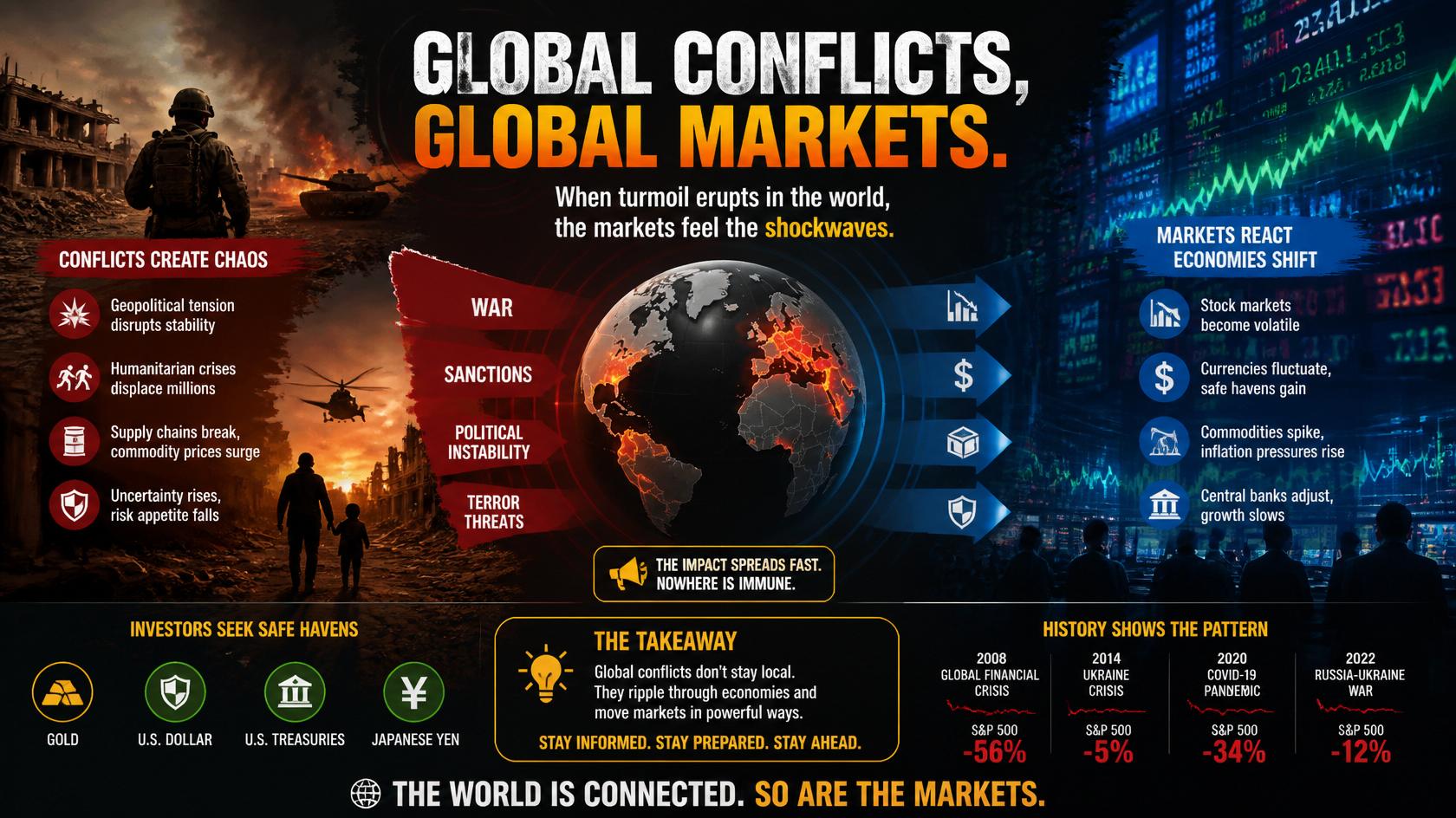
Financial markets are influenced by countless economic and political developments, but few events create as much uncertainty as global conflicts. Military confrontations, trade disputes, diplomatic tensions, and regional instability can quickly change investor sentiment and affect everything from stock prices and commodities to currencies and government bonds.
In 2026, global markets are more connected than ever. International trade, technology, and cross-border investment mean that an event in one part of the world can have consequences for financial markets thousands of miles away.
For investors and traders, understanding the connection between geopolitical events and market behavior can make it easier to manage risk and make more informed decisions.
This article examines how global conflicts affect financial markets, how different asset classes typically respond to uncertainty, and what investors can do to navigate periods of increased volatility.
Why Financial Markets React to Global Conflicts
Financial markets generally perform better when economic conditions are stable and predictable. Businesses can plan investments, consumers remain confident, and investors have a clearer idea of what the future may look like.
Global conflicts disrupt that stability.
A conflict can raise concerns about supply shortages, inflation, economic growth, government spending, and international trade. As uncertainty increases, investors often reassess their portfolios and move money toward assets they consider more defensive.
Modern technology can make these reactions even faster. News travels almost instantly through financial websites, trading platforms, television networks, and social media, allowing markets to respond within seconds to major geopolitical developments.
Investor Psychology During Times of Conflict
Investor psychology plays a major role in market movements during geopolitical crises.
When uncertainty rises, fear can quickly replace optimism. Investors may reduce their exposure to riskier assets and increase their allocation to investments that are traditionally viewed as safer.
Market sentiment can also change rapidly as new information becomes available. Signs of diplomatic progress may trigger a rally, while an escalation of tensions can cause sharp declines.
This emotional response is one reason market volatility often increases significantly during periods of geopolitical uncertainty.
The Impact on Stock Markets
Stock markets are often among the first areas to react when global tensions increase.
Investors may become concerned about weaker corporate earnings, reduced consumer spending, higher operating costs, disrupted supply chains, and slower economic growth.
Companies that rely heavily on international trade can be particularly vulnerable. Problems with shipping routes, access to raw materials, or overseas manufacturing can increase costs and disrupt operations.
Technology companies, manufacturers, airlines, tourism businesses, and multinational corporations may therefore experience increased volatility.
However, some industries can benefit from heightened geopolitical tensions.
Defense companies, cybersecurity businesses, energy producers, and companies involved in national security may attract greater investor interest when governments increase spending in these areas.
Gold as a Safe-Haven Investment
Gold has long been considered one of the world’s best-known safe-haven assets.
During periods of geopolitical uncertainty, some investors turn to gold as a way to diversify their portfolios and potentially protect wealth.
Gold is not directly tied to the financial performance of a single company or economy, which can make it attractive when confidence in traditional financial assets declines.
Gold does not automatically rise during every conflict, but prolonged uncertainty can increase demand for the metal.
Central bank activity can also influence the gold market, particularly when institutions increase their reserves during periods of economic or geopolitical uncertainty.
Oil Prices and Geopolitical Tensions
Energy markets can be particularly sensitive to global conflicts.
Major oil-producing regions are critical to the world’s energy supply. Military conflicts, sanctions, political instability, or disruptions to shipping routes can create concerns about future oil availability.
When markets anticipate tighter supply, crude oil prices can rise quickly.
Higher oil prices can then spread through the broader economy because energy is an important input for transportation, manufacturing, agriculture, and many other industries.
Businesses facing higher energy costs may experience pressure on profit margins, while consumers can face higher prices for fuel and other goods.
Currency Market Reactions
Foreign exchange markets can become highly volatile during geopolitical crises.
Investors often move toward currencies associated with countries they consider financially and politically stable.
The U.S. dollar has historically benefited from periods of global uncertainty because of its role as the world’s major reserve currency.
Other currencies may weaken if investors believe their economies are particularly exposed to geopolitical risks.
Currency movements can have a significant impact on multinational companies, exporters, importers, and international investors, making foreign exchange trends especially important during periods of instability.
Bond Markets During Uncertainty
Government bonds issued by financially stable countries can become more attractive when investors become concerned about riskier assets.
When demand for these bonds increases, their prices generally rise and their yields tend to fall.
This reflects a shift in investor priorities from pursuing higher returns toward preserving capital and reducing risk.
Bond markets can also provide useful information about expectations for economic growth, inflation, and future central bank decisions.
For this reason, professional investors closely monitor government bond yields during major geopolitical events.
Commodities Beyond Gold and Oil
Global conflicts can affect many commodities beyond gold and crude oil.
Agricultural commodities may experience price increases when conflicts interfere with farming, transportation, exports, or access to important supplies.
Industrial metals such as copper, aluminum, and nickel can also become more volatile when mining operations or international shipping routes are disrupted.
Critical minerals are becoming particularly important because they are used in semiconductors, renewable energy systems, electric vehicles, and defense technologies.
Any disruption to these supply chains can have consequences for manufacturers around the world.
Inflation and Economic Growth
Prolonged geopolitical conflicts can create additional inflationary pressure.
Higher energy prices, increased transportation costs, supply-chain disruptions, and greater government spending can all contribute to rising prices.
At the same time, uncertainty can reduce consumer confidence and business investment.
This creates a difficult environment for policymakers because they may need to manage inflation while also trying to support economic growth.
Financial markets pay close attention to inflation data because it can influence interest rates, corporate earnings, bond yields, and investment decisions.
Central Bank Responses
Central banks can play a major role when geopolitical events begin affecting the economy.
If a conflict significantly weakens economic activity, policymakers may consider reducing interest rates or introducing other measures designed to support growth.
However, if geopolitical tensions cause energy and commodity prices to rise sharply and create persistent inflation, central banks may be more reluctant to ease monetary policy.
These decisions can have a major impact on stocks, bonds, currencies, and commodities.
Investors therefore pay close attention to central bank statements and policy expectations during periods of geopolitical uncertainty.
The Role of Global Supply Chains
Modern businesses depend on complex supply chains that often stretch across multiple countries and continents.
A global conflict can disrupt shipping routes, delay deliveries, restrict exports, increase transportation expenses, or limit access to important raw materials.
These problems can reduce corporate profitability while also contributing to shortages and higher prices.
Industries such as automotive manufacturing, electronics, pharmaceuticals, and consumer goods can be particularly vulnerable to supply-chain disruptions.
As geopolitical risks increase, investors are paying greater attention to how well companies can diversify suppliers and strengthen their supply chains.
Opportunities for Investors
Although global conflicts create considerable uncertainty, they can also create opportunities.
Sharp market declines can sometimes allow long-term investors to purchase financially strong companies at more attractive valuations.
Certain industries may also benefit from changing government priorities and increased spending.
Defense technology, cybersecurity, infrastructure, domestic manufacturing, renewable energy, and critical-mineral companies may receive greater attention as countries focus on security and supply-chain independence.
The key is to avoid making investment decisions based purely on headlines.
Careful research and a long-term perspective can be more valuable than trying to predict every geopolitical development.
Risk Management During Geopolitical Events
Risk management becomes particularly important when markets are reacting to geopolitical uncertainty.
Diversifying across different asset classes and industries can reduce dependence on a single market.
Investors can also consider appropriate position sizing, avoid excessive leverage, and use risk-management tools such as stop-loss orders where suitable for their strategy.
Regular portfolio reviews can help investors adjust their exposure as economic conditions change without making decisions driven purely by fear.
During periods of extreme volatility, discipline can be just as important as identifying investment opportunities.
Long-Term Market Perspective
History shows that financial markets have experienced and eventually recovered from many major geopolitical crises.
Conflicts can cause significant short-term volatility, but economies can adapt through innovation, reconstruction, changes in trade relationships, and shifts in investment.
For long-term investors, focusing on fundamental economic trends rather than reacting to every short-term market movement can help maintain perspective.
Understanding that markets can recover over time may also make it easier to avoid emotionally driven investment decisions during periods of uncertainty.
The Future of Global Markets
As international markets become increasingly interconnected, geopolitical developments are likely to remain an important influence on investment decisions.
Energy security, cybersecurity, technological competition, trade policies, critical minerals, and international alliances are all likely to shape market sentiment in the years ahead.
Investors who combine geopolitical awareness with fundamental financial analysis and disciplined risk management may be better prepared for changing market conditions.
Rather than reacting emotionally to every headline, successful investors focus on the potential economic consequences of global events and how those developments could affect businesses, industries, and financial markets over the longer term.