
For generations, gold has been one of the first assets investors turn to when markets become uncertain. It has earned its reputation as a safe haven because it can help protect wealth during periods of inflation, financial stress, and currency instability.
But the investment landscape is changing. A different group of resources is gaining attention from governments, major institutions, technology companies, and commodity investors: rare earth metals.
These materials may not have the same history as gold, but they have something equally important in today’s economy: they are essential to many of the technologies people and businesses increasingly depend on. Electric vehicles, wind turbines, advanced electronics, defense equipment, robotics, and artificial intelligence infrastructure all rely on various rare earth elements.
As demand for these technologies continues to grow, rare earth metals are becoming increasingly important from both an economic and strategic perspective. For investors looking beyond traditional precious metals, the sector deserves a closer look.
What Exactly Are Rare Earth Metals?
Rare earth metals refer to a group of 17 chemical elements with distinctive magnetic, electrical, and optical characteristics. Despite their name, these elements are not necessarily rare in the Earth’s crust. The real challenge is finding deposits that can be mined economically and then separating and refining the individual elements.
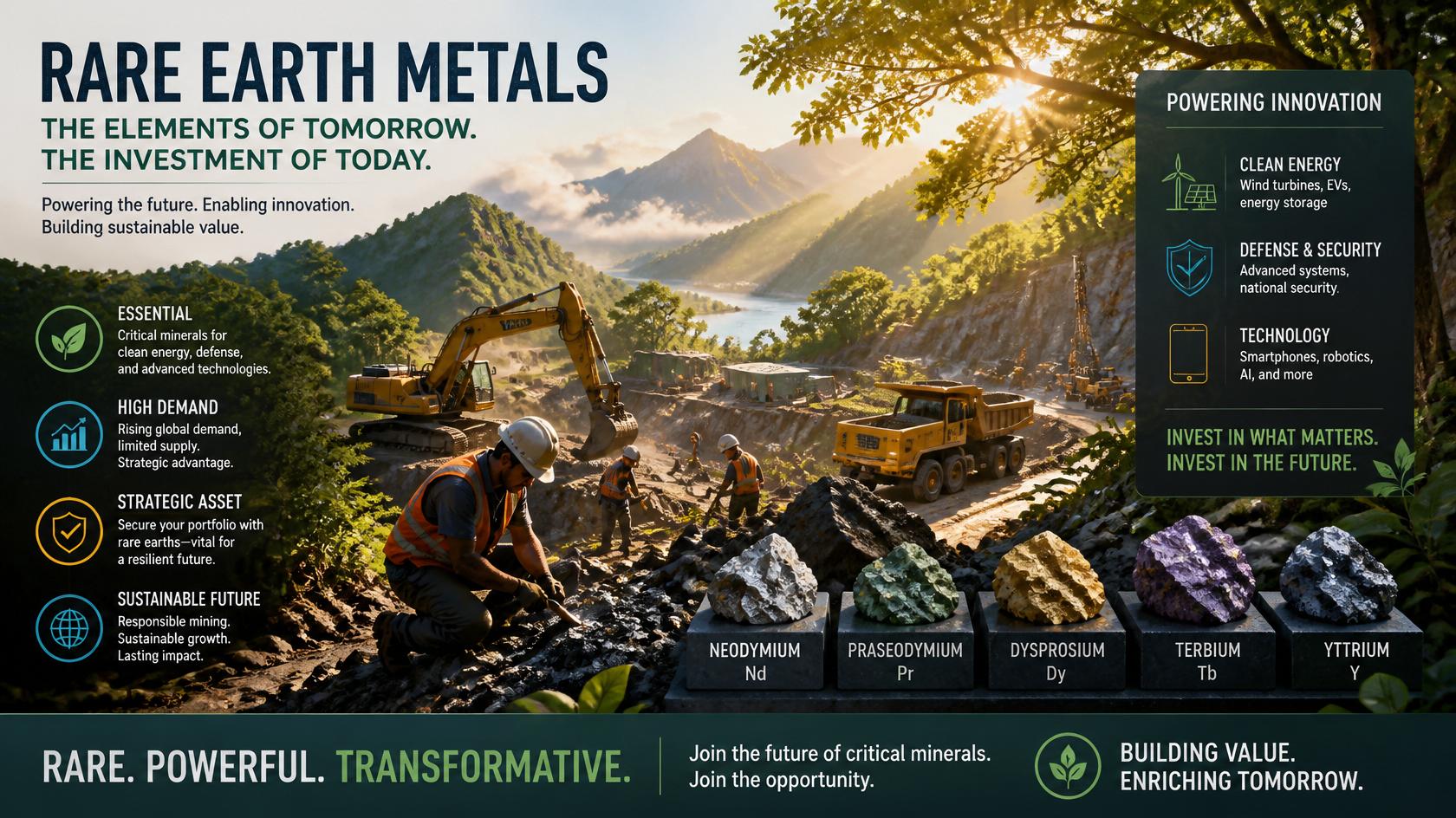
Some of the better-known rare earth elements include neodymium, praseodymium, dysprosium, terbium, lanthanum, cerium, and yttrium.
Each has different applications. Some are particularly important for powerful magnets, while others are used in electronics, catalysts, specialized glass, medical equipment, and advanced industrial applications.
This makes rare earth metals very different from gold. Gold is primarily valued as a store of wealth, a financial asset, and a material used in jewelry and specialized industries. Rare earth elements are mainly valuable because modern manufacturing needs them.
Why Rare Earth Metals Are So Important
It is difficult to look at modern technology without encountering products that depend on rare earth elements.
They are used in electric vehicles, smartphones, computers, wind turbines, satellites, military equipment, robotics, medical technologies, and various advanced manufacturing processes.
The shift toward cleaner energy is particularly important.
Electric vehicles use permanent magnets containing elements such as neodymium and praseodymium. Certain high-performance applications also use dysprosium to improve magnet performance at higher temperatures.
Wind turbines can also use rare earth-based permanent magnets to improve generator efficiency and reduce the size and complexity of some systems.
At the same time, the rapid expansion of artificial intelligence is creating additional demand for data centers, advanced computing equipment, robotics, and sophisticated electronics.
As the world becomes more electrified and digitally connected, the importance of the materials behind that transformation is likely to increase.
Why Investors Are Watching the Sector
Investors generally look for markets where demand has the potential to grow while supply remains difficult to expand.
Rare earth metals have several characteristics that make them interesting in this regard. Demand is supported by multiple growing industries, while developing new mining and refining capacity can take many years.
Building a mine is only part of the challenge. Rare earth elements must also be processed and separated, which requires specialized facilities, technology, capital, and expertise.
This creates a supply chain that can be difficult to expand quickly when demand suddenly increases.
Governments are also paying closer attention to the sector because rare earth materials are important to national security, advanced manufacturing, energy infrastructure, and technological competitiveness.
That combination of industrial demand and strategic importance is one reason institutional investors are increasingly interested in the market.
Rare Earth Metals vs. Gold
Gold and rare earth metals can both play a role in a diversified portfolio, but their investment characteristics are very different.
Gold has traditionally been used as a hedge against inflation, currency weakness, financial instability, and market uncertainty. Its value is strongly influenced by investor sentiment, interest rates, monetary policy, and global demand for a store of wealth.
Rare earth metals are much more closely connected to industrial activity and technological development. Their prices can be affected by manufacturing demand, government policy, supply-chain disruptions, mining activity, and technological changes.
This means the two assets may perform differently under different economic conditions.
Gold can benefit when investors become defensive, while rare earth metals may have greater upside potential when industrial investment and technological growth accelerate.
Rather than viewing them as direct competitors, investors may consider them two very different ways of gaining exposure to the global economy.
Electric Vehicles Could Be a Major Demand Driver
The growth of electric vehicles is one of the most important trends supporting long-term rare earth demand.
Many electric motors use powerful permanent magnets that contain neodymium and praseodymium. Some applications also use dysprosium to improve performance in demanding operating conditions.
As automakers increase EV production and consumers gradually shift toward electric transportation, demand for these materials could rise.
However, the relationship is not completely straightforward. Manufacturers are also working on alternative motor designs and technologies that can reduce or eliminate the need for certain rare earth elements.
Even so, the continued expansion of electric transportation remains an important factor for the sector.
Renewable Energy Adds Another Layer of Demand
Wind power is another industry closely connected to rare earth materials.
Some modern wind turbines use permanent-magnet generators because they can provide efficiency advantages, particularly in certain large-scale and offshore applications.
As countries continue investing in renewable energy and expanding electricity generation capacity, demand for the components used in these systems could increase.
The broader energy transition also involves battery storage, electric grids, power electronics, and other infrastructure. Not every part of this ecosystem relies heavily on rare earth elements, but the overall shift toward electrification is increasing demand for a wide range of critical minerals.
Artificial Intelligence Is Creating New Demand
The AI boom is not only about software.
Behind every advanced AI model is a physical infrastructure network that includes data centers, servers, processors, cooling systems, networking equipment, robotics, and power infrastructure.
Many advanced technologies involved in this ecosystem use specialized materials, including various rare earth elements.
The expansion of AI infrastructure could therefore become another long-term source of demand for critical minerals.
As companies continue investing heavily in computing capacity and automation, the need for advanced materials could grow alongside the digital economy.
Limited Supply Could Create Opportunities
One of the biggest attractions of rare earth metals is the complexity of bringing new supply online.
Mining a deposit does not automatically solve the supply problem. The material must be processed and separated into individual elements before it can be used in many high-value applications.
That refining process requires specialized knowledge and infrastructure.
Environmental regulations, permitting requirements, geopolitical tensions, trade restrictions, and large capital requirements can further slow the development of new projects.
If demand grows faster than production capacity, the resulting supply pressure could contribute to higher prices. However, investors should remember that commodity markets can also respond through new mines, recycling, technological substitutions, and changes in demand.
The Geopolitical Side of Rare Earth Metals
Rare earth elements have moved beyond being simple industrial commodities. They have become strategically important resources.
Governments are increasingly interested in securing reliable supplies because these materials are used in defense systems, aerospace technology, clean-energy equipment, telecommunications, and advanced manufacturing.
Countries that depend heavily on overseas sources are looking for ways to strengthen domestic supply chains. That includes developing new mines, building processing facilities, supporting recycling, and establishing partnerships with other producing nations.
This geopolitical competition could have a major influence on the rare earth industry in the years ahead.
Risks Investors Need to Understand
The potential of rare earth metals does not mean the sector is guaranteed to deliver strong returns.
Commodity prices can be extremely volatile. Changes in global manufacturing, economic growth, government policy, or technological development can quickly affect demand.
New mining projects can also increase supply and put downward pressure on prices. At the same time, companies may develop technologies that use smaller quantities of rare earth elements or replace them altogether.
Another important consideration is that rare earth metals are not one single commodity. Each element has its own supply chain, applications, production levels, and demand drivers.
Investors should therefore avoid assuming that strong demand for one rare earth element automatically means the entire sector will perform equally well.
How Can Investors Gain Exposure?
There are several ways investors can gain exposure to the rare earth industry.
One option is investing in mining companies involved in exploration and production. These businesses can provide significant upside if projects succeed, but they also carry substantial operational, financial, regulatory, and commodity-price risks.
Another approach is using exchange-traded funds focused on rare earths or broader critical-mineral industries. These can provide exposure to multiple companies rather than relying on a single mining operation.
Investors can also look at businesses involved in refining, recycling, magnet production, and advanced materials.
The best approach depends on an investor’s risk tolerance, investment horizon, and understanding of the industry.
What Could the Future Look Like?
The long-term outlook for rare earth metals is closely tied to some of the biggest economic trends of the coming years.
Electric transportation, renewable energy, artificial intelligence, robotics, defense modernization, advanced manufacturing, and digital infrastructure are all expanding areas of the global economy.
At the same time, developing new rare earth supply is complicated, expensive, and time-consuming.
That combination could make rare earth elements increasingly important as strategic resources.
Still, investors should expect volatility rather than a straight upward price path. Commodity markets rarely move in a perfectly predictable direction, and technological breakthroughs or new sources of supply can change the outlook quickly.
Final Thoughts
Gold remains one of the world’s most established safe-haven assets, but rare earth metals represent a very different investment story.
Gold is primarily connected to wealth preservation and financial confidence, while rare earth elements are tied directly to technological progress and industrial demand.
As the global economy moves toward electrification, automation, artificial intelligence, and advanced manufacturing, these materials could become even more valuable strategically.
For investors, the biggest opportunity may not be choosing rare earth metals instead of gold. Instead, understanding how each asset responds to different economic conditions can help build a more diversified view of the commodities market.
The rare earth sector is still developing, and significant risks remain. But with technology and geopolitical competition reshaping global supply chains, rare earth metals could become one of the most closely watched commodity markets of the next decade.