
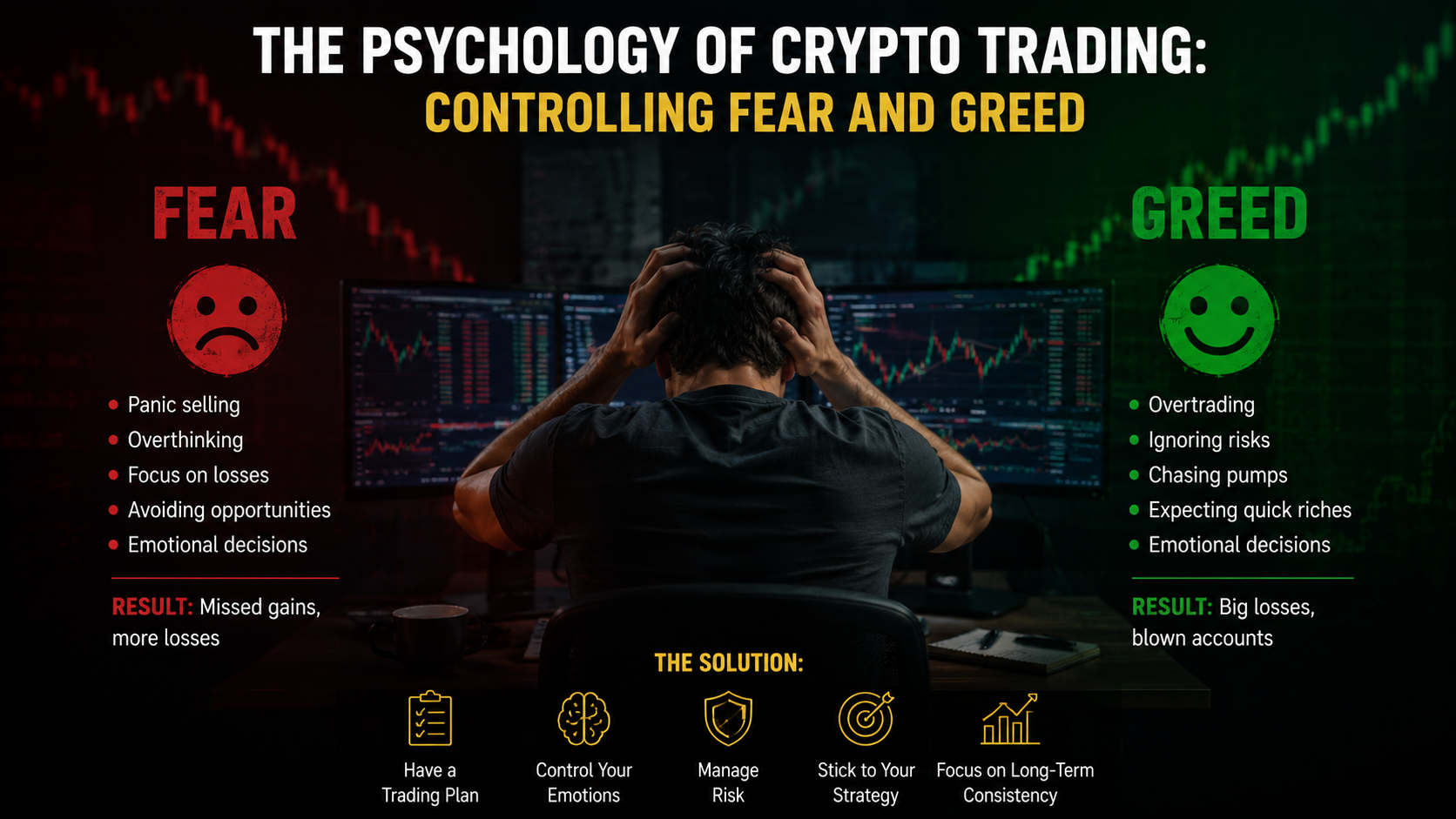
Market declines can trigger fear, while rapidly rising prices can make traders overly confident and willing to take risks they normally would avoid. Learning how to recognize these emotional reactions—and, more importantly, how to manage them—is a crucial part of becoming a disciplined cryptocurrency trader.
Crypto trading is not only about reading charts or finding the right entry point. Your mindset can have just as much influence on your results. Even a well-designed strategy can fail if emotions take control at the wrong moment.
This guide explores the psychology behind cryptocurrency trading, explains how fear, greed, and other emotional biases affect decision-making, and offers practical ways to develop greater emotional discipline.
Why Psychology Matters in Crypto Trading
Financial markets are ultimately influenced by human decisions. Traders react to news, price movements, expectations, and uncertainty, which means emotions are always part of the market.
Cryptocurrency markets can make these reactions even stronger because prices can move dramatically within a short period. A sudden rally may create excitement and confidence, while a sharp decline can quickly turn optimism into panic.
When emotions take over, traders often abandon strategies they carefully planned in advance. They may close positions too early, enter trades without proper analysis, or increase their risk simply because they feel confident.
The goal is not to completely eliminate emotions. That is unrealistic. Instead, successful traders learn to recognize emotional reactions and avoid allowing them to control important financial decisions.
Understanding Fear in Cryptocurrency Trading
Fear usually appears when traders become concerned about losing money or uncertainty surrounding the market.
A sudden price decline, negative regulatory announcement, security incident, or unexpected economic development can quickly create anxiety. When prices continue falling, investors may assume the decline will never end.
This can lead to panic selling.
The problem is that emotional selling often happens after prices have already fallen significantly. Traders may lock in losses because they are more focused on escaping the discomfort of the moment than evaluating the market objectively.
Fear can also work in the opposite direction. Some investors avoid potentially attractive opportunities simply because they are afraid of losing money.
Recognizing fear as an emotional response rather than automatically treating it as a trading signal can help investors make more rational decisions.
Understanding Greed in Cryptocurrency Trading
Greed often appears when traders become overly focused on making larger profits.
During strong bull markets, rising cryptocurrency prices can create a powerful sense of optimism. Seeing an asset gain rapidly may convince traders that the price will continue climbing indefinitely.
This can encourage them to enter trades after significant price increases, increase their position sizes, or use excessive leverage.
Greed can also cause traders to ignore predetermined profit targets. Instead of taking a reasonable gain, they continue holding because they believe an even bigger profit is just around the corner.
Eventually, market momentum can weaken or reverse, turning an apparently successful trade into a significant loss.
Setting realistic expectations and following predetermined trading rules can help keep greed under control.
The Fear of Missing Out
Fear of missing out, commonly known as FOMO, is one of the biggest psychological challenges in cryptocurrency trading.
Imagine seeing an asset rise rapidly while other traders appear to be making substantial profits. It is easy to feel that you are missing an opportunity.
That feeling can lead to impulsive decisions.
A trader may buy without researching the asset, ignore technical signals, or enter after a major price surge simply because they are afraid the opportunity will disappear.
Unfortunately, this behavior can result in buying near a market peak.
Experienced traders understand that the market will always provide new opportunities. Missing one trade is usually far less damaging than entering a position purely because of FOMO.
Panic Selling
Panic selling happens when investors quickly sell their holdings because they fear prices will continue falling.
Sharp market declines can create an emotional chain reaction. As more investors sell, prices may fall further, creating even more fear.
While reducing exposure can sometimes be a sensible risk-management decision, selling purely because of panic can cause traders to lock in losses without properly evaluating the situation.
Having predetermined stop-loss levels and a clear trading plan can make it easier to respond logically during market corrections.
Staying calm when others are reacting emotionally is an important skill for long-term traders.
Overconfidence After Winning Trades
Winning trades can create their own psychological problems.
After experiencing several successful trades, a trader may begin to believe that their decisions are almost always correct. This can lead to larger positions, excessive trading, or weaker risk controls.
The market, however, does not reward traders simply because they were successful yesterday.
Even an excellent strategy will produce losing trades from time to time.
Experienced traders understand that every position carries uncertainty. They continue following their risk-management rules even after a series of profitable trades.
Remaining humble after success can be just as important as staying calm after a loss.
Revenge Trading
Revenge trading occurs when a trader tries to recover a recent loss as quickly as possible.
After a losing trade, frustration can create an urge to immediately enter another position. Instead of waiting for a high-quality setup, the trader may take unnecessary risks simply to get the lost money back.
This often creates another loss, followed by even more frustration.
The cycle can continue until a relatively small loss becomes a much larger one.
Accepting that losses are a normal part of trading makes it easier to step away, review what happened, and wait for the next genuine opportunity.
The market does not owe anyone a recovery trade.
Confirmation Bias
Confirmation bias occurs when traders look for information that supports what they already believe while ignoring evidence that challenges their opinion.
For example, someone who believes a cryptocurrency is going to rise may pay attention only to positive news, bullish forecasts, and optimistic social media posts.
At the same time, they may ignore declining volume, negative developments, or signs of weakening momentum.
This can create a distorted view of the market.
Good traders deliberately look for evidence that could prove their original idea wrong. Considering both bullish and bearish possibilities encourages more objective decision-making.
The Importance of Discipline
Discipline is one of the most important qualities a trader can develop.
A disciplined trader does not change their strategy every time the market becomes exciting or frightening. Instead, they follow predefined rules.
These rules might include entry conditions, exit targets, stop-loss levels, maximum position sizes, and acceptable risk per trade.
Making these decisions before entering a position reduces the chance of making emotional choices later.
Over time, discipline can turn trading from an emotional guessing game into a more structured process.
Building Confidence Through Preparation
Real trading confidence comes from preparation rather than hope.
Learning technical analysis, understanding blockchain technology, studying market behavior, and practicing risk management can give traders a stronger foundation for making decisions.
When traders understand why they entered a position and what would invalidate their original idea, they are less likely to panic when prices move unexpectedly.
Using a demo account or studying historical charts can also provide valuable practice without immediately putting real money at risk.
Knowledge does not eliminate uncertainty, but it can make uncertainty easier to manage.
The Role of Risk Management
Risk management is closely connected to trading psychology.
When a trader risks too much money on a single position, even a small price movement can create significant emotional pressure.
On the other hand, keeping position sizes reasonable makes it easier to accept temporary losses without abandoning a trading plan.
Stop-loss orders, appropriate position sizing, diversification, and realistic profit targets can all help reduce unnecessary pressure.
Protecting your capital is not simply a financial goal. It also creates the psychological stability needed to make better decisions.
Developing Patience
Cryptocurrency markets operate around the clock, which can create the feeling that traders should always be doing something.
They do not.
Constantly searching for trades can lead to overtrading and unnecessary risk.
Experienced traders understand that some of the best decisions involve waiting. A strong setup may not appear for hours, days, or even longer.
Instead of trading because the market is moving, focus on trading only when your predefined conditions are met.
Sometimes, staying out of the market is the smartest decision you can make.
Creating a Written Trading Plan
A written trading plan can provide valuable guidance when emotions become intense.
Your plan should clearly explain your trading goals, preferred markets, entry conditions, exit rules, risk limits, and position-sizing approach.
Having these rules written down makes it easier to remain consistent when prices suddenly move against you.
A good trading plan should not remain unchanged forever. Traders can review their performance and make adjustments as they gain experience and learn more about their strategy.
Keeping a Trading Journal
A trading journal can reveal psychological patterns that are difficult to notice in the moment.
Record details such as why you entered a trade, your entry and exit prices, position size, market conditions, and how you felt before and during the trade.
Over time, these records can reveal recurring behaviors.
You may discover that you trade too aggressively after winning streaks, exit too quickly when prices fall, or enter trades because of social media hype.
Recognizing these patterns is the first step toward changing them.
Avoiding Information Overload
Cryptocurrency traders have access to an enormous amount of information.
News websites, social media, influencers, analysts, online communities, and market alerts can provide a constant stream of opinions.
Too much information can actually make decision-making harder.
One source may predict a major rally while another expects a crash. Constantly switching between opinions can create uncertainty and encourage impulsive trades.
Instead, focus on a small number of reliable sources and build decisions around your own trading plan and research.
More information is not necessarily better information.
Developing a Long-Term Mindset
Many emotional mistakes happen because traders become too focused on individual trades.
A single winning trade does not make a successful trader, and one losing trade does not make someone a failure.
Trading performance should be evaluated over a larger sample of trades and over a meaningful period of time.
A long-term perspective makes it easier to accept short-term losses without immediately changing a strategy that may still be working.
Thinking in terms of probabilities rather than guarantees can also help traders maintain realistic expectations.
Learning From Losses
Losses are an unavoidable part of trading.
Even highly experienced traders experience losing positions. What separates disciplined traders from emotional ones is often how they respond afterward.
Instead of treating a loss as a personal failure, examine what happened.
Was the trade consistent with your strategy? Did you follow your risk limits? Was the entry based on analysis or emotion? Did unexpected news change the market?
Answering these questions can turn a losing trade into a useful learning experience.
The objective is not to avoid every loss. It is to prevent one mistake from becoming a repeated pattern.
Building Stronger Emotional Discipline
Developing emotional discipline takes time. It does not happen after reading a few articles or experiencing a handful of trades.
Start by creating clear rules and following them consistently. Keep your position sizes manageable, maintain a trading journal, avoid unnecessary market noise, and take breaks when emotions become difficult to control.
Most importantly, understand that successful trading is a long-term process.
The cryptocurrency market will continue to experience rallies, crashes, unexpected news, and periods of extreme volatility. Traders cannot control those events, but they can control how they respond to them.