
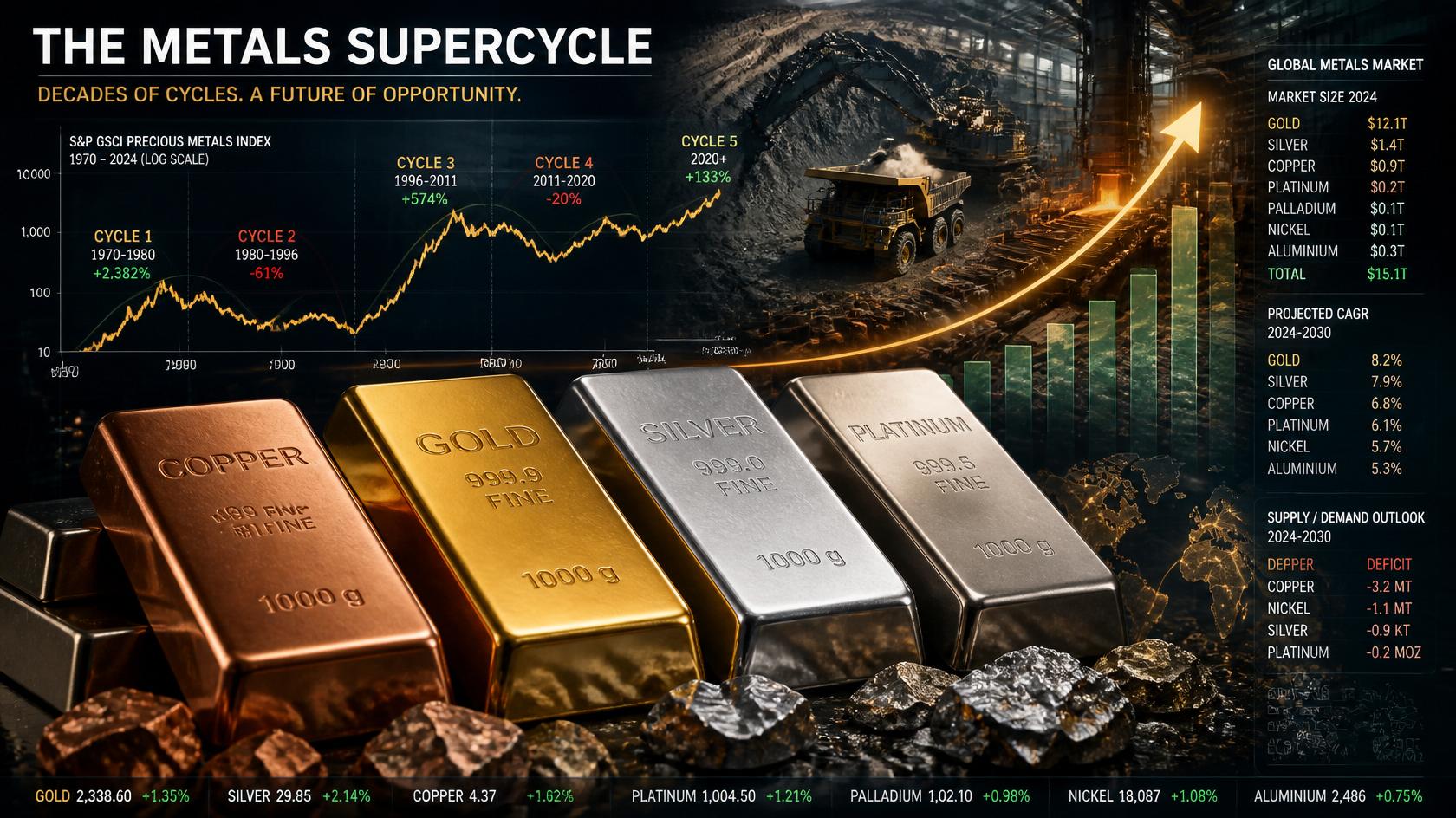
The possibility of a new metals supercycle has become an increasingly important topic in financial markets. As artificial intelligence, electric vehicles, renewable energy, infrastructure projects, and advanced manufacturing continue to expand, the world’s demand for essential metals is growing rapidly.
At the same time, the mining industry faces a major challenge. Years of relatively low investment in new mining projects have left producers with limited capacity to respond quickly to rising demand.
This combination of strong consumption and restricted supply has led many investors and traders to consider whether the global economy could be entering another long-term metals cycle.
For traders, understanding what drives a metals supercycle can provide valuable insight into long-term commodity trends and help identify potential opportunities while managing risk.
What Is a Metals Supercycle?
A metals supercycle is an extended period in which demand for commodities remains unusually strong, often pushing prices higher for many years.
Unlike a short-term rally caused by a temporary supply disruption or sudden change in investor sentiment, a supercycle is usually driven by major structural changes in the global economy.
Industrialization, urbanization, population growth, technological innovation, infrastructure development, and changes in energy consumption can all contribute to these long-lasting cycles.
One of the biggest challenges is that mining supply cannot respond quickly. A new mine can take many years to move from initial exploration through permitting, financing, construction, and commercial production.
If demand grows faster than new supply can come online, the resulting shortage can keep prices elevated for an extended period.
Why Traders Are Watching Metals in 2026
Several major economic trends are increasing interest in the metals market.
Artificial intelligence is one of the newest demand drivers. The rapid construction of data centers and expansion of high-performance computing require large amounts of electrical equipment, power infrastructure, cooling systems, and advanced electronics.
These projects can increase demand for metals such as copper, aluminum, silver, and other industrial materials.
The global shift toward renewable energy is another important factor. Solar farms, wind turbines, battery storage systems, electric vehicles, and upgraded power grids generally require significant amounts of metal.
Infrastructure spending is also adding to demand. Governments and private companies are investing in electricity networks, transportation systems, manufacturing facilities, telecommunications, and modern urban infrastructure.
Together, these trends could support strong metal consumption throughout the decade.
Why Supply Could Become a Problem
Strong demand is only one side of a potential supercycle. Supply is equally important.
Developing a mine is not a quick process. Companies must locate viable deposits, complete feasibility studies, secure financing, obtain regulatory approvals, build infrastructure, and construct processing facilities before production can begin.
The entire process can take many years.
Mining companies also reduced investment in some areas during previous commodity downturns. That limited spending can create a delayed supply problem because today’s production depends partly on investments made years earlier.
Environmental requirements, labor shortages, rising operating expenses, political instability, and difficulties obtaining permits can add further delays.
If new production fails to keep pace with demand, commodity prices may come under additional upward pressure.
Copper Could Be One of the Biggest Winners
Copper is often described as one of the most important metals for the modern economy.
It is widely used in electrical wiring, power grids, electric vehicles, renewable energy systems, telecommunications, construction, and industrial equipment.
The expansion of AI infrastructure adds another potential source of demand because data centers require significant electrical and power-distribution infrastructure.
The energy transition is also highly copper-intensive. New electricity networks, renewable power projects, charging infrastructure, and electrified transportation all require substantial amounts of copper.
This combination of traditional industrial demand and new technology-related consumption makes copper one of the metals traders are watching closely.
Silver Has a Unique Position
Silver occupies an interesting position because it combines the characteristics of a precious metal with significant industrial demand.
It is used in solar technology, electronics, electrical components, medical applications, and various advanced manufacturing processes.
At the same time, investors purchase silver as a precious metal and potential store of value.
This dual role means silver can benefit from both industrial expansion and increased investment demand.
However, silver is also known for significant price volatility. Traders should be prepared for sharp moves in both directions rather than assuming that strong long-term fundamentals will produce a smooth upward trend.
Nickel and the Battery Industry
Nickel has become an important commodity in the energy transition, particularly because certain battery technologies use nickel to improve energy density.
As electric vehicle production and energy storage systems expand, demand for battery-related materials could remain significant.
However, nickel is also a good example of why commodity investing requires careful analysis. Changes in battery chemistry, new production capacity, substitution, and changing EV demand can all influence its long-term outlook.
Strong demand does not automatically guarantee higher prices if supply expands even faster.
Lithium Remains Closely Linked to Electrification
Lithium is another major material associated with electric vehicles and energy storage.
The rapid expansion of battery manufacturing has made lithium strategically important to the global energy transition.
However, lithium markets can be particularly volatile. New mining projects and rapid increases in production can create periods of oversupply, causing prices to fall even when long-term demand remains strong.
For traders, this highlights the importance of monitoring both consumption and production rather than focusing on demand forecasts alone.
Aluminum Could Benefit From Infrastructure Growth
Aluminum is another important industrial metal with applications across transportation, construction, aerospace, packaging, and manufacturing.
Its relatively low weight makes it particularly useful in vehicles and aircraft, while its widespread use in construction makes it important for infrastructure development.
As governments increase spending on transportation networks, power systems, buildings, and industrial facilities, aluminum demand could receive additional support.
Platinum and Palladium
Platinum and palladium have their own unique supply and demand dynamics.
Both metals are used in automotive applications and various industrial processes. Platinum is also receiving increased attention because of its potential role in hydrogen-related technologies.
Their relatively specialized markets can produce significant price swings when supply or demand changes unexpectedly.
For traders, these metals may offer opportunities but can also carry greater market-specific risks than larger commodity markets.
How Inflation Can Affect Metals
Inflation can provide additional support to commodity markets because metals are physical assets with real-world industrial value.
When production costs rise, mining companies may face higher expenses for energy, labor, equipment, transportation, and financing. At the same time, investors may increase their exposure to commodities as a way of diversifying against declining purchasing power.
However, inflation alone does not guarantee higher metal prices.
If inflation becomes severe enough to trigger aggressive interest-rate increases and a major economic slowdown, industrial demand could weaken.
The relationship between inflation and commodities therefore depends on the broader economic environment.
Interest Rates Still Matter
Central-bank policy can have a significant influence on commodity markets.
Lower interest rates can encourage borrowing, construction, business investment, and consumer spending. Stronger economic activity generally supports demand for industrial metals.
Higher rates can have the opposite effect by making borrowing more expensive and slowing economic growth.
However, if structural demand from electrification, infrastructure, and technology remains strong, metals can continue attracting investment even when interest rates are elevated.
For traders, watching interest-rate expectations alongside manufacturing data, infrastructure spending, and commodity inventories can provide a clearer picture of market conditions.
Geopolitics Could Add More Volatility
Metals are increasingly becoming strategic resources.
Trade restrictions, export controls, sanctions, political instability, military conflicts, and supply-chain disruptions can all affect the availability of critical materials.
Governments are also working to secure domestic or allied sources of important minerals because reliable access is increasingly viewed as an economic and national-security issue.
These developments can create sudden price movements.
A supply disruption may push prices sharply higher, while an unexpected policy change or new source of production can have the opposite effect.
Trading Strategies for a Metals Supercycle
Trading during a potential supercycle requires a different mindset from chasing short-term price movements.
Trend-following strategies can be useful when strong fundamental demand creates persistent price trends. Traders may use technical analysis to identify breakouts, pullbacks, support levels, resistance zones, and momentum changes.
Diversification can also be valuable. Instead of focusing on a single metal, traders may monitor several markets with different demand drivers.
Fundamental indicators can provide additional insight. Global inventories, mining output, manufacturing activity, infrastructure spending, energy investment, and demand from emerging technologies can all help traders understand where the market may be heading.
Most importantly, risk management should remain a priority. Even during powerful commodity bull markets, prices can experience deep corrections.
What Could Stop a Metals Supercycle?
No commodity boom lasts forever.
A major global recession could reduce manufacturing activity and weaken demand for industrial metals.
Technology could also change the equation. New materials, alternative battery chemistries, more efficient designs, or recycling could reduce the amount of certain metals required for specific applications.
Higher commodity prices can also encourage mining companies to invest in new production. Eventually, additional supply may begin catching up with demand and reduce price pressure.
Government policies, slower infrastructure spending, weaker economic growth, or slower adoption of clean-energy technologies could also change the outlook.
Successful traders should therefore avoid assuming that prices will continue rising indefinitely.
The Long-Term Outlook for Metals
The global economy is going through a major transformation.
Artificial intelligence is driving investment in data centers and advanced computing. Renewable energy is expanding electricity generation capacity. Electric vehicles are changing transportation. Governments are upgrading power grids and infrastructure, while countries are increasingly focused on energy and mineral security.
All of these developments require physical resources.
At the same time, the mining industry faces long development timelines and years of relatively cautious investment in new production.
If demand continues expanding faster than supply, several metals could experience sustained upward pressure over the coming years.
That does not mean every metal will rise at the same pace, or that prices will move higher without major corrections. Commodity markets are highly cyclical and can change quickly.
Still, the combination of technological growth, electrification, infrastructure investment, and constrained mining supply makes the potential metals supercycle one of the most interesting long-term themes for traders and investors in 2026.
For those willing to look beyond short-term market noise, understanding these structural supply-and-demand trends may be just as important as analyzing price charts.