
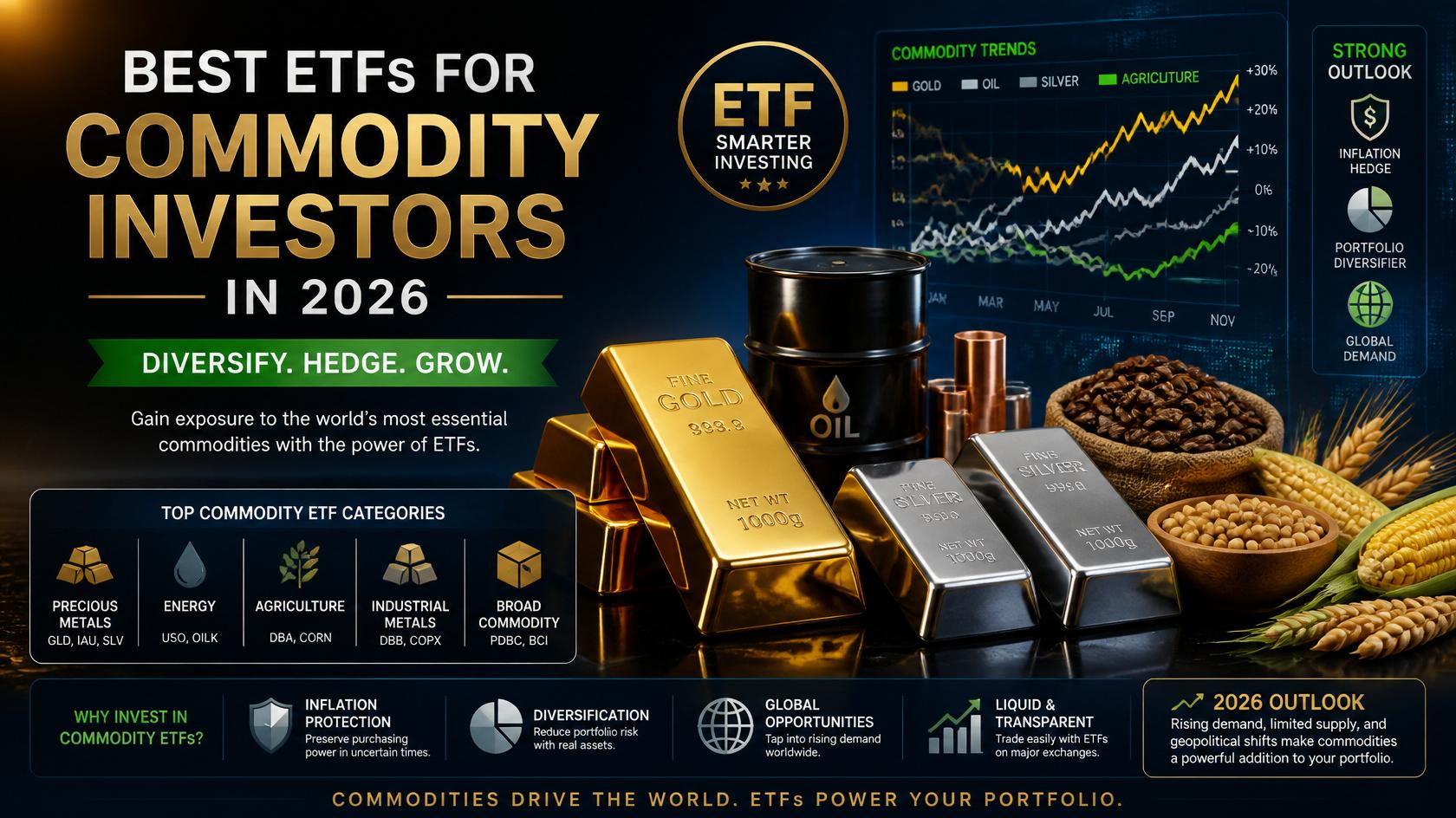
Commodity investing has become increasingly popular as investors look for ways to diversify their portfolios, protect against inflation, and benefit from long-term changes in the global economy. In 2026, exchange-traded funds (ETFs) remain one of the simplest ways to gain exposure to commodities without having to buy physical assets or trade futures contracts directly.
Commodity ETFs give investors access to a wide range of markets, including gold, silver, oil, natural gas, agriculture, industrial metals, and diversified commodity baskets. They also offer the convenience of stock-market trading, transparency, and relatively low costs compared with some traditional ways of investing in commodities.
This guide looks at why commodity ETFs are attracting attention in 2026, the different types available, and how investors can choose funds that fit their goals and risk tolerance.
Why Commodity ETFs Are Popular in 2026
Global markets continue to face uncertainty from inflation, geopolitical tensions, changing interest rates, and shifting supply chains. Because commodities can behave differently from stocks and bonds, they can provide another layer of diversification for investors.
There are also several long-term trends supporting commodity demand. Renewable energy development, artificial intelligence infrastructure, demand for critical minerals, and rising global energy consumption are all creating new opportunities across commodity markets.
Instead of trying to pick individual mining, energy, or agricultural companies, many investors prefer ETFs because a single fund can provide exposure to an entire commodity market or group of commodities.
Understanding Commodity ETFs
Commodity ETFs are funds designed to track the performance of one or more commodities.
Some funds are backed by physical commodities. Gold and silver ETFs, for example, may hold actual metal in secure storage.
Other ETFs gain exposure through futures contracts. These funds attempt to follow commodity prices without directly owning the underlying physical asset.
There are also ETFs that invest in companies involved in commodity-related industries, including mining, oil production, agriculture, and energy infrastructure.
Each structure works differently, so investors should understand what a fund actually owns before putting money into it.
Gold ETFs Remain a Safe-Haven Choice
Gold continues to be viewed as a store of value during periods of economic and geopolitical uncertainty.
Gold ETFs give investors exposure to gold prices without the hassle of purchasing, storing, and insuring physical bullion.
In 2026, gold remains attractive because of factors such as central bank buying, geopolitical uncertainty, and concerns about inflation.
For investors looking for a defensive component in their portfolio, gold ETFs can provide a convenient way to gain exposure to the precious metal.
Silver ETFs Benefit from Industrial Growth
Silver has a unique position in the commodity market because it is both a precious metal and an important industrial material.
Demand for silver is supported by areas such as solar-panel manufacturing, electric vehicles, electronics, and other advanced industrial applications.
This combination can make silver more volatile than gold, but it can also give the metal additional upside when industrial activity is strong.
Silver ETFs allow investors to participate in these potential trends without having to purchase and store physical silver themselves.
Energy ETFs Continue Offering Opportunity
Energy remains one of the most actively traded areas of the commodity market.
Oil and natural gas ETFs provide exposure to energy prices, which can be influenced by global consumption, production levels, weather, geopolitical developments, and decisions made by major energy producers.
Growing electricity consumption, expanding liquefied natural gas exports, and continued industrial activity are also supporting long-term energy demand.
For investors who expect energy prices to remain strong over the coming years, energy-focused ETFs can provide a straightforward way to gain exposure to the sector.
Uranium ETFs Gain Momentum
Nuclear energy has attracted renewed attention as governments look for reliable sources of low-carbon electricity.
New reactor construction, longer operating lives for existing nuclear facilities, and rising electricity demand are all supporting the long-term case for uranium.
Instead of trying to choose individual uranium mining companies, investors can use uranium-focused ETFs to spread their exposure across multiple producers and developers.
As nuclear power becomes an increasingly important part of the global energy discussion, uranium ETFs have become an area worth watching in the commodity market.
Industrial Metals ETFs
Industrial metals are benefiting from several long-term trends, including infrastructure investment, electrification, and technological development.
Copper is particularly important because it is widely used in electric vehicles, renewable energy systems, electrical grids, and data centers.
Other critical materials, including lithium, nickel, cobalt, and rare earth elements, are important to batteries, electronics, and clean-energy technologies.
Industrial metals ETFs allow investors to gain exposure to these broader trends without taking on the risks associated with investing in just one mining company.
Agricultural Commodity ETFs
Agricultural commodities are influenced by factors such as weather, population growth, trade policies, crop production, and changing consumer demand.
ETFs can provide exposure to commodities including wheat, corn, soybeans, coffee, sugar, and livestock.
Agricultural markets can be highly volatile because unexpected weather events or changes in global supply can quickly affect prices.
However, agricultural commodities often respond differently from energy and metals, which can make them useful for portfolio diversification.
Broad Commodity ETFs
Some investors prefer not to focus on one commodity or sector.
Broad commodity ETFs can provide exposure to several markets at the same time, including energy, precious metals, industrial metals, and agricultural commodities.
This approach can reduce dependence on the performance of one particular commodity while allowing investors to participate in broader commodity trends.
For long-term investors looking for more balanced commodity exposure, diversified funds may be worth considering.
Benefits of Investing in Commodity ETFs
Commodity ETFs offer several advantages over directly owning physical commodities or trading futures.
They can provide diversification through exposure to one or multiple commodities.
They also trade during normal stock-market hours, making them relatively easy to buy and sell.
Investors do not have to deal with the storage and insurance requirements associated with physical commodities.
Many ETFs also have relatively low management fees, although costs vary from fund to fund.
Another advantage is accessibility. Investors can gain exposure to international commodity markets without necessarily needing a specialized futures-trading account.
Risks Investors Should Consider
Commodity ETFs are not risk-free investments.
Commodity prices can change rapidly in response to economic conditions, geopolitical events, weather, production disruptions, and shifts in supply and demand.
Futures-based ETFs can also behave differently from the spot price of a commodity because of factors such as contract-roll costs and the structure of the futures market.
ETFs that invest in mining or energy companies face additional risks. Their performance can be affected by operating costs, management decisions, production problems, regulations, and company-specific financial issues.
For that reason, investors should understand how an ETF is structured before investing rather than assuming every commodity fund works in the same way.
Artificial Intelligence and Commodity Demand
Artificial intelligence is creating new demand across several commodity markets.
The rapid growth of AI requires massive data centers and reliable electricity supplies. This can increase demand for energy resources such as natural gas and uranium while also supporting investment in renewable power infrastructure.
AI and semiconductor facilities also require industrial metals such as copper and silver, along with other critical materials.
As AI adoption expands, commodity producers that supply the physical resources needed to build and operate this infrastructure could benefit from long-term demand.
This makes strategic-resource commodity ETFs an interesting area for investors following the AI growth story.
Inflation Protection
Inflation is another reason investors consider commodities.
When the prices of goods and services rise, the value of many raw materials can also increase because commodities are essential inputs used throughout the economy.
However, commodities do not always rise during inflationary periods, so they should not be viewed as a guaranteed hedge.
Still, their historical relationship with inflation makes commodity ETFs attractive to investors looking for additional portfolio diversification and potential protection against declining purchasing power.
Choosing the Right Commodity ETF
The right commodity ETF depends largely on an investor’s objectives and tolerance for risk.
More conservative investors may prefer gold or diversified commodity ETFs, particularly when their main goal is portfolio diversification and stability.
Investors seeking greater growth potential may be more interested in industrial metals, uranium, or energy-focused ETFs. These areas can offer stronger upside during favorable market conditions, but they can also experience larger price swings.
Investors interested in income may consider commodity-related equity ETFs that hold dividend-paying mining and energy companies.
Before investing, it is useful to examine factors such as the ETF’s expense ratio, assets under management, liquidity, holdings, structure, and historical performance.
Building a Balanced Commodity Portfolio
Instead of concentrating everything in one commodity, investors may consider spreading exposure across several areas of the market.
A diversified commodity allocation could include precious metals for defensive exposure, industrial metals for economic and technology growth, energy for global consumption, and agriculture for additional diversification.
The goal is not to predict which commodity will perform best every year. Instead, a balanced approach can help reduce dependence on one market while giving investors exposure to several long-term global trends.
Commodity ETFs can be useful portfolio tools, but they still require careful research. Understanding the fund’s structure, the underlying commodity, market conditions, and potential risks is essential before making an investment decision.
.