
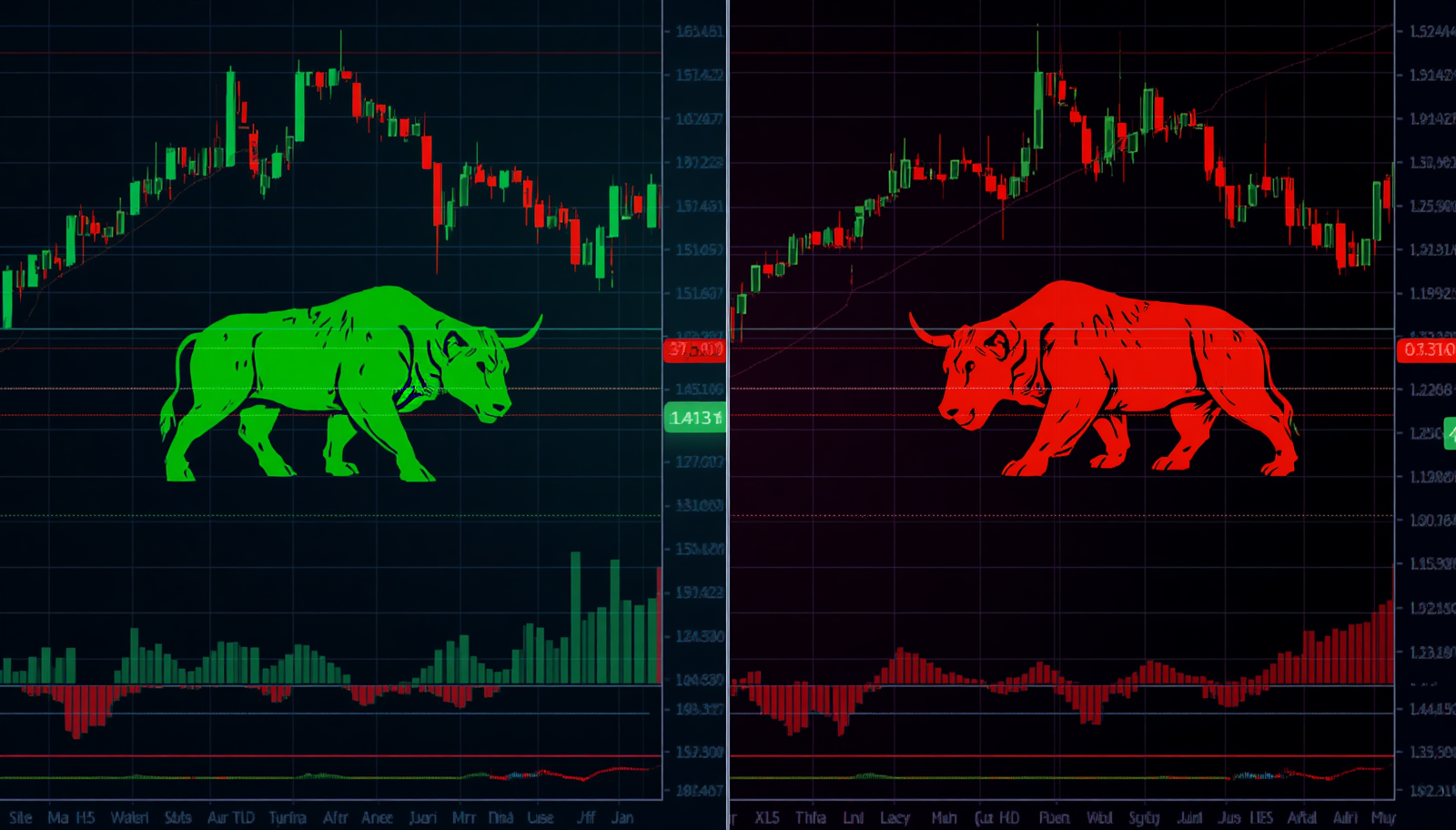
Cryptocurrency markets move through different phases, and understanding those phases can make a big difference in how traders approach their decisions. Two of the most important market conditions are bull markets and bear markets.
A bull market generally occurs when cryptocurrency prices continue moving higher over an extended period. Confidence grows, trading activity increases, and more investors become optimistic about future prices.
A bear market is almost the opposite. Prices experience a prolonged decline, investor confidence weakens, and fear and uncertainty become more common.
Knowing which type of market you are dealing with can help you choose a more suitable strategy, manage risk, and avoid making emotional decisions. However, identifying a market cycle is never completely certain. Several indicators should be considered together rather than relying on a single signal.
What Is a Bull Market?
A bull market is a period when cryptocurrency prices generally trend upward for an extended time.
As prices rise, investor confidence often increases as well. More traders may enter the market because they expect the upward trend to continue. Positive developments such as increased institutional interest, technological improvements, favorable regulations, and wider blockchain adoption can also support bullish sentiment.
Bull markets can last for months or even years, but they are rarely a straight line upward. Corrections and temporary declines can occur even during a strong bullish trend.
For this reason, traders should avoid assuming that every price drop marks the beginning of a bear market.
What Is a Bear Market?
A bear market occurs when cryptocurrency prices experience a significant and sustained decline.
During these periods, investor confidence usually falls and trading sentiment can become increasingly negative. Traders may reduce their positions, move toward less risky assets, or wait for clearer signs of recovery.
Bear markets can develop for many reasons, including weak demand, unfavorable economic conditions, regulatory uncertainty, security problems, or a sharp reversal following an extended period of price growth.
Although bear markets can be difficult, they can also create opportunities for investors who carefully research projects and focus on long-term fundamentals rather than trying to predict every short-term movement.
Why Market Cycles Matter
Understanding market cycles helps traders avoid using the same strategy in every market condition.
During bullish periods, traders may focus on established trends and look for opportunities to participate in continued upward movement.
During bearish conditions, protecting capital becomes more important. Traders may reduce position sizes, keep more cash available, or concentrate on assets with stronger fundamentals.
The key is recognizing that a strategy that works well during a strong bull market may perform very differently when market conditions change.
Analyzing Long-Term Price Trends
Price trends are one of the simplest ways to evaluate the broader direction of the cryptocurrency market.
Bullish markets generally create a pattern of higher highs and higher lows. This indicates that buyers continue stepping in at increasingly higher prices.
Bearish markets tend to form lower highs and lower lows, showing that sellers are maintaining control.
Rather than focusing only on daily price movements, traders can examine weekly and monthly charts to get a clearer view of the larger trend. Short-term fluctuations can sometimes be misleading, while longer time frames provide more useful context.
Trading Volume
Price alone does not always tell the complete story. Trading volume can provide additional information about the strength behind a market move.
When prices rise alongside increasing volume, it can suggest that more buyers are participating in the move.
On the other hand, if prices continue climbing while volume gradually falls, the trend may be losing momentum.
During bearish periods, increasing selling volume can indicate strong downward pressure.
Volume should not be treated as a standalone signal, but combining it with price action can give traders a better understanding of market strength.
Using Moving Averages
Moving averages are widely used to identify longer-term cryptocurrency trends.
A short-term moving average remaining above a longer-term moving average can indicate stronger bullish momentum. When the shorter average falls below the longer average, it may suggest that bearish pressure is increasing.
Moving averages also smooth out some of the short-term noise found in cryptocurrency prices, making broader trends easier to see.
Many traders use multiple moving averages together, but no combination can guarantee that a market will continue in a particular direction.
Understanding Market Sentiment
Investor psychology has a major influence on cryptocurrency prices.
Bull markets are often associated with optimism, increasing media coverage, strong investor participation, and growing confidence.
Bear markets tend to produce fear, uncertainty, negative news, and declining participation.
Extreme sentiment can sometimes provide useful warning signs. When optimism becomes excessive, prices may become vulnerable to a correction. Likewise, periods of extreme fear can sometimes occur near major market bottoms.
Still, sentiment should be used as supporting information rather than a reason to enter or exit a trade by itself.
Support and Resistance
Support and resistance levels can help traders understand how the market is behaving around important prices.
Support is an area where buying interest has previously helped prevent prices from falling further. Resistance is an area where selling pressure has previously limited upward movement.
In a strong bull market, prices may repeatedly break through resistance levels. Previous resistance can sometimes become new support after a successful breakout.
During a bear market, support levels may repeatedly fail as sellers maintain control.
Watching how price reacts around these zones can provide valuable clues about market strength.
Market Capitalization
Looking at the total cryptocurrency market capitalization can provide a broader perspective than analyzing a single coin.
A rising overall market capitalization may indicate that more capital is entering digital assets, while a declining market capitalization can suggest that investors are reducing their exposure.
This broader view can help traders determine whether a price increase is part of a market-wide movement or limited to only a few cryptocurrencies.
Market-wide participation is generally an important characteristic of stronger and more sustainable trends.
Bitcoin’s Influence on the Market
Bitcoin remains an important influence on the cryptocurrency market.
When Bitcoin experiences strong upward momentum, investor confidence can spread across other digital assets. At the same time, a significant Bitcoin decline can place pressure on altcoins as traders become more cautious.
Bitcoin dominance can also provide clues about where capital is moving within the cryptocurrency market.
Although Bitcoin does not determine the direction of every cryptocurrency, its performance is closely watched because of its size and influence.
Institutional Investment
Institutional participation has become an increasingly important factor in digital asset markets.
Activity from financial institutions, investment funds, asset managers, and publicly traded companies can influence liquidity and investor confidence.
Growing institutional involvement may support broader market adoption and strengthen market infrastructure.
However, institutional participation should not automatically be interpreted as a guarantee of rising prices. Large investors can also reduce positions or sell assets when market conditions change.
Economic Conditions
Cryptocurrency does not operate independently from the broader economy.
Interest rates, inflation, economic growth, employment conditions, monetary policy, and geopolitical developments can all influence investor appetite for risk.
When economic conditions are favorable, investors may be more willing to hold higher-risk assets such as cryptocurrencies.
When interest rates rise or economic uncertainty increases, investors may become more cautious and reduce exposure to volatile assets.
Combining macroeconomic analysis with technical indicators can provide a more complete view of the market.
Blockchain and On-Chain Activity
One unique advantage of cryptocurrency markets is the availability of blockchain data.
Traders can examine information such as wallet activity, transaction volume, network usage, and developer participation to gain insight into how a blockchain ecosystem is developing.
Increasing network activity can sometimes indicate growing adoption and interest.
Declining activity may signal weakening participation, although the meaning can vary depending on the cryptocurrency and its specific use case.
On-chain analysis works best when combined with price, volume, and fundamental research.
Technical Indicators
Technical indicators can help traders confirm whether a market is developing bullish or bearish characteristics.
The Relative Strength Index (RSI) can help measure momentum and identify potentially overextended conditions.
The Moving Average Convergence Divergence (MACD) can provide information about momentum and possible changes in trend direction.
Bollinger Bands can help traders evaluate volatility and identify periods when price movement is expanding or contracting.
No indicator is perfect. Using several forms of evidence together is generally more useful than depending entirely on one technical tool.
Avoid Emotional Trading
Emotions can become especially powerful during major cryptocurrency market movements.
When prices rise rapidly, greed may encourage traders to buy simply because they fear missing out.
When prices collapse, fear can lead investors to sell during panic without considering their original strategy.
Neither reaction is ideal.
A written trading plan can help investors stay disciplined during periods of extreme volatility. Having predefined entry conditions, exit rules, and risk limits makes it easier to avoid impulsive decisions.
Strategies for Bull Markets
Bull markets can create attractive opportunities, but they can also encourage excessive risk-taking.
Many traders focus on established trends and look for opportunities to enter during reasonable pullbacks rather than chasing rapidly rising prices.
Diversifying across carefully researched assets can also reduce dependence on a single cryptocurrency.
Profit-taking is another important consideration. Strong rallies are often followed by corrections, so assuming that prices will continue rising indefinitely can expose traders to unnecessary risk.
The goal should be disciplined participation rather than trying to capture every possible gain.
Strategies for Bear Markets
Bear markets generally require a more defensive approach.
Some traders reduce their position sizes or wait for clearer signs that selling pressure is weakening.
Long-term investors may use market declines as opportunities to gradually accumulate cryptocurrencies they believe have strong fundamentals. However, buying simply because prices have fallen is not enough. An asset can continue declining for a long time.
Rather than trying to identify the exact bottom, disciplined investors often focus on research, gradual positioning, diversification, and appropriate risk management.
Common Mistakes When Identifying Market Trends
One of the biggest mistakes traders make is assuming that a short-term price movement represents a completely new market cycle.
A strong bull market can experience significant corrections, while a bear market can produce powerful temporary rallies.
Another mistake is relying on a single indicator. Price trends, volume, sentiment, economic conditions, market capitalization, and blockchain activity can all provide different pieces of information.
Ignoring these factors can lead to an incomplete assessment of the market.
Successful traders look for confirmation across multiple signals before deciding whether a major trend has genuinely changed.
The Importance of Patience
Identifying a bull or bear market takes time.
Major market cycles usually develop gradually rather than changing direction overnight. Trying to predict every small price movement can lead to unnecessary trades and emotional decisions.
Instead of constantly reacting to short-term volatility, traders can focus on the bigger picture and wait for stronger evidence before making major changes to their strategy.
Patience, discipline, and risk management remain essential regardless of whether the market is rising or falling.ning to identify bull and bear markets is an important skill for cryptocurrency traders and investors. Price trends, trading volume, moving averages, market sentiment, support and resistance, Bitcoin dominance, institutional activity, economic conditions, and blockchain data can all help provide a clearer picture of the current environment.
However, no indicator can predict the future with certainty.
The most effective approach is to combine multiple forms of analysis, maintain realistic expectations, and adjust your strategy as market conditions evolve. By focusing on risk management and avoiding emotional decisions, traders can become better prepared to navigate both bullish and bearish cryptocurrency markets.