
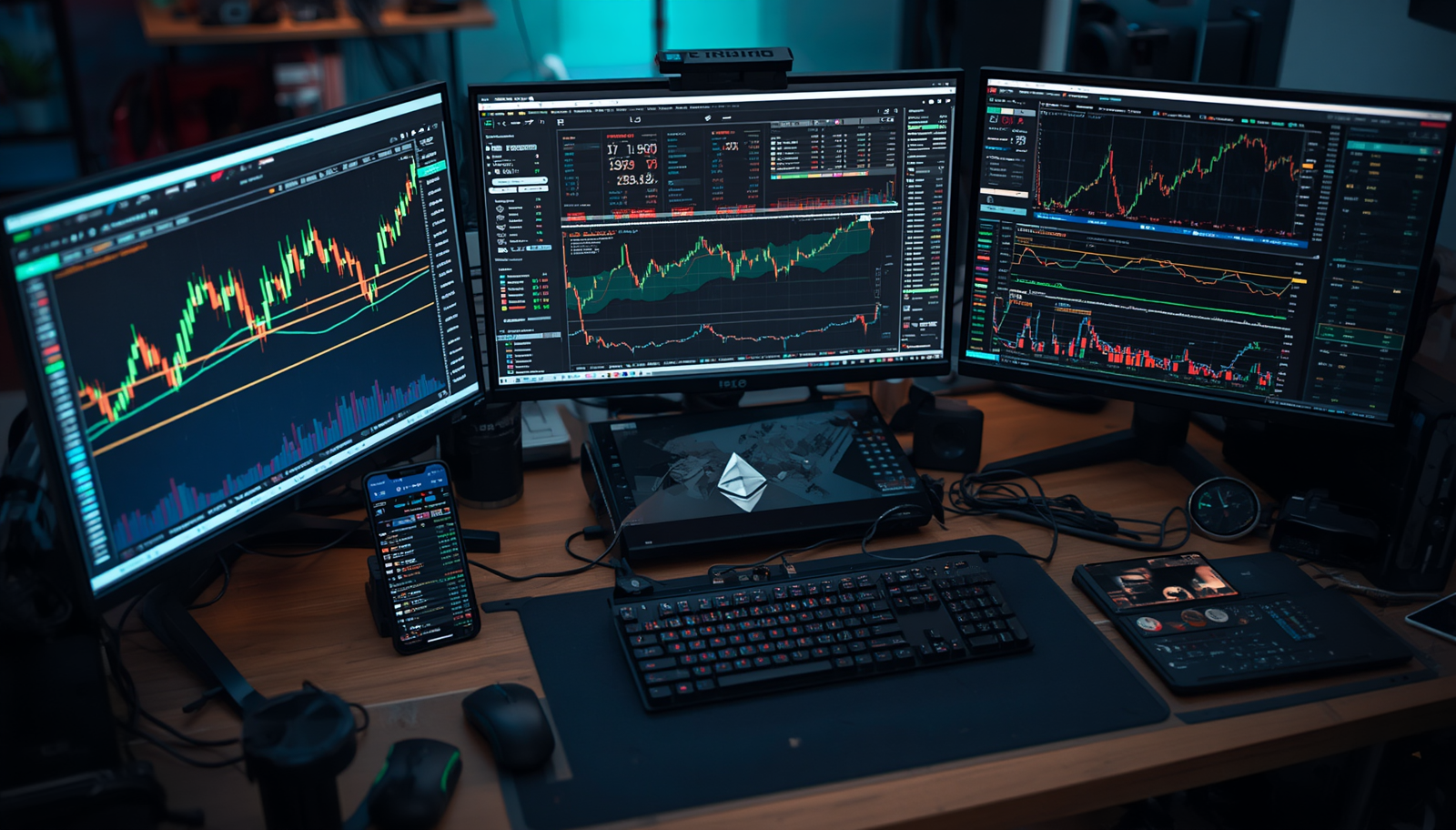
With cryptocurrency markets operating around the clock and prices sometimes changing within minutes, successful trading requires more than instinct or luck. Traders need reliable tools to analyze the market, track opportunities, manage risk, and make decisions based on useful data.
Whether you are just starting out or already managing a diverse crypto portfolio, the right tools can make your trading process more organized and efficient. Charting platforms, portfolio trackers, market scanners, blockchain analytics, trading journals, and risk management tools can all play an important role.
This guide explores the most useful crypto trading tools, explains what they do, and shows how they can help traders build a more disciplined approach to the market.
Why Crypto Trading Tools Matter
Unlike traditional financial markets, cryptocurrency trading takes place 24 hours a day, seven days a week. Prices can move sharply because of breaking news, regulatory announcements, changing sentiment, economic developments, or large transactions.
Trying to monitor everything manually can quickly become overwhelming.
Trading tools simplify this process by helping investors analyze price movements, discover potential opportunities, monitor their portfolios, and keep track of risk. Instead of making decisions based purely on emotion, traders can use relevant data to support their strategies.
The goal is not to use as many tools as possible. It is to find a small set of reliable tools that actually improve your decision-making.
Cryptocurrency Charting Platforms
Charting platforms are among the most important tools for anyone who uses technical analysis.
They allow traders to study historical price movements, identify trends, analyze candlestick patterns, and apply technical indicators.
Most advanced charting platforms support tools such as moving averages, Bollinger Bands, RSI, MACD, Fibonacci retracements, trend lines, and support and resistance levels.
The ability to switch between different time frames is also important. A short-term trader may focus on minute or hourly charts, while a swing or position trader may rely more heavily on daily and weekly charts.
Learning to read price charts effectively can be more valuable than simply adding dozens of indicators to a screen.
Technical Indicator Tools
Technical indicators help traders interpret price behavior, momentum, volatility, and market trends.
Common indicators include moving averages, RSI, MACD, Bollinger Bands, stochastic oscillators, and volume-based indicators.
Rather than depending on one indicator to generate every trading decision, experienced traders often combine a few complementary signals.
For example, a trader might use a moving average to identify the broader trend and RSI to evaluate momentum.
Indicators are useful for confirmation, but they should not be treated as guaranteed signals.
Portfolio Management Tools
Managing several cryptocurrencies across different accounts can become difficult without proper organization.
Portfolio management tools bring important information together in one place. Depending on the platform, they may show current holdings, portfolio value, asset allocation, profit and loss, transaction history, and overall performance.
Some services can connect with supported exchanges and wallets, making it easier to keep records updated automatically.
A clear overview of your portfolio can also reveal whether you are too heavily invested in one asset or sector.
Market Scanner Tools
Market scanners save traders from manually checking hundreds or thousands of cryptocurrencies.
These tools can search the market for assets that meet specific conditions, such as unusual volume, major price movements, breakouts, high volatility, or changes in technical indicators.
For example, a trader interested in momentum strategies could configure a scanner to highlight cryptocurrencies experiencing significant price increases accompanied by higher trading activity.
This makes research faster and helps traders concentrate on markets that deserve closer attention.
Crypto News Aggregators
News can have an immediate impact on cryptocurrency prices.
Regulatory decisions, exchange announcements, blockchain upgrades, security incidents, institutional developments, and major economic events can all trigger substantial price movements.
News aggregators bring information from multiple sources into one place, making it easier to stay updated.
However, speed should not come at the expense of accuracy. Traders should verify important information before making financial decisions, particularly when news originates from social media or unverified accounts.
Blockchain Analytics Tools
One of the unique advantages of cryptocurrency markets is that many blockchain transactions are publicly visible.
Blockchain analytics tools can provide information about wallet activity, transaction volumes, exchange inflows and outflows, network usage, and movements involving large holders.
This type of on-chain information can add another layer to traditional technical and fundamental analysis.
For example, unusual movements of large amounts of cryptocurrency to or from exchanges may attract traders’ attention because they can provide clues about changing market activity.
On-chain data is most useful when interpreted alongside other market information rather than treated as a standalone prediction tool.
Crypto Trading Bots
Trading bots automate predefined trading strategies.
Once properly configured, a bot can monitor market conditions continuously and execute trades when specific criteria are met.
Automation can be useful for traders who want to follow a systematic strategy without watching charts all day. It can also reduce some emotional reactions that often occur during periods of rapid price movement.
However, bots are not automatic profit machines. A poorly designed strategy can lose money just as quickly as a poorly executed manual strategy.
Traders should understand how their bots work, test strategies carefully, and monitor performance regularly.
Risk Management Tools
Risk management should be at the center of every trading strategy.
Risk management tools can help traders calculate position sizes, estimate potential losses, determine risk-to-reward ratios, and plan stop-loss levels.
For example, before entering a trade, a trader can calculate how much capital would be lost if the stop-loss were triggered.
This encourages traders to think about downside risk before focusing on potential profits.
Protecting capital allows traders to remain in the market long enough to benefit from future opportunities.
Cryptocurrency Screeners
Crypto screeners help investors narrow down the enormous number of digital assets available today.
Traders can filter cryptocurrencies using factors such as market capitalization, trading volume, price performance, volatility, technical indicators, and other available metrics.
Instead of spending hours examining individual coins, a screener can quickly produce a shortlist of assets that match specific criteria.
Screeners are particularly useful during research, although every shortlisted asset still requires further analysis before a trade is considered.
Sentiment Analysis Tools
Market sentiment can have a powerful influence on cryptocurrency prices.
Sentiment analysis tools examine information from news sources, social media, search activity, and online communities to estimate whether investors are becoming more optimistic or fearful.
Modern AI systems can process large amounts of information quickly, making sentiment analysis more sophisticated than it was in the past.
Still, sentiment can change rapidly. Traders should use it as additional context rather than treating it as a direct buy or sell signal.
Cryptocurrency Price Alerts
It is impossible for most traders to watch cryptocurrency charts continuously.
Price alerts solve this problem by notifying investors when an asset reaches a particular price or when unusual market activity occurs.
For example, a trader could set an alert near an important resistance level instead of repeatedly checking the chart throughout the day.
Alerts encourage traders to follow their plans and wait for predetermined conditions rather than entering positions impulsively.
Trading Journal Software
A trading journal is one of the simplest tools for improving performance over time.
A good journal records details such as the asset traded, entry price, exit price, position size, reason for entering, stop-loss level, profit or loss, and the trader’s thoughts during the trade.
After completing a series of trades, reviewing this information can reveal recurring mistakes.
Perhaps certain setups perform poorly, trades are being closed too early, or position sizes are becoming too large after a winning streak.
Without a trading journal, identifying these patterns can be much harder.
Tax Tracking Tools
Crypto transactions can create complicated record-keeping requirements.
Tax tracking tools can organize transactions from supported exchanges and wallets, calculate gains and losses, and generate reports that can assist with tax preparation.
Keeping accurate records from the beginning is much easier than trying to reconstruct years of transactions later.
Tax rules vary by jurisdiction, so traders should verify their obligations with qualified local tax professionals or official guidance.
Mobile Trading Applications
Mobile trading has made it possible to monitor cryptocurrency markets almost anywhere.
Modern applications can provide live prices, charts, portfolio information, alerts, market news, and trade execution.
This convenience is useful, but traders should avoid confusing constant access with the need to constantly trade.
Strong account security is also essential. Using unique passwords, multi-factor authentication, and other available security features can help protect digital assets and trading accounts.
Artificial Intelligence Trading Assistants
Artificial intelligence is becoming increasingly useful in cryptocurrency research.
AI systems can process historical prices, technical indicators, market sentiment, blockchain data, and economic information at high speed.
Some tools can summarize market conditions, identify patterns, generate research insights, or assist with portfolio analysis.
However, AI should be treated as a decision-support tool rather than a guaranteed source of profitable predictions.
Markets are unpredictable, and even sophisticated algorithms can produce incorrect conclusions.
Educational Platforms
No trading tool can replace knowledge.
Educational resources can help traders understand blockchain technology, technical analysis, risk management, trading psychology, portfolio construction, and market fundamentals.
Beginners should focus on understanding how markets work before experimenting with complicated automated systems.
Continuous education also becomes important as cryptocurrency technology, regulations, and trading practices evolve.
Common Mistakes When Choosing Trading Tools
Having more tools does not automatically make someone a better trader.
One common mistake is filling a chart with so many indicators that the trader receives conflicting signals and becomes unsure what to do.
Another mistake is purchasing expensive software without understanding how it works.
Some traders also rely completely on automated systems without learning the strategy behind them.
A better approach is to start with a few essential tools and learn how each one contributes to your trading process.
How to Build Your Personal Trading Toolkit
Your ideal toolkit should match your trading style, experience, and goals.
A beginner may only need a reliable charting platform, portfolio tracker, risk management calculator, educational resources, and trading journal.
As experience grows, market scanners, on-chain analytics, sentiment tools, and advanced research platforms can be added.
More advanced traders may explore algorithmic systems, AI-assisted analysis, and automated portfolio management.
Building your toolkit gradually makes it easier to understand each resource instead of becoming overwhelmed by unnecessary features.
The Future of Crypto Trading Tools
Cryptocurrency technology continues to develop rapidly.
Artificial intelligence, machine learning, blockchain analytics, automation, predictive modeling, and increasingly sophisticated portfolio tools are likely to become even more accessible.
Future trading platforms may offer more personalized analysis, real-time market insights, automated risk monitoring, and smarter portfolio management.
However, technology will not eliminate the need for sound judgment.
The most successful approach is to combine useful technology with research, realistic expectations, disciplined risk management, and a clear trading strategy.