
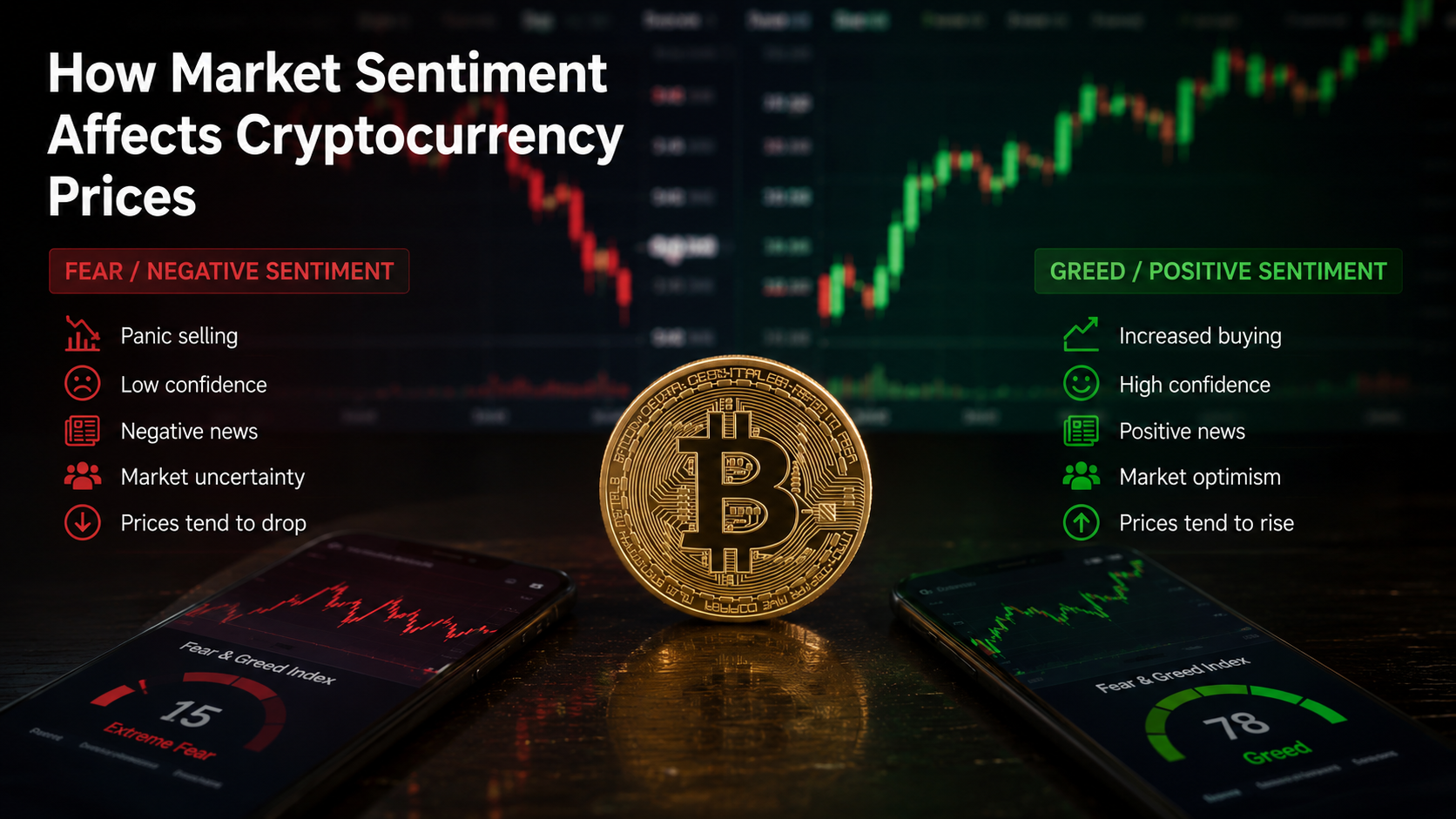
Market sentiment reflects how investors collectively feel about a cryptocurrency or the broader digital asset market. In crypto, those feelings can change incredibly quickly. Because the market operates 24 hours a day and reacts almost instantly to global developments, a single news story, social media trend, or regulatory announcement can shift investor confidence within minutes.
Understanding market sentiment can give traders useful context when analyzing price movements. It can help them recognize when optimism is building, when fear is spreading, and when market participants may be reacting emotionally rather than logically.
This guide explains what market sentiment means, what influences it, how it affects cryptocurrency prices, and how traders can use sentiment analysis without allowing emotions to control their own decisions.
What Is Market Sentiment?
Market sentiment is the overall mood or attitude of investors toward a particular asset or financial market.
When traders believe prices are likely to rise, sentiment is generally considered bullish. This often encourages buying activity and can push prices higher.
When investors expect prices to fall, sentiment becomes bearish. Fear and uncertainty can encourage selling, increasing downward pressure.
Cryptocurrency markets are particularly sensitive to sentiment because many digital assets are relatively young, highly speculative, and influenced heavily by expectations about future adoption and technology. As a result, investor perception can sometimes have a major impact on prices, especially over shorter periods.
Why Market Sentiment Matters in Cryptocurrency
Cryptocurrencies can experience much larger price swings than many traditional investments. Prices may react to social media discussions, breaking news, regulatory decisions, technological developments, or statements from influential market participants.
Unlike established companies, many cryptocurrencies do not have traditional earnings reports or long financial histories that investors can use to determine value.
This means expectations and public perception can play an especially important role.
By understanding the mood of the market, traders can gain additional context instead of simply reacting after a major price movement has already occurred.
Bullish Market Sentiment
Bullish sentiment develops when investors become increasingly confident that cryptocurrency prices will rise.
During these periods, more people may enter the market, trading activity can increase, and positive news tends to receive greater attention.
As demand grows, rising prices can attract even more buyers. This creates a cycle in which optimism supports price growth and rising prices create additional optimism.
However, strong confidence can eventually turn into excessive speculation. When investors become convinced that prices can only move higher, valuations may become difficult to justify.
Learning to distinguish healthy optimism from irrational enthusiasm is an important part of market analysis.
Bearish Market Sentiment
Bearish sentiment appears when investors become concerned about declining prices.
Negative regulatory developments, security incidents, weak market conditions, economic uncertainty, or disappointing technological developments can all contribute to a more pessimistic outlook.
As fear spreads, investors may begin reducing their positions. Increased selling can then place additional pressure on prices.
Bear markets can be uncomfortable, but they can also create opportunities for investors who focus on long-term fundamentals rather than making decisions based purely on short-term fear.
Fear and Greed Drive Market Cycles
Fear and greed are two of the strongest emotions influencing financial markets.
Greed tends to become more visible during powerful rallies. Investors see prices climbing and may assume the trend will continue indefinitely. This can encourage them to buy aggressively, increase their risk, or enter positions without proper analysis.
Fear often becomes dominant during sharp declines. Investors may rush to sell because they are worried about losing even more money.
This emotional cycle can cause traders to buy after prices have already risen substantially and sell after major declines.
Experienced traders understand that emotional extremes can influence market behavior and try to avoid allowing the crowd’s emotions to dictate their own decisions.
The Role of News in Market Sentiment
News can have an immediate effect on cryptocurrency sentiment.
Positive developments such as greater institutional adoption, technological improvements, supportive regulations, major partnerships, or increased blockchain usage can strengthen investor confidence.
On the other hand, exchange failures, security breaches, restrictive regulations, legal disputes, or broader economic concerns can quickly damage sentiment.
Because cryptocurrency markets never officially close, traders can react to major developments at almost any time.
The challenge is separating meaningful information from speculation, rumors, and exaggerated headlines. Good traders verify important information before making financial decisions.
Social Media and Online Communities
Social media has become a major source of cryptocurrency discussion.
Investors regularly share opinions, trading ideas, breaking news, price predictions, and project updates across online communities.
A wave of positive discussion can increase attention toward a cryptocurrency and potentially encourage additional buying.
Negative discussions can have the opposite effect, particularly when rumors spread quickly.
However, popularity does not automatically mean an investment is sound. Traders should treat social media as a source of information and sentiment rather than as a substitute for independent research.
Institutional Investment and Market Confidence
Institutional participation can have a meaningful effect on cryptocurrency sentiment.
When investment firms, financial institutions, asset managers, or publicly traded companies announce cryptocurrency investments, it may increase confidence among other market participants.
Institutional involvement can also improve perceptions of cryptocurrency as an established asset class and potentially increase market liquidity.
However, institutional activity can work in both directions. Large purchases may support bullish sentiment, while significant selling can contribute to short-term volatility.
Government Regulations and Investor Psychology
Regulation is another major factor affecting cryptocurrency sentiment.
Clear and supportive rules can reduce uncertainty and make investors more comfortable participating in the market.
Conversely, restrictive policies, trading limitations, enforcement actions, or regulatory investigations may cause investors to become more cautious.
Because cryptocurrency regulations differ between countries and continue to evolve, traders often monitor government announcements closely.
Understanding how regulatory developments affect investor psychology can make sudden market reactions easier to interpret.
Economic Conditions Influence Sentiment
Cryptocurrency does not operate independently from the wider economy.
Inflation, interest rates, employment data, currency movements, economic growth, and geopolitical events can all influence investor behavior.
When financial conditions are favorable, investors may be more willing to take risks and allocate money toward volatile assets such as cryptocurrencies.
When interest rates rise or economic uncertainty increases, investors may become more defensive and reduce exposure to higher-risk investments.
Looking at cryptocurrency sentiment alongside broader economic conditions provides a more complete view of the market.
Technical Analysis and Market Sentiment
Price charts can provide useful clues about changing investor sentiment.
Technical analysts examine price action, trading volume, momentum, support and resistance, moving averages, and other indicators to understand the balance between buyers and sellers.
For example, a sustained price increase accompanied by strong trading volume may suggest growing demand.
Likewise, falling prices combined with heavy selling volume can indicate that bearish pressure is increasing.
Combining technical analysis with sentiment analysis gives traders two useful perspectives: what investors are doing and how they appear to be feeling about the market.
Sentiment Indicators Used by Traders
Several tools are designed to measure market sentiment.
These indicators may examine factors such as price momentum, volatility, trading activity, investor positioning, and other market behavior to estimate whether fear or optimism is dominating.
Sentiment indicators are useful for identifying unusually positive or negative conditions, but they should not be treated as guaranteed signals.
Extreme optimism can sometimes occur before a correction, while extreme fear can appear during periods that eventually become attractive long-term entry opportunities.
Context is therefore essential.
How Artificial Intelligence Improves Sentiment Analysis
Artificial intelligence is making sentiment analysis much more sophisticated.
Modern AI systems can process large amounts of information from financial news, social media discussions, market data, and blockchain activity much faster than a human analyst could.
Machine-learning models can identify recurring patterns in investor behavior and adjust their analysis as new information becomes available.
For traders, this can make it easier to monitor changing market sentiment without manually reviewing thousands of individual posts and reports.
Still, AI should be treated as a decision-support tool rather than a guaranteed predictor of future prices. Human judgment and risk management remain important.
Common Mistakes When Following Market Sentiment
One of the biggest mistakes traders make is blindly following the crowd.
If everyone appears optimistic, it can be tempting to buy without asking whether the current price already reflects that optimism.
The opposite can happen during market crashes. Widespread fear may cause investors to sell simply because everyone else is selling.
Another problem is relying on unverified information from social media or anonymous online sources.
Market sentiment can provide useful clues, but it should be considered alongside technical analysis, fundamental research, blockchain data, economic conditions, and risk management.
How to Use Market Sentiment in Your Trading Strategy
Sentiment works best when it complements a broader trading strategy.
For example, a trader might use sentiment analysis to understand whether market confidence is increasing, then use technical analysis to identify potential entry and exit levels.
Blockchain activity and fundamental research can provide additional confirmation, while risk-management rules help limit potential losses.
The goal is not to predict every emotional shift in the market. Instead, traders should use sentiment to understand the environment in which price movements are occurring.
Remaining patient and following a consistent plan is generally more useful than reacting to every change in market mood.
The Future of Cryptocurrency Sentiment Analysis
Sentiment analysis is likely to become even more advanced as the cryptocurrency industry develops.
Artificial intelligence, machine learning, blockchain analytics, and big-data technologies will continue improving how investors measure market psychology.
Institutional investors are increasingly combining sentiment information with traditional market data, while retail traders now have access to analytical tools that were once available mainly to professional firms.
Even as technology improves, one thing is unlikely to change: cryptocurrency markets will continue to be influenced by human expectations, confidence, fear, and speculation.
For traders, understanding those emotions can be just as important as understanding the charts.