
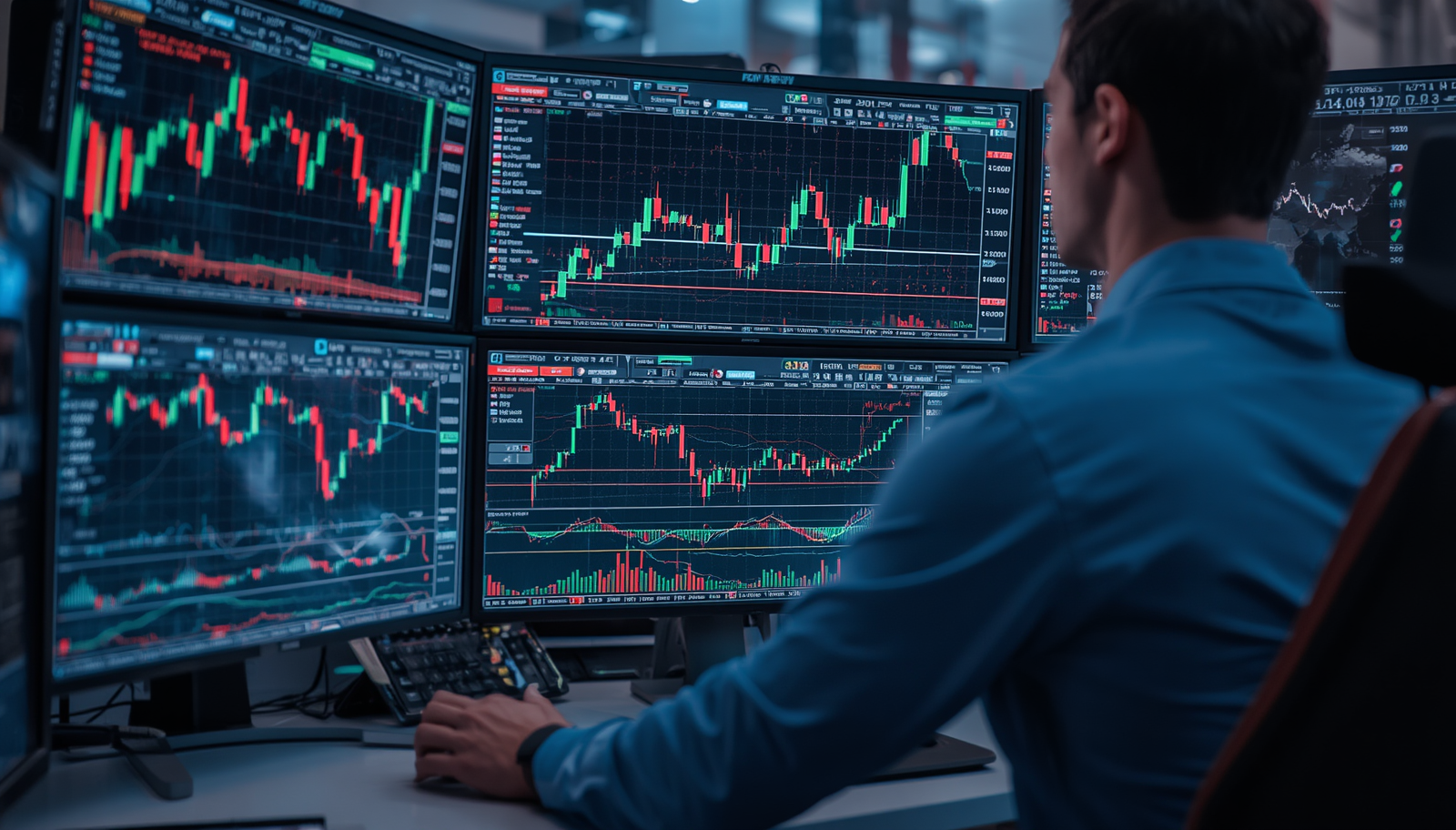
Forex trading can seem complicated when you first encounter currency pairs, exchange rates, charts, leverage, and market movements. At its core, however, the concept is relatively simple: traders buy one currency while simultaneously selling another, hoping to benefit from changes in their relative values.
For example, imagine a trader expects the Euro to become stronger against the US Dollar. They might buy the EUR/USD pair. If the Euro gains value compared with the Dollar, the trade could generate a profit. If the Euro loses value instead, the trader could face a loss.
Unlike the stock market, where investors buy and sell shares of companies, forex trading revolves around the changing values of national currencies.
How the Forex Market Works
The foreign exchange market is a decentralized global marketplace. Instead of operating through one physical exchange, forex transactions take place through a worldwide network of banks, financial institutions, brokers, corporations, governments, and individual traders.
Because major financial centers operate in different time zones, the forex market remains open around the clock from Monday to Friday. When one major trading session closes, another is often beginning.
This continuous activity gives traders the ability to respond to economic announcements, political developments, and other market events throughout the trading week.
Understanding Currency Pairs
Currencies are always quoted in pairs.
The first currency is called the base currency, while the second is known as the quote currency. The exchange rate tells you how much of the quote currency is needed to buy one unit of the base currency.
Forex pairs are generally divided into three broad categories.
Major pairs include the US Dollar alongside another major global currency. These pairs typically have high trading volume and strong liquidity.
Minor pairs contain major currencies but do not include the US Dollar. They can still be actively traded, although their liquidity may differ from that of major pairs.
Exotic pairs combine a major currency with a currency from an emerging or developing economy. These pairs can experience wider spreads and larger price movements, which may increase trading risk.
Why Forex Trading Is Popular
Forex attracts traders for several reasons.
One of its biggest advantages is liquidity. Large amounts of currency are traded every day, allowing many traders to enter and exit positions relatively easily.
The market’s extended trading hours also make it accessible to people with different schedules. Traders can choose sessions that fit around their work, studies, or other responsibilities.
Currency prices are also influenced by economic and political developments around the world. This creates frequent changes in market conditions and potential trading setups.
Modern trading platforms have made access even easier by offering live prices, charting tools, educational material, alerts, and mobile applications.
However, accessibility should not be confused with simplicity. Forex trading carries significant risk, and beginners need to understand the market before putting real money at risk.
What Influences Currency Prices?
Currency prices are constantly changing because of a combination of economic, political, and financial factors.
Interest rates are particularly important. When a country’s central bank raises rates, its currency may become more attractive to investors seeking higher returns, although the actual market response depends on broader expectations.
Inflation is another major factor because it affects purchasing power and can influence monetary policy.
Traders also pay attention to employment figures, economic growth, manufacturing activity, consumer confidence, and other economic indicators.
Political developments can have an equally important impact. Elections, government policies, international trade disputes, geopolitical tensions, and changes in political stability can all cause currency prices to move.
Understanding these influences helps traders put price movements into a broader economic context.
Technical Analysis in Forex Trading
Technical analysis focuses on historical price behavior and market structure.
Traders use price charts to look for trends, support and resistance levels, candlestick formations, moving averages, and momentum indicators.
For example, a trader may identify an established uptrend and wait for price to pull back toward a support area before considering a potential entry.
Technical analysis can also help traders determine possible exit points and where a stop-loss might be placed.
There is no need to fill a chart with dozens of indicators. A small number of tools that a trader understands well can often be more useful than a complicated collection of conflicting signals.
Fundamental Analysis
Fundamental analysis looks at the economic conditions behind currency movements.
Forex traders may follow inflation data, gross domestic product, employment statistics, central bank decisions, interest rates, and monetary policy.
Economic calendars are particularly useful because they show when important reports and announcements are scheduled. Major releases can cause sharp price movements, especially when the actual result differs significantly from market expectations.
Combining fundamental information with technical analysis can provide a more complete view of the market.
Understanding Leverage
Leverage allows traders to control a larger position than they could with their available capital alone.
This can make profitable trades more rewarding, but it also increases the size of potential losses. A relatively small market movement can have a significant effect on a leveraged position.
For this reason, beginners should be especially careful with leverage. Using the maximum leverage offered by a broker does not mean it is appropriate for your strategy.
Capital preservation should come before the desire to control large positions.
Risk Management
Risk management is one of the foundations of responsible forex trading.
Before entering a trade, traders should know how much they are prepared to lose if the market moves in the wrong direction.
A stop-loss order can help limit potential losses, although execution conditions can vary during fast-moving or highly volatile markets.
Position sizing is equally important. Taking smaller positions can help ensure that one unsuccessful trade does not cause significant damage to an account.
Traders should also avoid risking excessive capital on a single idea. Long-term consistency usually comes from controlling losses rather than trying to make a large profit from every trade.
Popular Forex Trading Strategies
Different traders use different approaches depending on their goals and schedules.
Day trading involves opening and closing positions within the same trading day. These traders generally focus on shorter-term price movements and avoid holding positions overnight.
Swing trading aims to capture larger price movements that may develop over several days or weeks.
Position trading takes a longer-term approach. Traders may hold positions for weeks or months while focusing heavily on broader economic and fundamental trends.
Scalping is an extremely short-term style that attempts to capture numerous small price movements. Because it requires quick decisions and close market monitoring, it can be particularly demanding.
The right strategy depends on your available time, experience, risk tolerance, and personality. A strategy that suits one trader may be completely unsuitable for another.
The Importance of Trading Psychology
Trading is not only a technical or financial challenge. It is also a psychological one.
Fear can cause traders to close positions too early or avoid otherwise reasonable opportunities. Greed can encourage excessive risk-taking, overtrading, or holding onto positions longer than planned.
Losses can also trigger emotional reactions, especially when traders attempt to immediately recover their money by taking additional trades.
A structured trading plan can help reduce these problems. Instead of reacting to every market movement, traders can follow predetermined rules and make decisions based on their strategy.
Patience and discipline are often just as important as technical knowledge.
Developing a Trading Plan
A trading plan provides a clear framework for making decisions.
It should define your goals, preferred currency pairs, trading style, entry and exit conditions, risk limits, position sizing, and rules for managing open trades.
Having these rules written down can make it easier to remain consistent during periods of market volatility.
Reviewing your performance regularly is also important. A trading journal can help you record why you entered a trade, what happened afterward, and whether you followed your plan.
Over time, this information can reveal recurring mistakes and areas where your strategy may need improvement.
Common Mistakes Beginners Make
One of the biggest mistakes new traders make is entering the market before they understand how it works.
Using excessive leverage is another common problem. Although large positions can appear attractive, they can quickly produce significant losses.
Some beginners trade without stop-loss levels, constantly change strategies after losing trades, or chase the market after a large price movement has already occurred.
Emotional trading is another major challenge. Trying to recover losses immediately can lead to even larger losses.
Forex trading also requires continuous learning. Markets change, strategies perform differently under different conditions, and economic factors are constantly evolving.
Choosing a Reliable Trading Platform
Your trading platform is an important part of the overall experience.
A reliable platform should provide strong account security, dependable execution, competitive trading costs, useful charting features, and responsive customer support.
Mobile compatibility can also be valuable for traders who need to monitor positions away from their computers.
However, beginners should not choose a broker or platform solely because of promotional offers or high leverage. Regulatory status, security, transparency, fees, and reliability deserve much more attention.
The Role of Artificial Intelligence in Forex
Artificial intelligence is becoming increasingly important in financial markets.
Machine learning systems can process large amounts of historical price data, economic information, and market news in a short period. These technologies can help identify patterns, generate alerts, and support automated trading systems.
Algorithmic trading can execute predefined rules without the emotional reactions that often affect human traders.
Still, AI is not a guaranteed path to profits. Automated systems can produce incorrect signals, perform poorly in changing market conditions, or fail when unexpected events occur.
Traders should understand how these tools work rather than relying on them blindly.
Mobile Forex Trading
Smartphones have made it much easier to monitor financial markets.
Modern forex applications can provide live currency prices, interactive charts, economic calendars, account information, alerts, and trade execution.
This convenience allows traders to stay informed even when they are away from their computers.
However, constant access can also encourage overtrading. Being able to check the market every few minutes does not mean that you need to make a trade every few minutes.
Technology should make trading more organized, not more impulsive.
The Future of Forex Trading
The forex industry is likely to continue evolving as technology advances.
Artificial intelligence, machine learning, predictive analytics, automation, blockchain-based financial infrastructure, and improved trading platforms could further change how traders access and analyze currency markets.
Faster execution, better analytical tools, stronger cybersecurity, and more personalized trading features may improve the overall trading experience.
At the same time, the fundamental principles of successful trading will remain important. Technology can help traders analyze information, but it cannot eliminate market uncertainty or replace responsible risk management.
Tips for Long-Term Forex Success
Building long-term success in forex trading requires patience and realistic expectations.
Start by learning how currency markets work before risking significant capital. Spend time practicing chart analysis and understanding the economic factors that influence exchange rates.
Use sensible position sizes and maintain consistent risk limits. Avoid relying on excessive leverage or trying to recover losses through impulsive trades.
Keep a detailed trading journal and review your results regularly. Look for patterns in both your successful and unsuccessful trades.
Most importantly, avoid treating forex as a way to get rich quickly. Sustainable progress comes from education, discipline, careful risk management, and the ability to adapt as market conditions change.ove over time are generally those who focus on controlling risk, following a structured plan, and continuing to learn.
Rather than chasing every market movement, focus on developing a repeatable process that fits your goals, experience, and risk tolerance.