
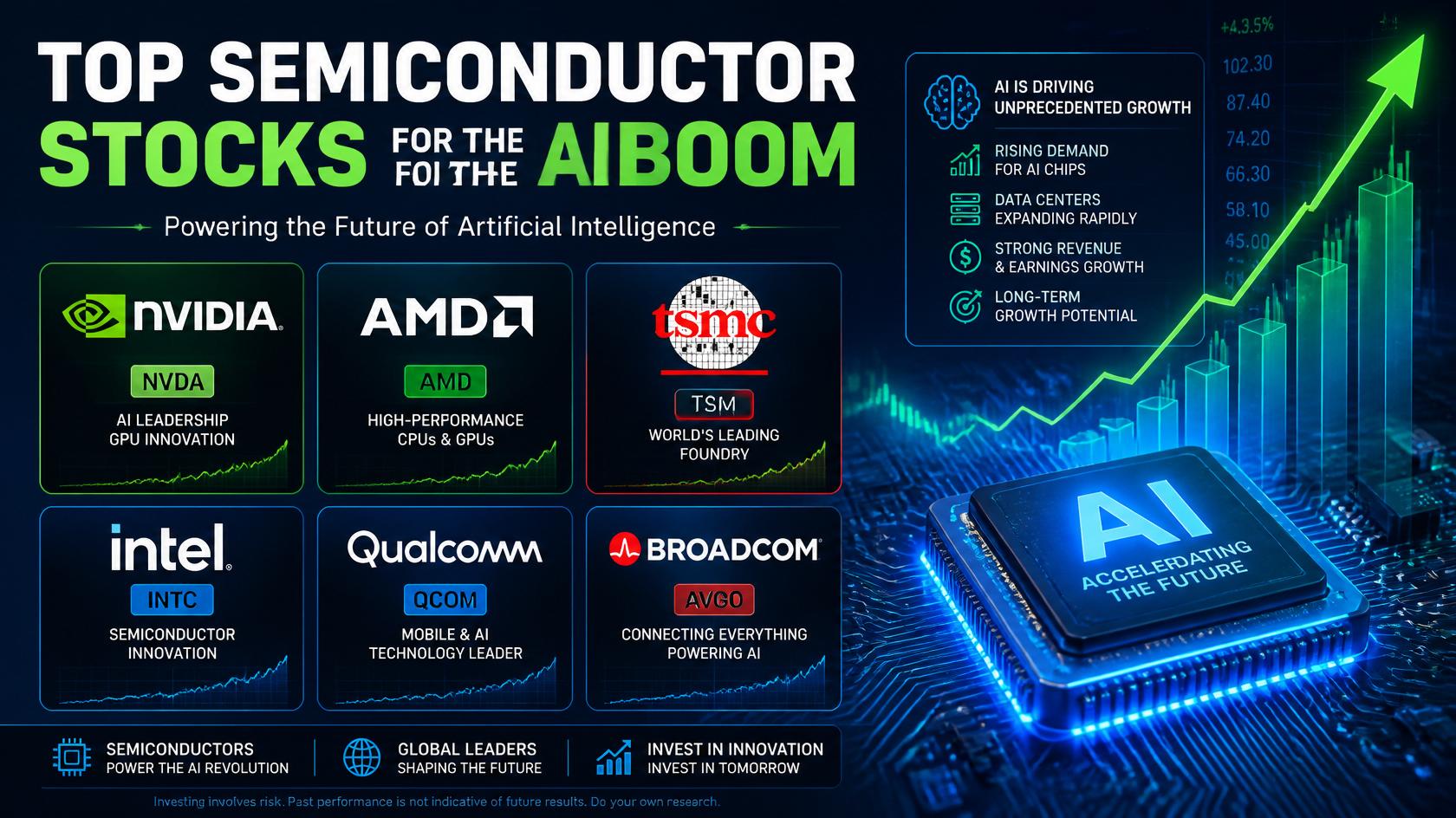
Artificial intelligence is quickly changing the technology industry, and semiconductor companies are at the heart of that transformation. Every AI model, data center, autonomous system, and intelligent device depends on powerful chips to process enormous amounts of information.
As companies around the world continue spending heavily on artificial intelligence infrastructure, demand for advanced semiconductors is growing. This has placed chip designers, manufacturers, and suppliers in an important position as investors look for businesses that could benefit from the long-term expansion of AI.
From graphics processors and advanced memory to networking equipment and chip manufacturing, different parts of the semiconductor industry are benefiting from the AI boom.
Here are some of the major semiconductor companies investors are watching in 2026.
Why Semiconductor Companies Matter to AI
AI systems require enormous computing power.
Training large language models, running generative AI applications, operating autonomous vehicles, and powering advanced robotics all require specialized hardware capable of processing massive amounts of data quickly.
Semiconductor companies provide the technology behind that computing power. Their products include graphics processors, central processors, memory chips, networking components, custom AI accelerators, and other specialized hardware.
The growth of AI is also creating demand beyond traditional computing. Cloud data centers are expanding, businesses are adopting AI tools, autonomous systems are becoming more advanced, and edge computing is allowing devices to process information locally.
These trends could keep semiconductor demand strong for years.
NVIDIA
NVIDIA has become one of the most important companies in the AI hardware market.
Its graphics processing units, or GPUs, are widely used for AI training, machine learning, deep learning, and generative AI applications.
Large cloud providers, technology companies, research institutions, and AI developers use NVIDIA hardware to build and operate demanding computing systems.
The company’s advantage goes beyond its chips. Its software ecosystem, networking technology, development tools, and broader AI platform create an environment that encourages customers to continue using its products.
NVIDIA’s position makes it one of the most closely watched semiconductor companies in the AI market. However, its strong growth expectations can also create valuation risk if future results fail to meet investor expectations.
Advanced Micro Devices (AMD)
AMD has developed into a major competitor in high-performance computing and AI.
The company produces CPUs, GPUs, and AI accelerators that are used across data centers, enterprise computing, gaming, and other markets.
As cloud providers and businesses look for multiple sources of AI hardware, AMD has an opportunity to expand its market presence.
Its growing AI product portfolio gives investors another way to gain exposure to the expansion of AI computing.
The key question for AMD is how effectively it can convert its technology into sustained market share and profitable growth while competing against much larger rivals.
Taiwan Semiconductor Manufacturing Company
Taiwan Semiconductor Manufacturing Company, commonly known as TSMC, occupies a different position in the semiconductor industry.
Rather than primarily selling its own branded processors, TSMC manufactures chips designed by other companies.
This makes the company a critical part of the global semiconductor supply chain. Many advanced chips used in AI systems depend on sophisticated manufacturing processes, and TSMC is one of the leading companies capable of producing them at scale.
As AI chip designers continue developing more powerful processors, demand for advanced manufacturing technology could increase.
TSMC’s position gives investors exposure to the broader semiconductor industry rather than relying on the success of a single chip designer.
However, its geographic concentration also means investors need to consider geopolitical and supply-chain risks.
Broadcom
Broadcom has become increasingly important to the AI infrastructure market.
Modern AI data centers involve thousands of processors that need to communicate with one another extremely quickly. Networking technology therefore plays a critical role in overall system performance.
Broadcom provides networking semiconductors, custom AI solutions, connectivity products, and other infrastructure technologies used in large-scale computing environments.
Its diversified business also includes significant software and infrastructure operations, which can provide additional sources of revenue beyond AI chips.
For investors, Broadcom offers exposure to the less visible but essential networking side of the AI infrastructure boom.
Qualcomm
Qualcomm is best known for its smartphone technology, but its role in AI is expanding.
One important opportunity is edge AI, where devices process artificial intelligence workloads locally instead of sending every task to a remote data center.
This approach can improve response times, reduce dependence on cloud connectivity, and help protect certain types of data.
Qualcomm’s chips are used across smartphones, vehicles, industrial equipment, and Internet of Things devices.
As AI becomes part of everyday hardware, the company could benefit from the increasing demand for efficient computing at the edge.
Intel
Intel remains a major player in the semiconductor industry and is investing heavily to strengthen its position in AI and advanced chip manufacturing.
The company is developing AI-focused processors while also investing in manufacturing facilities and foundry capabilities.
Intel faces strong competition and has experienced significant challenges in recent years. Its ability to improve manufacturing, execute its product strategy, and compete effectively in AI will be important factors for investors.
If its investments succeed, the company could have an opportunity to regain a stronger position in the semiconductor market.
Micron Technology
AI is not just about processors.
Modern AI servers also require enormous amounts of high-speed memory, making memory manufacturers an important part of the AI supply chain.
Micron Technology produces memory products used in servers, data centers, computers, and other advanced computing systems.
As AI models become larger and data-center workloads become more demanding, the need for high-performance memory can increase.
This makes Micron an important company for investors who want exposure to the memory side of the AI infrastructure market.
However, the memory industry is highly cyclical, so investors should be prepared for periods of changing prices and demand.
Marvell Technology
Marvell focuses on semiconductor products used in data centers, networking, storage, and cloud infrastructure.
Its technology helps move data efficiently between different components inside modern computing systems.
This is particularly important for AI clusters, where large numbers of processors need to communicate rapidly.
Marvell’s exposure to cloud computing, networking, and custom semiconductor solutions gives it several potential growth drivers as AI infrastructure expands.
The company’s performance will depend on its ability to maintain strong customer relationships and continue developing competitive products.
Arm Holdings
Arm has a different business model from many traditional semiconductor companies.
The company develops processor architectures and licenses its technology to semiconductor manufacturers and technology companies.
Arm-based designs power billions of devices worldwide, including smartphones, embedded systems, and increasingly sophisticated computing products.
As AI expands from large cloud data centers into smartphones, vehicles, industrial equipment, robotics, and other edge devices, energy-efficient computing becomes increasingly important.
Arm’s low-power architecture could therefore play an important role as AI becomes more widely integrated into everyday technology.
What Should Investors Look for in an AI Semiconductor Stock?
Choosing a semiconductor stock requires more than simply finding a company associated with artificial intelligence.
Revenue growth is an important starting point. Investors should examine whether AI-related demand is actually translating into sustainable business growth.
Research and development spending is another important factor because semiconductor companies must constantly improve their technology to remain competitive.
Customer relationships also matter. Strong partnerships with major cloud providers, technology companies, and enterprise customers can provide valuable sources of long-term demand.
Manufacturing capabilities and supply-chain resilience are equally important. A company may have excellent technology, but production constraints can limit how much revenue it can generate.
Investors should also pay attention to profit margins, free cash flow, debt levels, and valuation.
A great company can still be a poor investment if its stock price already assumes unrealistic future growth.
Risks of Investing in AI Semiconductor Stocks
The semiconductor industry offers enormous growth potential, but it also comes with significant risks.
Semiconductor demand can be highly cyclical. Companies may experience rapid growth during periods of strong demand and then face sharp slowdowns when customers reduce inventories or economic conditions weaken.
Geopolitical tensions are another major concern. Semiconductor manufacturing depends on complex international supply chains, and trade restrictions or political conflicts can disrupt production and distribution.
Technology also changes extremely quickly. Companies must spend heavily on research and development to keep pace with competitors.
Competition is intense, and today’s market leader can face serious pressure when a rival introduces better technology.
Investors should therefore avoid treating AI semiconductor stocks as guaranteed winners.
The Long-Term Outlook
Artificial intelligence is still developing, and adoption is expanding across many industries.
Companies are investing in data centers, automation, cybersecurity, healthcare technology, autonomous transportation, robotics, cloud computing, and enterprise AI applications.
All of these technologies require computing power.
As AI models become more sophisticated, demand could continue shifting toward faster processors, advanced memory, improved networking, and more efficient computing systems.
This creates opportunities across different parts of the semiconductor ecosystem rather than only among GPU manufacturers.
However, future growth will depend on actual AI adoption, corporate spending, technological progress, competition, manufacturing capacity, and economic conditions.
Final Thoughts
Semiconductor companies are among the biggest beneficiaries of the artificial intelligence revolution because chips provide the physical foundation for modern AI systems.
NVIDIA and AMD are competing in high-performance AI computing, TSMC provides advanced manufacturing, Broadcom supports networking and custom AI infrastructure, Qualcomm is expanding edge AI, Micron supplies critical memory, Marvell focuses on connectivity and data-center infrastructure, Intel is investing in AI and manufacturing, and Arm provides processor architecture used across billions of devices.
Each company offers a different way to participate in the AI trend, and each comes with its own risks.
For investors, the goal should not simply be to buy the most popular AI stock. Understanding a company’s technology, financial health, competitive position, valuation, and long-term growth potential is far more important.
As artificial intelligence continues reshaping the global economy, semiconductor companies are likely to remain at the center of the technology revolution, giving investors a range of opportunities to gain exposure to the future of computing.